

Introduction & Market Context
Digital Realty Trust () presented its second-quarter 2026 financial results on July 23, showcasing what management described as a business “firing on all cylinders” with record performance across multiple metrics. The data center REIT reported core funds from operations of $2.13 per share, excluding net promote income, marking a 14% year-over-year increase and prompting the company to raise its full-year 2026 guidance.
Shares rose 3.6% in after-hours trading to $185.80 following the announcement, reflecting investor enthusiasm for the company’s raised outlook and strong demand indicators. The presentation highlighted Digital Realty’s execution across its three strategic pillars: colocation and connectivity, hyperscale development, and strategic private capital.
Quarterly Performance Highlights
Digital Realty delivered record bookings in its zero-to-one-megawatt plus interconnection business, reaching $108 million in the second quarter—the third consecutive quarterly record and representing 52% of total bookings for the period. This milestone is particularly significant as the company had set a goal approximately two years ago to double the then-current $50 million quarterly run rate in this segment.
As shown in the following breakdown of the company’s strategic execution, all three core pillars demonstrated strong growth metrics for the quarter:
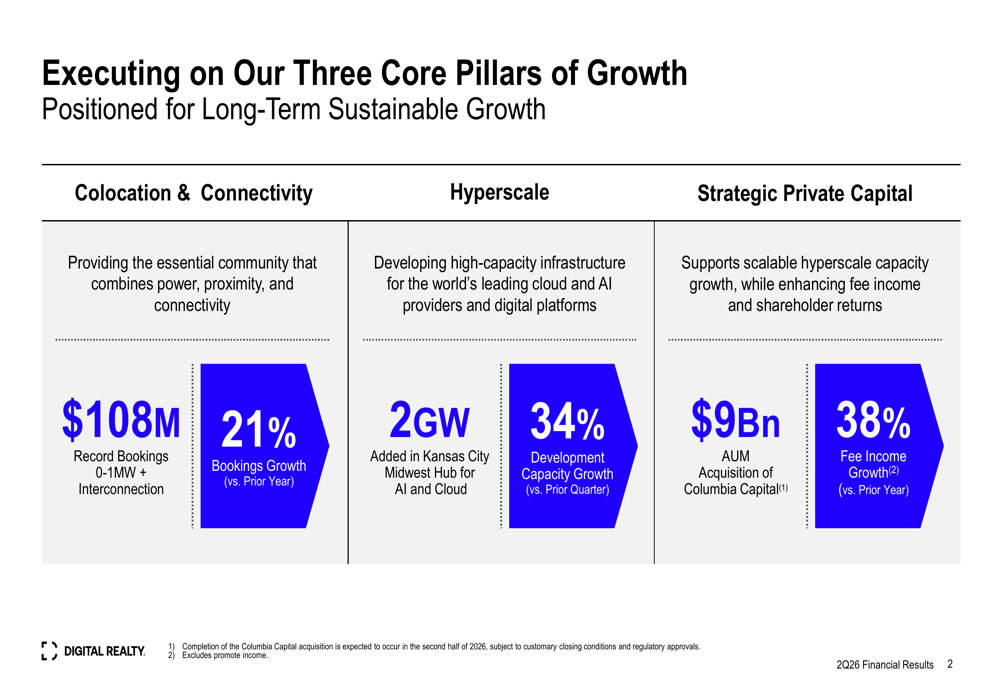
Total bookings reached $307 million at 100% share, with the company adding 142 new customer logos during the quarter. The colocation and connectivity segment posted 21% bookings growth compared to the prior year, while the hyperscale business expanded development capacity by 34% versus the prior quarter. The strategic private capital pillar reported 38% fee income growth year-over-year, excluding promote income.
The company’s historical bookings trend, illustrated in the following chart, demonstrates sustained momentum across multiple customer segments:
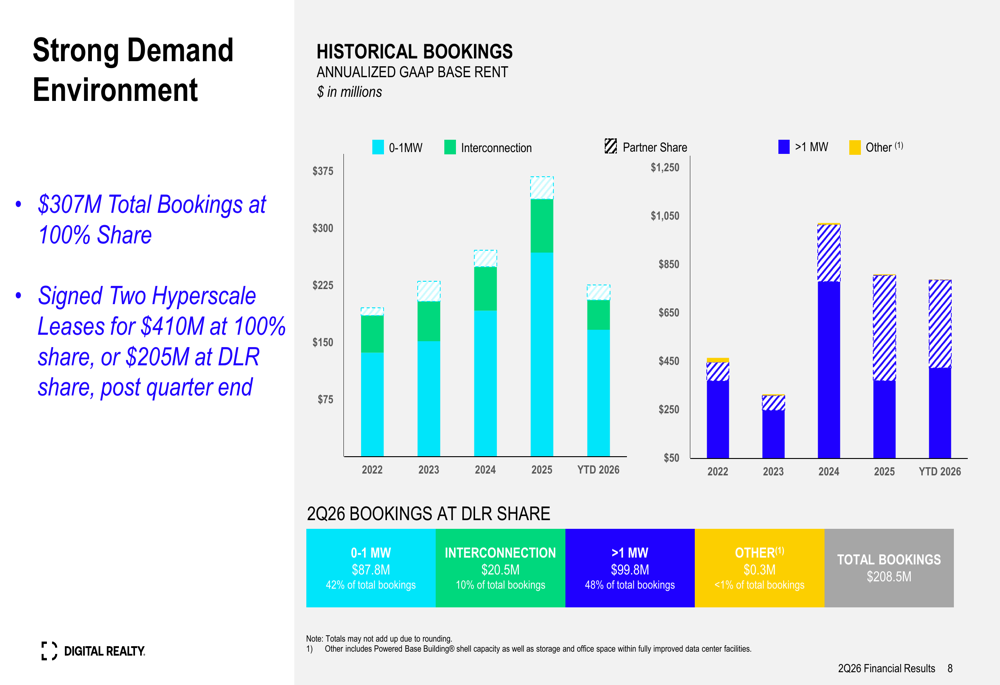
The quarter’s performance was broad-based across deal sizes, with 0-1 MW deployments contributing $87.8 million (42% of total bookings), interconnection adding $20.5 million (10%), and larger deployments over 1 MW accounting for $99.8 million (48%). This diversified booking profile reflects demand from both enterprise customers pursuing digital transformation and AI initiatives, as well as hyperscale cloud providers expanding capacity.
Record Backlog Provides Multi-Year Visibility
Digital Realty’s backlog climbed to a record $1.9 billion at 100% share, or $1.4 billion at the company’s proportionate share, representing approximately 30% of in-place data center rent. This backlog provides substantial visibility into future revenue streams, with clear commencement timing across multiple years.
The following chart illustrates the backlog composition and expected commencement schedule:
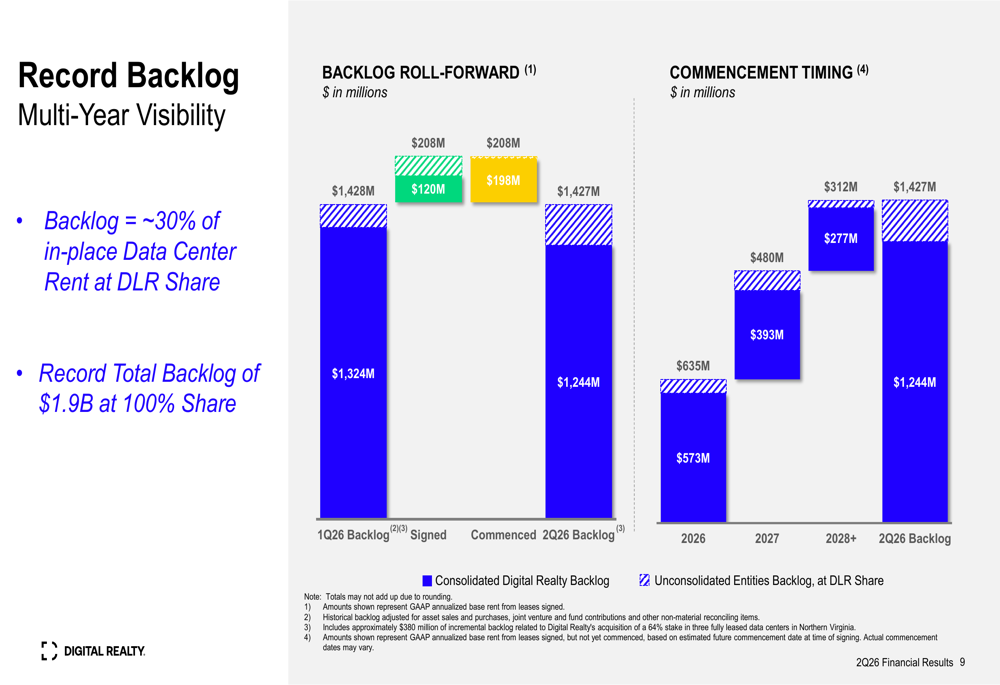
The backlog breakdown shows $635 million scheduled to commence in the second half of 2026, $480 million in 2027, and $312 million in 2028 and beyond. Management noted that 1.4 gigawatts of development capacity is currently under construction at a total cost of $20 billion, with the pipeline 63% pre-leased—providing further confidence in the conversion of development activity to operating revenue.
Additionally, Digital Realty signed two hyperscale leases after quarter-end totaling $410 million at 100% share, or $205 million at the company’s proportionate share, which will contribute to future quarters’ results.
Pricing Power Drives Record Renewal Spreads
The company demonstrated significant pricing power during the quarter, achieving record cash mark-to-market renewal spreads of 25.4% and GAAP spreads of 32.0%. This performance was led by strength in the Asia-Pacific region, particularly in supply-constrained markets like Singapore.
The detailed renewal spread performance by customer segment is shown below:
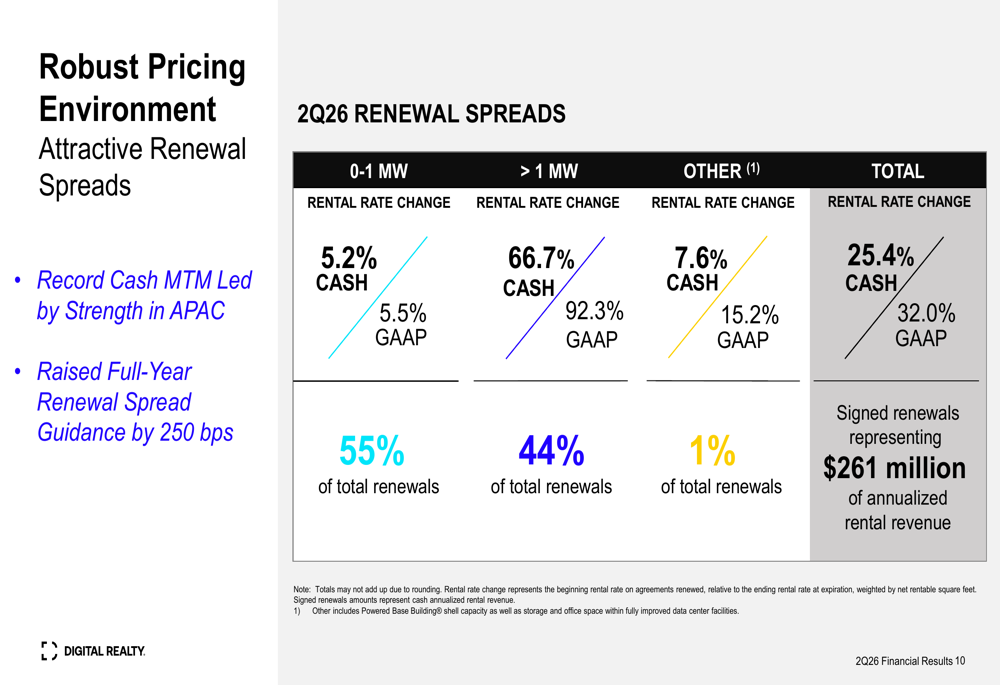
Renewals in the larger deployment category (greater than 1 MW) showed exceptional strength with 66.7% cash spreads and 92.3% GAAP spreads, though these represented 44% of total renewals. The smaller 0-1 MW segment, which comprised 55% of renewals, posted more moderate but still healthy spreads of 5.2% cash and 5.5% GAAP. In total, the company signed renewals representing $261 million of annualized rental revenue.
Based on this strong performance, Digital Realty raised its full-year cash renewal spread guidance by 250 basis points to a range of 9.0% to 11.0%, up from the previous 6.0% to 8.0% target.
Global Infrastructure Platform Positions for AI and Cloud Growth
Digital Realty’s global footprint encompasses approximately 3 gigawatts of in-place IT capacity and 9 gigawatts of future development capacity, for a total of 12 gigawatts of data center IT capacity worldwide. This scale positions the company to meet growing demand from cloud computing, artificial intelligence workloads, and digital transformation initiatives.
The company’s global capacity distribution is illustrated in the following map:
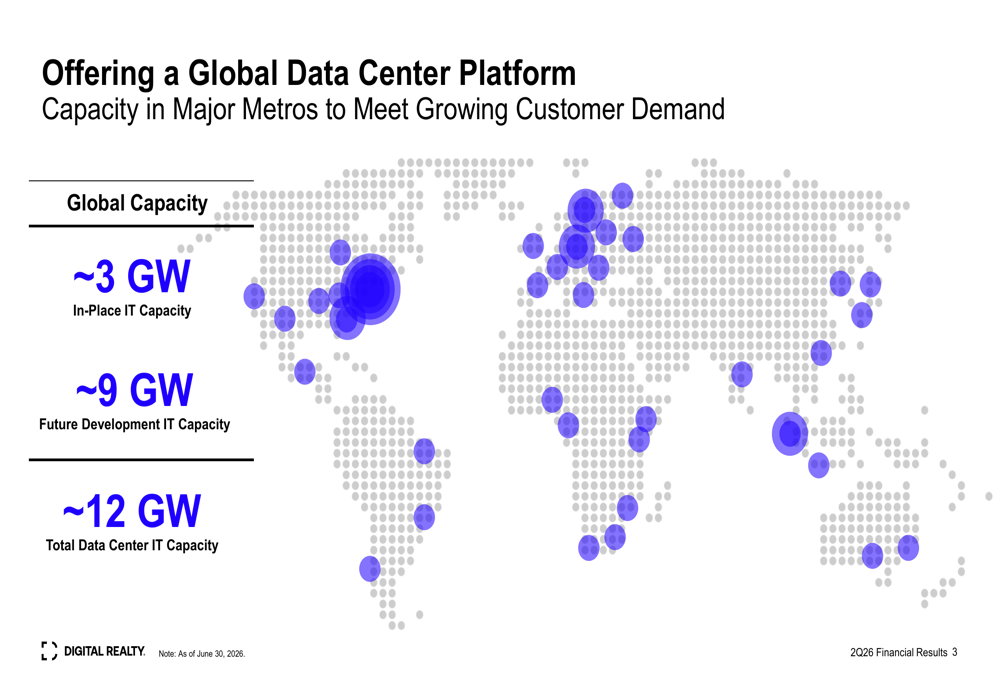
A key development during the quarter was the addition of 2 gigawatts of capacity in Kansas City, establishing a new Midwest hub for AI and cloud deployments. This expansion reflects Digital Realty’s strategy of securing power and land in markets with favorable utility relationships and regulatory environments.
The composition of the company’s 9 gigawatts of future development capacity shows strategic positioning for both large hyperscale deployments and smaller connected capacity needs:
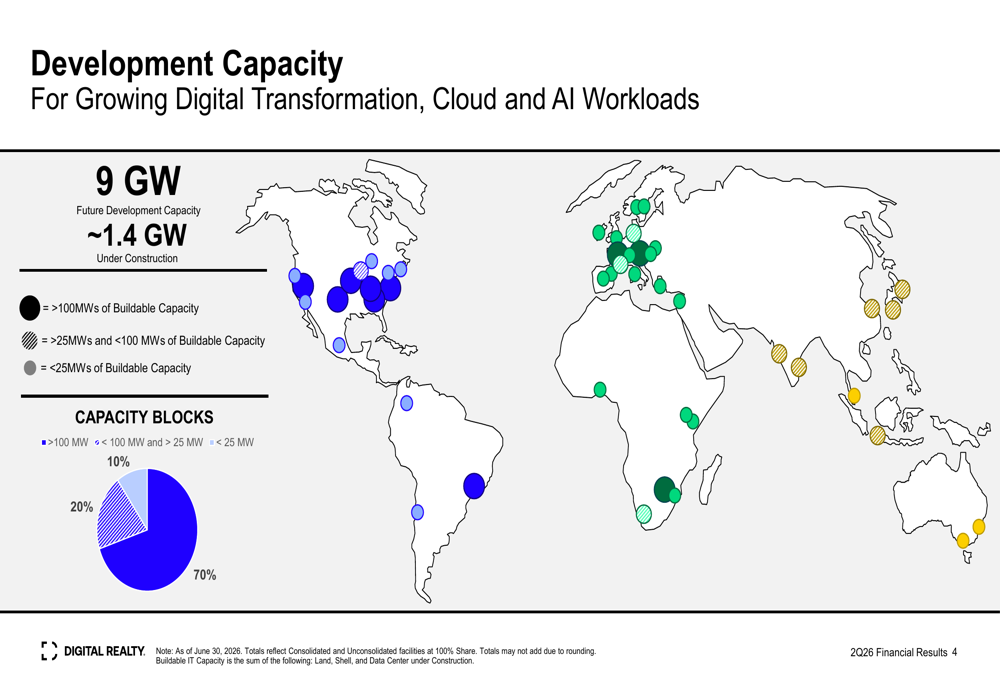
Notably, 70% of buildable capacity consists of blocks greater than 100 megawatts, suitable for hyperscale cloud and AI customers, while 20% falls in the 25-100 megawatt range and 10% is less than 25 megawatts. This mix allows Digital Realty to serve diverse customer requirements while maintaining capital efficiency through its private capital partnerships for the largest deployments.
Raised 2026 Guidance Reflects Strong Momentum
Based on second-quarter performance and pipeline visibility, Digital Realty raised guidance across multiple financial metrics for full-year 2026. The updated outlook demonstrates management’s confidence in sustained demand and operational execution.
The comprehensive guidance updates are detailed in the following table:
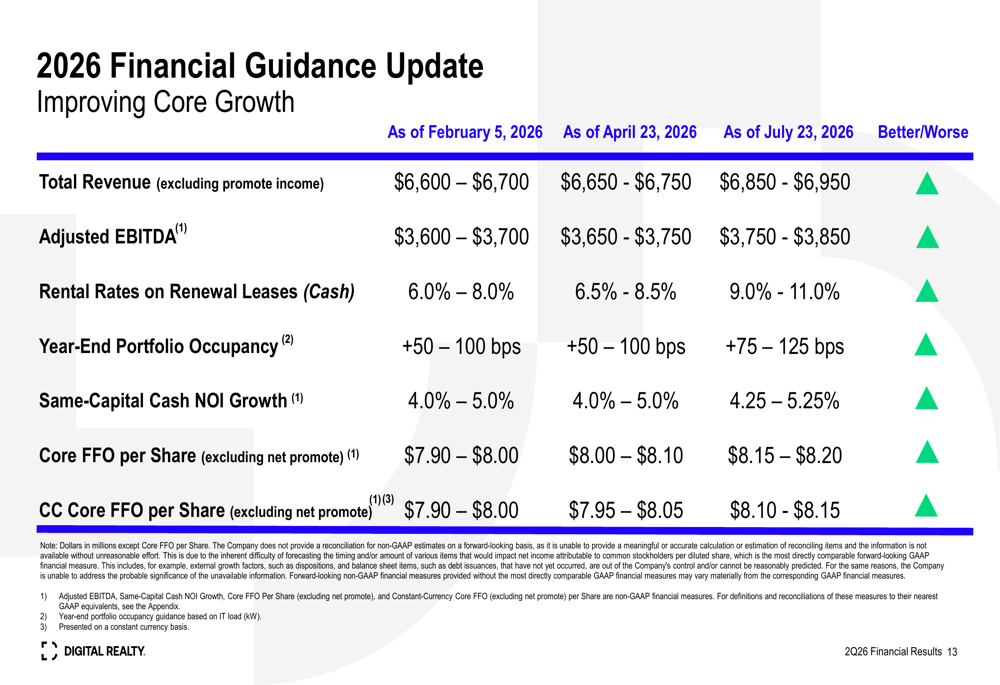
Core FFO per share guidance, excluding net promote income, increased to $8.15-$8.20 from the prior range of $7.90-$8.00. Management noted this implies 10% constant-currency growth at the midpoint and marks a second consecutive year of double-digit core FFO per share growth. Total revenue guidance (excluding promote income) rose to $6,850-$6,950 million from $6,600-$6,700 million, while adjusted EBITDA guidance increased to $3,750-$3,850 million from $3,600-$3,700 million.
Same-capital cash net operating income growth guidance was raised to 4.25%-5.25% on a constant-currency basis, up from 4.0%-5.0%. Year-end portfolio occupancy guidance improved to an increase of 75-125 basis points from the prior 50-100 basis point range.
The company also increased its capital expenditure guidance, net of partner contributions, to $4.25-$4.75 billion, up $750 million from prior guidance, reflecting accelerated development activity to meet customer demand. Dispositions and joint venture capital guidance increased by an additional $500 million, supporting the company’s capital recycling strategy.
Sustainability Leadership and ESG Credentials
Digital Realty emphasized its sustainability initiatives, positioning itself as a leading data center partner for customers seeking to reduce their environmental footprint. The company’s sustainability metrics demonstrate significant progress toward clean energy and resource efficiency goals.
The following summary presents Digital Realty’s key sustainability achievements:
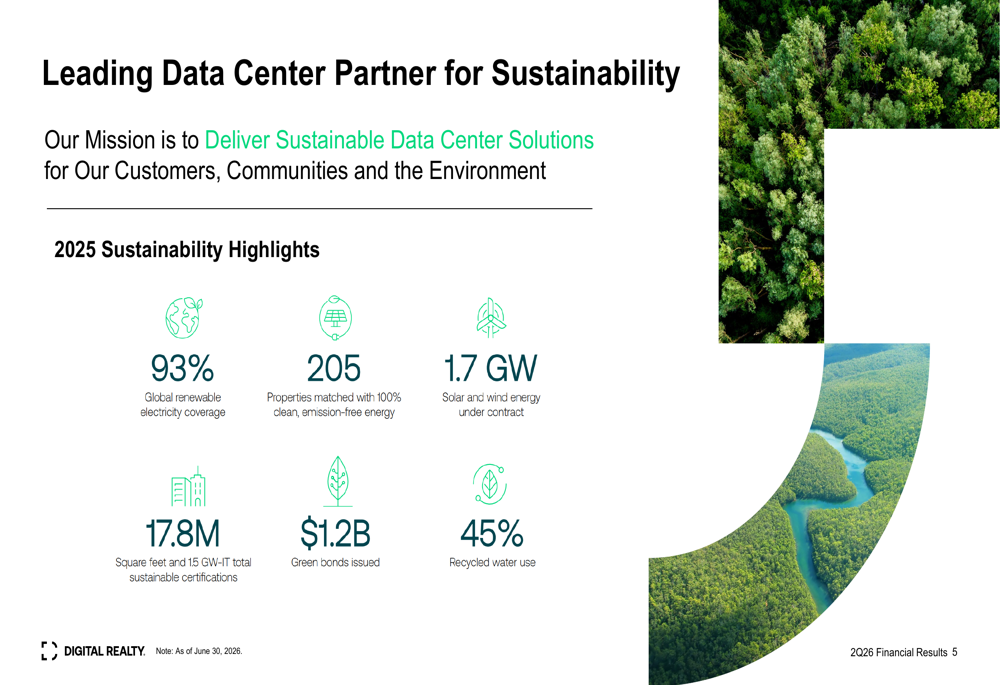
As of June 30, 2026, Digital Realty reported 93% global renewable electricity coverage, with 205 properties matched with 100% clean, emission-free energy. The company has contracted for 1.7 gigawatts of solar and wind energy and has issued $1.2 billion in green bonds to finance sustainable infrastructure. Additionally, 17.8 million square feet and 1.5 gigawatts of IT capacity have achieved sustainable certifications, while the company has achieved 45% recycled water use across its portfolio.
These sustainability credentials are increasingly important as hyperscale cloud providers and enterprise customers face pressure to reduce Scope 3 emissions associated with their data center infrastructure.
Financial Position and Capital Structure
Digital Realty maintained a strong balance sheet with approximately $6 billion in available liquidity and net debt to adjusted EBITDA of 4.7 times, down 0.4 turns over the past 12 months. The company’s debt profile reflects a conservative approach to leverage and interest rate risk.
The debt maturity schedule and capital structure composition are shown below:
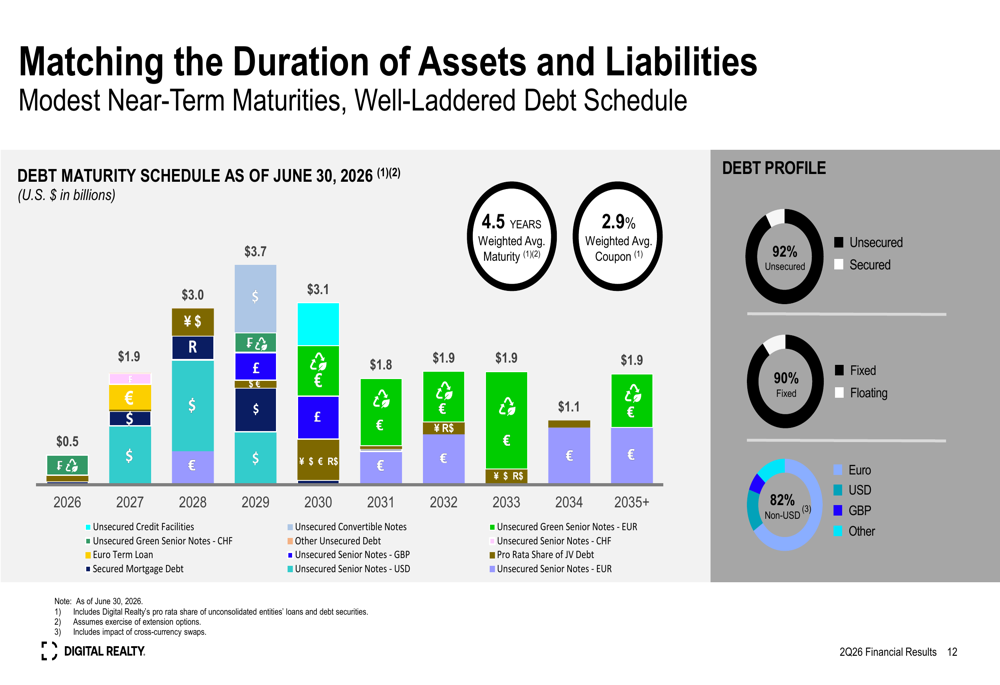
The company’s debt has a weighted average maturity of 4.5 years and a weighted average coupon of 2.9%. The capital structure is 92% unsecured and 90% fixed-rate, providing stability in a potentially volatile interest rate environment. Near-term maturities are modest, with a well-laddered schedule that peaks at $3.7 billion in 2029 and $3.1 billion in 2030.
Digital Realty’s revenue exposure by currency shows diversification across major global markets, with 54% denominated in U.S. dollars, 23% in euros, and the remainder spread across Singapore dollars, British pounds, and other currencies. The company noted that local operations funded in local currencies act as a natural hedge, limiting currency translation risk.
Strategic Growth Drivers and Market Positioning
Digital Realty’s presentation emphasized three core pillars of growth that position the company for sustained expansion. The colocation and connectivity business focuses on providing what the company describes as “the essential community that combines power, proximity, and connectivity.” This segment serves enterprise customers and smaller cloud deployments, with particular strength in network-dense facilities that support interconnection and low-latency applications.
The hyperscale pillar involves developing high-capacity infrastructure for leading cloud providers and AI platforms. Management highlighted that this segment benefits from secular trends including cloud migration, AI model training and inference, and data localization requirements driven by regulatory considerations.
The strategic private capital pillar, which includes the U.S. Hyperscale Fund and the pending Columbia Capital acquisition expected to close in the second half of 2026, allows Digital Realty to participate in large-scale capacity development while limiting balance sheet exposure. The Columbia Capital transaction will add approximately $9 billion in assets under management and generate fee income with lower capital intensity than wholly-owned development.
During the earnings call, management addressed questions about how the company balances on-balance-sheet hyperscale development, network-dense colocation, and off-balance-sheet private capital vehicles. Executives indicated that growth would come from multiple sources simultaneously: renewal pricing in supply-constrained markets, hyperscale leasing, record small-footprint bookings, and fee income from private capital. The company emphasized maintaining investment-grade customer relationships for larger capacity blocks while capturing pricing power in markets with limited supply.
Risk Factors and Execution Challenges
While Digital Realty’s presentation emphasized positive momentum, the company faces several execution challenges inherent in its aggressive growth strategy. The planned capital expenditure of $4.25-$4.75 billion, net of partner contributions, represents substantial investment that must be deployed efficiently to generate targeted returns.
Large-scale data center development carries risks related to construction timing, cost overruns, and power availability. The company’s ability to secure adequate utility power commitments, particularly for AI-optimized facilities requiring high-density configurations, remains critical to converting its 9 gigawatts of development capacity into operating revenue.
Integration risk also factors into the company’s outlook, as Digital Realty is simultaneously managing the Blackstone transaction, the Teraco investment, and the pending Columbia Capital acquisition. Successfully integrating these platforms while maintaining operational excellence across the existing portfolio requires significant management attention and execution capability.
Additionally, some of the second quarter’s results benefited from non-recurring items, including insurance proceeds related to a 2024 incident in Singapore and promote income from the Blackstone transaction. These one-time gains may not repeat in future periods, requiring the company to deliver organic growth to sustain its raised guidance targets.
Market concentration presents another consideration, as a significant portion of hyperscale demand comes from a relatively small number of major cloud providers. While Digital Realty has demonstrated success in diversifying its customer base—adding 142 new logos in the quarter—the company’s largest customers remain critical to its growth trajectory.
Forward-Looking Statements
Digital Realty’s presentation concluded with an emphasis on consistent execution of its strategic vision and strong positioning for multi-year growth. The record backlog of $1.9 billion at 100% share provides visibility into revenue commencement over the next several years, with $635 million scheduled for the second half of 2026, $480 million in 2027, and $312 million in 2028 and beyond.
The company’s 1.4 gigawatts of development capacity under construction, which is 63% pre-leased, represents substantial near-term revenue potential as these facilities are completed and commence operations. The additional $410 million of hyperscale leases signed after quarter-end further strengthens the pipeline.
Management expressed confidence that demand trends supporting the data center industry—including artificial intelligence workloads, cloud migration, digital transformation, and data localization—remain durable. The company’s global platform, with capacity in major metropolitan areas worldwide, positions Digital Realty to capture demand across diverse customer segments and geographic markets.
With a market capitalization of $67.4 billion and a dividend yield of 2.72% supported by 23 consecutive years of dividend payments, Digital Realty continues to attract income-focused investors while delivering growth through its three-pillar strategy. The raised 2026 guidance, including the midpoint target of 10% constant-currency core FFO per share growth, suggests management believes the current momentum is sustainable despite the challenging macroeconomic environment and competitive data center landscape.
Full presentation:
This article was generated with the support of AI and reviewed by an editor. For more information see our T&C.