
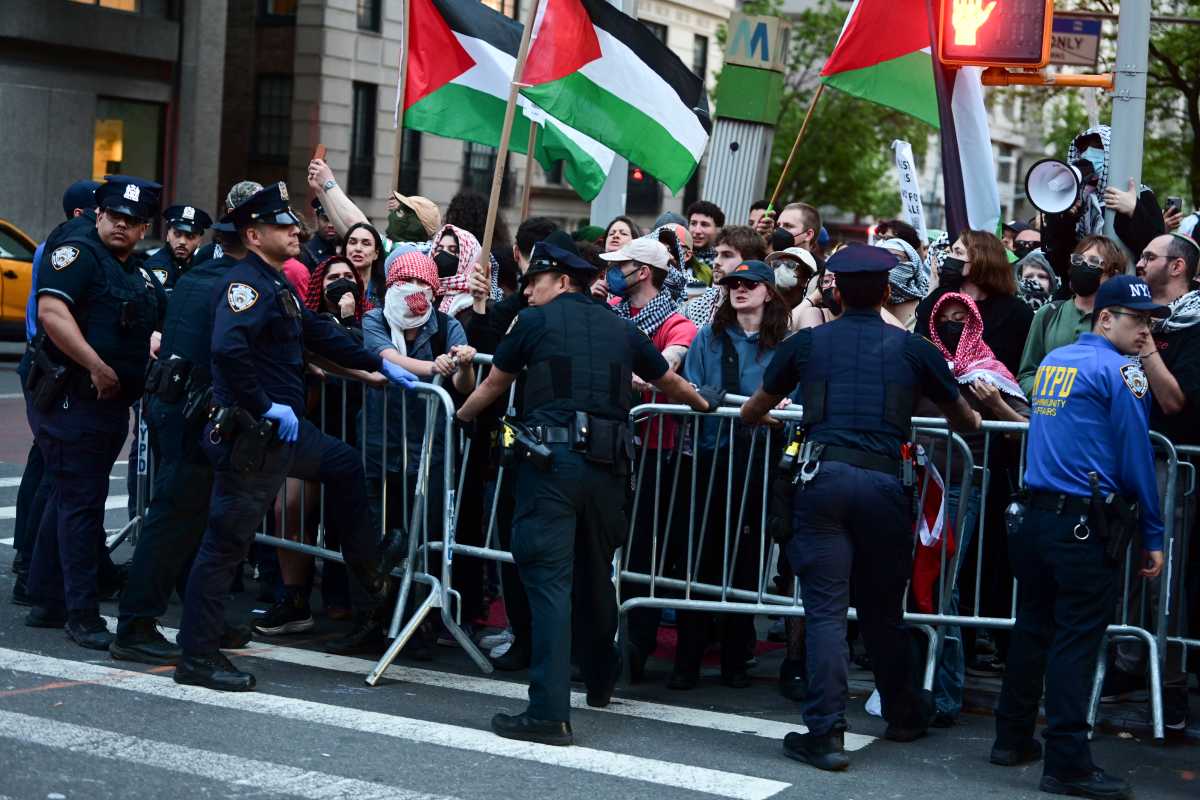
The protest targeted “The Great Israeli Real Estate Event 2026,” which was advertised online as coming to Manhattan on May 5 as part of a tour that also includes Flatbush and Queens. The Park East Synagogue hosted a similar event last November, which prompted a fierce demonstration from pro-Palestinians just steps away from the house of worship’s entrance — and spurred calls for protest buffer zones to keep protesters at bay in the future.
The website for the May 5 event invited attendees to “listen to experts” on topics including aliyah, higher education in Israel and finances in Israel, and listed locations including Jerusalem, Tel Aviv, Ramat Beit Shemesh, Netanya, Raanana, Modiin, Herzliya, Haifa, Nahariya, Rishon LeZion, Ashdod, Beersheva and Ashkelon.
The NYPD did not permit members of the media to pass the barricades that locked down East 67th Street between Lexington and Third avenues. But Intercept reporter Noah Hurowitz posted on X, alongside materials from inside the event, that he entered and saw “at least one table advertising properties in the West Bank, including Kfar Eldad and Karnei Shomron.”
A brawl broke out between a pro-Israeli passerby and one of the pro-Palestine protesters pic.twitter.com/69rx6ZoBwu
— Adam Daly (@AdamDalyNews) May 5, 2026

Mayor Zohran Mamdani’s office said before the protest that the mayor was “deeply opposed to the real estate expo this evening that includes the promotion of the sale of land in settlements in the Occupied West Bank.”
“These settlements are illegal under international law and deeply tied to the ongoing displacement of Palestinians,” a City Hall spokesperson said in a statement.
At the same time, Mamdani’s office said the city was committed to ensuring access to the synagogue.
“Our administration has also been clear that we are committed to ensuring safe entry and exit from any house of worship, and that such access never be in question while all protesters are able to exercise their First Amendment rights,” the spokesperson said.
Policing the protest
In a separate statement on protest policing, City Hall said NYPD would be on site “to ensure the safety of protestors and guarantee those interested in entering the synagogue can do so.”
Police officers were on the scene after 5 p.m. on May 5, setting up a nearly three-block perimeter ahead of the scheduled 6:30 p.m. demonstration. The lockdown kept East 67th Street between Lexington and Third avenues largely inaccessible, including to members of the media.
The closest protest area to the synagogue was at East 67th Street and 3rd Avenue, where pro-Palestinian protesters and pro-Israel counterprotesters were held in opposing pens across the intersection.


A second protest site formed outside Hunter College, at Lexington Avenue and East 68th Street, where pro-Palestinian demonstrators filled both sides of the intersection. The roadway remained open to traffic for part of the protest, but officers struggled to keep demonstrators behind barricades as the crowd grew.
At one point, protesters pushed barricades into the roadway. Officers moved in from behind, splitting up the crowd, while other officers at the front pushed demonstrators back toward the sidewalk.
Before the march, tensions flared at the Lexington Avenue site when a passerby began heckling protesters. Several punches were thrown before police broke up the confrontation. Other agitators also appeared in the crowd, including a streamer whom officers escorted into a yellow cab.


Protesters later marched from Lexington Avenue toward 3rd Avenue. A scuffle broke out as demonstrators reached barricades near East 66th Street and Third Avenue.
As one barricade came down, several demonstrators and officers fell to the ground. Police said water was thrown at officers from a building along the demonstration route.
Adelina Sadik, one of the demonstrators, said one barricade came down as demonstrators and police pushed near one another.
“One of the barricades got knocked out,” Sadik said. “There was a bunch of people trying to push back on the left side. And then, like, people start falling, and the cops fall with them too.”
The NYPD said demonstrators surrounded an officer at East 66th Street and 3rd Avenue, and that pepper spray was used to disperse the crowd.
Sadik said she felt spray hit her face and mouth as people fell around her. As she spoke to amNewYork afterward, she said her mouth was still burning; another demonstrator sat on the ground nearby, pouring water into his eyes.
“All of a sudden, I just feel a spray in my face,” Sadik said. “My mouth started tingling, and it felt numb.”
Sadik said she did not immediately realize she had been pepper-sprayed.
“Now my mouth is, like, burning, like, on fire,” she said. “I feel it in my throat, too.”
Sadik called the policing excessive and said the city’s response reflected unequal treatment of Muslim and pro-Palestinian communities.
“I think it’s excessive,” she said, arguing that officials were using the fact that the event was held at a synagogue to justify broad police protections.
Police said one officer suffered a leg injury and was taken to a hospital.
Nevertheless, the demonstration ended with no arrests, according to the NYPD.
A preview of perimeter policing
The police response came after weeks City Council passed a law directing the NYPD to develop plans for managing demonstrations near houses of worship, following previous protests outside synagogues, including Park East, that drew public condemnation.
Immediately following the November protest at Park East, then-Mayor Eric Adams issued an executive order directing the NYPD to establish buffer zones for protests near houses of worship. Upon taking office weeks later on Jan. 1, new Mayor Mamdani nullified that order and others issued by Adams following his September 2024 criminal indictment.
The Council overwhelmingly passed Intro. 1-B to direct the NYPD to create protocols for buffer zones near religious sites, but though Mamdani did not veto it, he also refused to sign it into law. As a result, the bill became law automatically 30 days after its passage without the mayor’s signature, as per the city charter.
But the NYPD plan required under the law was still in development, making Tuesday’s protest an early street-level preview of how the department may use perimeter-based policing around religious institutions.
The legislation was softened earlier this year after discussions with Police Commissioner Jessica Tisch. Earlier versions would have required fixed security perimeters at every entrance and exit of houses of worship in certain cases, with those perimeters extending up to 100 feet and requiring barriers such as police tape or barricades.
The amended bill dropped the 100-foot requirement, removed the barrier mandate and instead directed the police commissioner to produce plans outlining considerations for when and how buffer zones may be used.

On Tuesday night, NYPD appeared to use a broader discretionary model before that formal plan was complete: keeping protesters away from the synagogue entrance, directing groups onto surrounding avenues, separating opposing demonstrators with pens and barricades, and blocking off nearby streets.
The perimeter appeared to keep protesters farther from Park East than the 100-foot buffer zone originally proposed before the bill was revised.
Council Speaker Julie Menin said at the time that the changes were designed to give the NYPD flexibility and preserve protest rights.
Tuesday’s demonstration was organized in part by Pal-Awda, an anti-Zionist activist group that said it was protesting the real estate event, not the synagogue itself.
On Tuesday, pro-Israel counterprotester Ronen Levy, of Queens, said he was not a member of Park East but came because he believed Jewish New Yorkers had a shared responsibility to protect synagogues.
“Jewish people don’t have to be members directly of a synagogue,” Levy said. “You could just walk in if you want to pray the morning prayers, the afternoon prayers, or the evening prayers, you could just walk in and be and be a member and pray, because we’re all one.”


Levy said he supported the NYPD perimeter and backed restrictions around protests at houses of worship and schools, as long as they applied equally to synagogues, mosques and churches.
“You want to protest? You want to assemble on the street, you want to assemble in a park, you want to assemble in a center or Columbus Circle? You’re more than welcome,” Levy said. “But to protest in a shul or a mosque or a church, that’s unethical, that’s un-American.”
He also defended holding the real estate event in a synagogue, saying such events are aimed at Jewish communities interested in Israel or aliyah.
“It came to where they do it in the shul, because it’s a lot easier to get Jewish people to come down, because it’s a Jewish congregation,” Levy said. “Most people in synagogues, they want to go live in Israel.”
A young Jewish man who said he had been praying inside Park East and was filming the pro-Palestinian protesters from the sidelines told amNewYork he felt threatened by the chants near the synagogue.
“I feel a bit intimidated as a Jew,” he said, citing chants of “resistance is justified” near the synagogue. “That’s really something that’s very dangerous.”
He also said he believed police did not have enough officers on site, claiming protesters had pushed down barricades shortly before more NYPD officers arrived.
The protest took place the day after a rash of antisemitic hate crimes in Queens, where vandals spraypainted swastikas and other hateful messages at Jewish community centers and nearby homes.


Tova, a Pal-Awda organizer who said she was part of the group’s “stolen land” campaign, said the protest was aimed at the real estate expo, not at Jewish worshippers.
“They intentionally hide these real estate sales, which are selling stolen Palestinian land inside of synagogues,” she said. “We’re not protesting the synagogue.”
She said the proof was that activists were not demonstrating there during ordinary religious services.
“Do you see protests at the synagogue every Saturday?” she said. “The only time there’s protests at the synagogue is when they’re having a stolen Palestinian land sale inside the synagogue.”
Tova rejected the need for new protest restrictions and argued the city should instead investigate the land-sale events.
“There is no need to stop us from protesting,” she said. “We wouldn’t be there protesting if they weren’t doing these illegal activities.”
She added that protesters had a constitutional right to be within “sight and sound” of the event they were protesting, which, she said, the NYPD’s perimeter prevented.
At the Lexington Avenue protest site, witness Daryl Ali, who described himself as a grassroots activist unaffiliated with any organization, said he saw the earlier altercation involving two people and accused one person of continuing to throw punches even as others tried to separate them.
“You still have one party still throwing punches at everybody that’s trying to tell them to stop,” Ali said. “You can clearly see who the aggressor is.”
Ali criticized the police for appearing to remove the alleged assailant from the crowd without making an immediate arrest.
“There’s no reason for them to let somebody go after they just completely assaulted random people in the crowd,” he said.

Rabbi David Feldman of Neturei Karta International, an anti-Zionist Orthodox Jewish group, spoke to amNewYork as the crowd began to disperse and said the protest was being wrongly framed as antisemitic.
“People are claiming that speaking up against these events is antisemitic in any way, or an affront on religious venues, and this is totally misleading,” Feldman said. “This is about condemning ongoing crimes.”
Feldman argued that conflating anti-Zionism with antisemitism harms Jewish people.
“When you conflate anti-Zionism with antisemitism, when you conflate Judaism with Zionism, you’re making a statement,” he said. “You are saying that all Jews, God forbid, are behind these crimes.”
He said his group came to show that Israel does not represent all Jews.
“The State of Israel does not represent all Jews, and certainly does not represent the Jewish religion,” Feldman said.
The demonstration ended without arrests, but the clash underscored the unresolved question at the center of the city’s new protest-management laws: how far police can go to protect access to houses of worship without pushing demonstrators out of sight and sound of the events they are protesting.
Similar Israeli real estate events have drawn protests across the country from groups opposed to the sale of land or homes in Palestinian territories occupied by Israel.
A recent U.N. human rights office report accused Israel of violating international law in the occupied West Bank, including East Jerusalem, by maintaining a discriminatory system in which settlements play a central role, citing land confiscations, expanded Israeli control and the displacement of farming and herding communities.
Israel has repeatedly rejected allegations of systemic discrimination or apartheid, saying settlements and security measures are necessary for its citizens’ safety and that the West Bank’s status should be resolved through negotiations.