
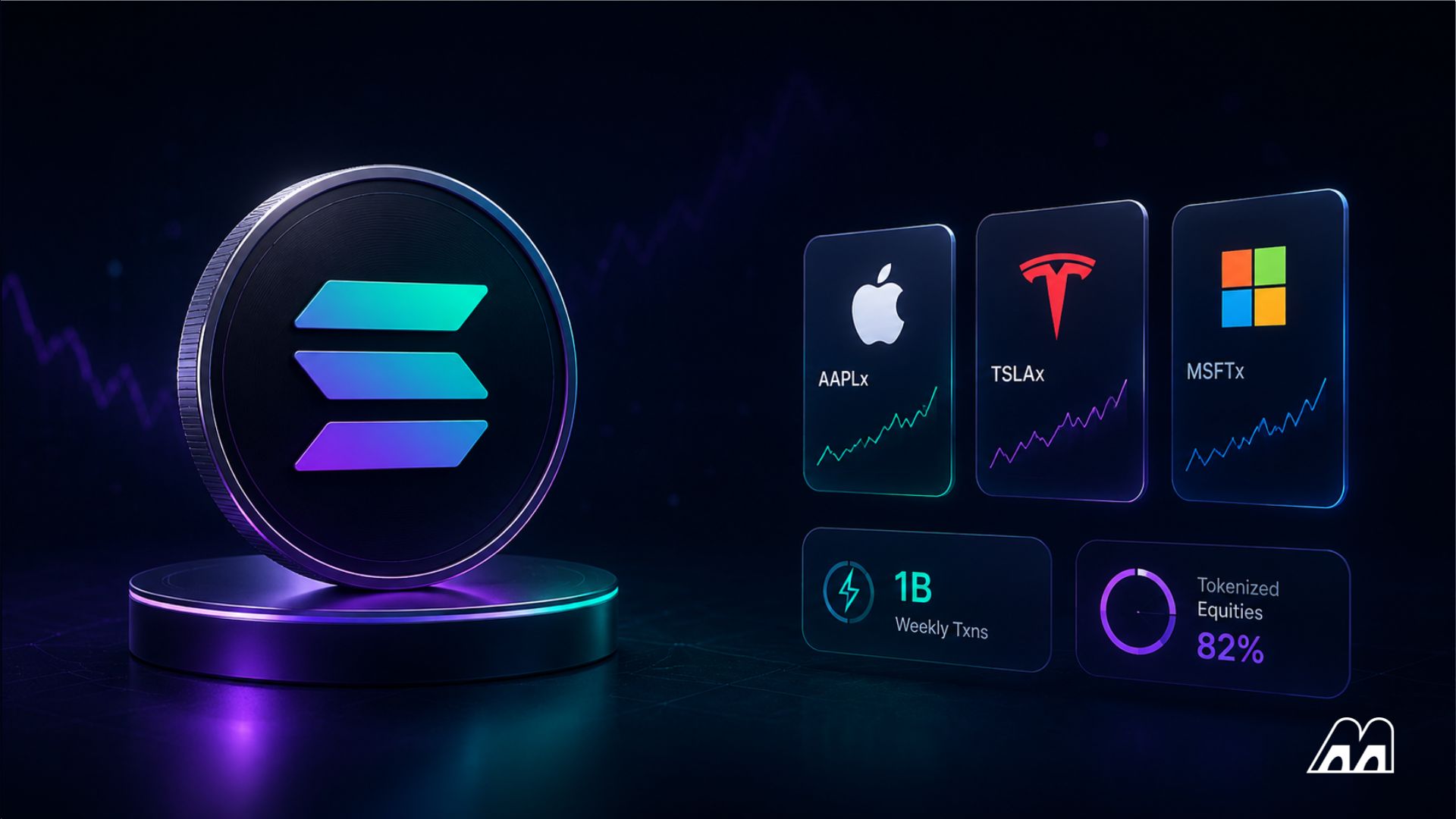
Solana processed a record-breaking 1,012,226,009 transactions during the week of July 27 to August 2, setting a new all-time high for weekly network activity. At the same time, the blockchain handled roughly $1.45 billion in tokenized equities volume during July alone, capturing approximately 82% of all tokenized stock trading across every blockchain.
The milestones arrive alongside a series of technical upgrades and tokenomics proposals that could reshape how the network operates and how SOL supply changes over time.
What the Numbers Show
The weekly transaction count crossed the 1 billion threshold with 1,012,226,009 total transactions, according to data shared by Solana’s official account and sourced from Blockworks analytics. This figure eclipses the previous record of 962.4 million non-vote transactions set in late June 2026.
Non-vote transactions strip out the automatic validator voting that keeps the blockchain in sync. What remains is genuine user-driven activity: DEX swaps, token transfers, stablecoin settlements, gaming actions, and increasingly, AI agent operations.
To put the scale in context:
- Solana processed 25.3 billion transactions in Q1 2026, more than 14 times BNB Chain’s 1.7 billion during the same period
- Weekly active wallets nearly doubled from 16.8 million to 29.7 million in just 14 days during July
- Daily transaction counts have consistently exceeded 100 million since early 2026, with a single-day peak of 148 million recorded in January
The network’s average throughput holds at roughly 960 transactions per second under sustained load. Ethereum, by comparison, processes approximately 15 TPS under normal conditions.
Tokenized Equities: $1.45 Billion and 82% Market Share
July’s tokenized equities figures extend a trend that has accelerated sharply through 2026. Solana processed approximately $1.45 billion in tokenized equities volume during the month, capturing around 82% of all tokenized stock trading across every blockchain.
This builds on an extraordinary growth trajectory:
- Q2 2026 saw $5.77 billion in total tokenized asset volume on Solana, a 114% increase from Q1
- Tokenized equities alone reached $4.8 billion in Q2 volume, more than four times the $1.1 billion recorded in Q1
- Cumulative tokenized equity volume on Solana crossed $10 billion by late June 2026
- 97% of all on-chain tokenized equity spot volume to date has settled on Solana, according to the Solana Foundation
The tokenized equity category barely existed on any blockchain 18 months ago. SpaceX’s record-setting IPO on June 12 was a major catalyst, with tokenized SpaceX shares on platforms like Backpack Securities generating over $108 million in transaction volume within the first 24 hours of listing. Securitize, backed by BlackRock, brought its own stock on-chain exclusively on Solana when it listed on the NYSE in early July.
The broader real-world asset ecosystem on Solana now holds $3.7 billion in non-stablecoin value across more than 313,000 holders, according to RWA.xyz data. Major institutions including J.P. Morgan, BlackRock, and SBI Holdings have all deployed products on the network.

Tokenized Gold Surges 689% Year-Over-Year
Solana’s growth in tokenized assets extends beyond equities. The market value of tokenized gold on Solana grew 689.1% year-over-year compared to August 2025, averaging 18.8% growth month over month, according to a Birdeye Data report published this week.
That growth rate runs more than twice what BNB Chain recorded over the same period and roughly 4.6 times the rate on Avalanche and Ethereum.
Solana’s gold perpetuals market peaked in May 2026 with $7.19 billion in volume and $21.6 million in month-end open interest. On volume alone, Solana’s gold perps at their peak nearly doubled Hyperliquid’s strongest month, signaling that synthetic commodity exposure is not consolidating onto a single venue.
Testnet Slot Times Cut to 350 Milliseconds
The transaction records come as Solana pushes through infrastructure upgrades designed to make the network even faster.
The first slot time reduction under SIMD-0525 has been activated on testnet, cutting slot times from 400 milliseconds to 350 milliseconds. The proposal lays out four sequential 50-millisecond decrements, with the end goal of reaching 200-millisecond slots.
Each reduction requires a fresh supermajority endorsement from validators, creating checkpoints where upgrade momentum gets tested. Anza CEO Brennan Watt announced the first testnet activation, urging validators to upgrade to the Agave v4.2 client. The mainnet target for the first slot reduction is August 17, 2026.
Running alongside the slot time work is Alpenglow, Solana’s largest consensus overhaul since its 2020 mainnet launch. The upgrade replaces both Proof of History and TowerBFT with a new system designed to reduce transaction finality from roughly 12.8 seconds to between 100 and 150 milliseconds.
Alpenglow entered community validator testing in May 2026 after passing a governance vote with 98.27% approval. Mainnet deployment is targeting late Q3 or early Q4 2026.

Validator Proposals Could Double Disinflation and Boost SOL Burns
Two linked governance proposals are gaining validator support and could significantly change SOL’s supply dynamics.
SIMD-0550 would double Solana’s annual disinflation rate from 15% to 30%. The change would pull the network’s 1.5% terminal inflation rate forward to 2029 instead of 2032 and remove approximately 18.9 million SOL of future emissions over six years, worth roughly $1.36 billion at current prices.
SIMD-0553 would restructure transaction fees based on actual network resource consumption and burn 100% of those fees. At current activity levels, daily SOL burns would climb from approximately 650 SOL to as many as 9,000 SOL per day.
The proposals have been bundled under SGP-0003 and backed by approximately 24.94 million SOL in stake so far, led by validator Helius. However, they need roughly 40 million more SOL in support to clear the 15% signaling threshold before a formal vote, with the deadline set for August 18, 2026.
Anza’s CEO has committed all three major Solana economic proposals, including SIMD-123 (block revenue sharing), SIMD-0550, and SIMD-0553, to ship in 2026. DeFi Development Corp. (DFDV), the first US public company with a treasury strategy built around SOL accumulation, has publicly announced its support for both proposals.

The Price Disconnect
Despite the network milestones, SOL’s price tells a different story. The token trades near $73 as of early August 2026, down more than 55% from its 52-week high of $294.82.
Solana closed July with its 10th consecutive red monthly candle, the longest losing streak in SOL history. The gap between network performance and token performance has become the central question for SOL holders.
Several factors help explain the disconnect:
- Revenue metrics fell in Q2 2026. Real Economic Value dropped 43% to $51 million. Priority fees fell 45%, and Jito tips dropped 50%. Application revenues hit their lowest level since Q1 2024 at $228.4 million
- Memecoin fee revenue dried up. The memecoin frenzy that drove Solana’s fee income through 2024 and 2025 has cooled significantly
- Tokenized equities generate minimal fees. Settlement of tokenized stocks costs a fraction of a cent per transaction, nothing like the MEV and priority fee revenue that memecoin trading produced
- New competition from Robinhood Chain. Robinhood’s Arbitrum-based Layer 2 launched July 1, hitting $500 million in daily volume within nine days and potentially pulling tokenized stock activity away from Solana
Morgan Stanley launched a spot Solana ETF on July 28, pulling $19.06 million in its second trading day, the largest single-day inflow across all US SOL ETF products since early May. Whether institutional ETF flows can offset the fee revenue decline remains an open question heading into August.
What Comes Next for Solana
August 2026 is shaping up as a pivotal month for the network:
- August 17: Target date for the first mainnet slot time reduction to 350ms
- August 18: Deadline for SIMD-0550 and SIMD-0553 to clear the signaling threshold
- Late Q3/early Q4: Alpenglow mainnet deployment window
- Firedancer expansion: The alternative validator client reached mainnet through version v0.1005.40100 in July, with early deployments starting at 207 validators and performance testing demonstrating over 600,000 TPS
The combination of record-breaking transaction volume, accelerating tokenized asset adoption, and pending infrastructure upgrades creates a network that is simultaneously stronger than ever by usage metrics and under pressure to convert that activity into sustainable economics. Whether the burn proposals pass, whether slot time reductions land on mainnet without incident, and whether tokenized equities can generate meaningful revenue for the network will determine if August breaks the 10-month losing streak or extends it.
FAQs
How many transactions did Solana process in the record week?
Solana processed 1,012,226,009 transactions during the week of July 27 to August 2, 2026. This marks the first time the network’s weekly transaction count has exceeded 1 billion, surpassing the previous record of 962.4 million set in late June.
What percentage of tokenized equity trading happens on Solana?
Solana handled approximately 82% of all tokenized stock trading across every blockchain during July 2026. The network’s cumulative share of on-chain tokenized equity spot volume stands at roughly 97% since the category emerged in mid-2025.
What is the Solana Alpenglow upgrade?
Alpenglow is Solana’s largest protocol upgrade since its 2020 mainnet launch. It replaces both Proof of History and TowerBFT with a new consensus system designed to reduce transaction finality from approximately 12.8 seconds to between 100 and 150 milliseconds. The upgrade is targeting mainnet deployment in late Q3 or early Q4 2026.
What are SIMD-0550 and SIMD-0553?
SIMD-0550 would double Solana’s annual disinflation rate from 15% to 30%, reaching the 1.5% terminal inflation floor by 2029 instead of 2032. SIMD-0553 would restructure transaction fees and increase daily SOL burns from roughly 650 to potentially 9,000 SOL per day. Both proposals need approximately 40 million more SOL in validator support by August 18, 2026 to proceed to a formal vote.
Why is SOL price down despite record network activity?
SOL trades near $73 despite strong usage metrics because Solana’s fee revenue has declined sharply. Memecoin trading, which previously drove high fees, has cooled, while tokenized equity settlement generates minimal per-transaction revenue. Real Economic Value fell 43% in Q2 2026, and application revenues dropped to their lowest since Q1 2024.