
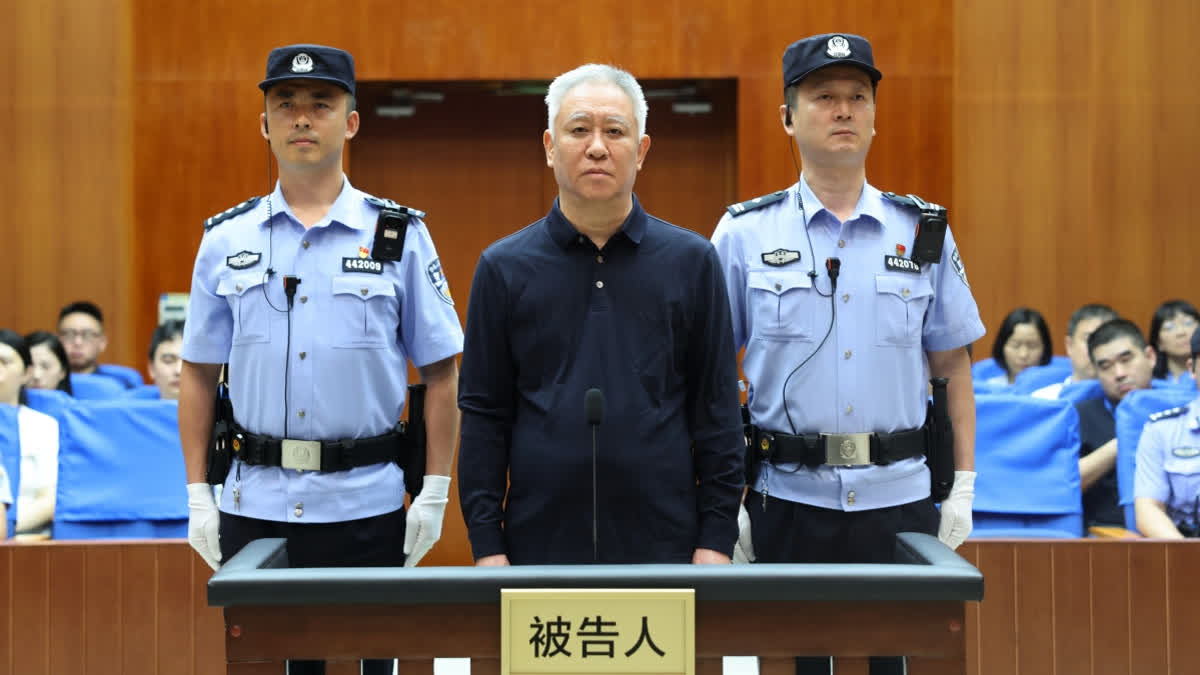

In this handout photo released by Xinhua News Agency, Hui Ka Yan, also known as Xu Jiayin, founder of property developer Evergrande stands trial at the Shenzhen Intermediate People’s Court in Shenzhen, south China’s Guangdong Province, Thursday, Aug. 20, 2026. (AP)
Beijing: A Chinese court on Thursday sentenced Xu Jiayin, former boss of Evergrande Group, the property giant at the centre of China’s housing market slump, to life in prison for multiple crimes and ordered confiscation of all his personal property.
The Shenzhen Intermediate People’s Court has fined Xu Jiayin CNY 8.82 billion and the Evergrande Group’s onshore operating unit Hengda Real Estate CNY 7 billion (about USD one billion).
These are some of the biggest corporate fines levied by a Chinese court for criminal charges, state-run Xinhua news agency reported. The 67-year-old Xu, also known as Hui Ka Yan, was deprived of political rights for life. He pleaded guilty to charges including embezzlement of corporate assets and corporate bribery in April.
The court found Xu guilty of illegally absorbing public deposits, fundraising fraud, illegally issuing loans, fraudulent issuance of securities, unlawful disclosure of important information, and corporate bribery, state-run Xinhua news agency reported.
The court also convicted Xu of illegally using funds and embezzlement, and Evergrande Real Estate Group of fraudulent issuance of securities. The illegal gains of the defendants shall be further recovered, and where recovery is insufficient, restitution shall be ordered.
The court also sentenced 56 personnel of the company, including Hui’s two sons, to fixed-term imprisonment ranging from 22 months to 18 years, with fines or property confiscated.
The court said the criminal acts of Xu and his two companies seriously disrupted the socialist market economy, infringed upon public and private property rights, and undermined the integrity of public officials in the performance of their duties.
Given the exceptionally large sums involved, the particularly egregious circumstances, the extraordinarily heavy economic losses caused, and the extremely serious harm to society, they should be severely punished in accordance with the law, the court said.
He was deprived of his political rights for life, and all his personal assets were ordered confiscated. The court also ordered the continued recovery of his illegal gains and restitution for any remaining shortfall.
Xu, who rose from humble beginnings in rural China, where he was raised by his grandmother, ventured into property development and established Evergrande in 1996 when the Communist country began opening up its economy to private investments.
The company rose rapidly through an aggressive expansion programme funded with large amounts of borrowed money.
It suffered a massive setback when the Chinese government introduced measures to control debt in the country’s property sector in 2020.
This prompted it to resort to the sale of its properties at huge discount rates to pay interest payments on huge borrowing, leading to its collapse in 2021.
The trial marks a milestone in Evergrande’s fall, from the peak of China’s property market to the world’s most indebted real estate developer, based on its total liabilities of USD 332 billion in 2023, the Hong Kong-based South China Morning Post reported.
The country’s property sector, which once accounted for roughly a quarter of the economy, has been in a prolonged downturn since late 2020, with falling home prices weighing on household wealth.
“This judicial ruling is seen as marking the end of an oldera growth model for China’s property sector and heralding the start of a new one,” Yan Yuejin, vice-president of Shanghai-based property consultancy E-house China Research and Development Institute, told the Post.
The collapse of Evergrande has plunged China’s property sector, the mainstay of the country’s economy, into an irreversible crisis, prompting the government to periodically intervene to keep the housing market from complete collapse.
China’s GDP shrank to 4.3 per cent in the second quarter this year, the softest quarterly expansion since late 2022, down from five per cent in the first quarter. After the collapse of Evergrande, the property crisis spread across China.
The High Court in Hong Kong in January 2024 ordered its liquidation.In March 2024, the China Securities Regulatory Commission penalised the insolvent developer 4.2 billion yuan (USD 616 million), saying Evergrande inflated its sales in the years preceding its eventual collapse.
It was also fined Hui 47 million yuan (USD 6.71 million) and barred him for life from accessing the capital markets.
“The financial distress of Evergrande in 2021 signalled the end of the ‘three highs’ business model – characterised by high debt, high leverage, and high asset turnover – for Chinese developers,” Edward Chan, director of S&P Global Ratings, told the Post.
Its collapse has a profound impact on the Chinese property market, the mainstay of the economy, which was already hit hard by the massive Covid-19 lockdowns.
The news of the collapse of the Evergrande Group sent shockwaves across the property market, with the value of new commercial housing sales falling from about CNY 18.2 trillion (USD 2.84 trillion) in 2021 to CNY 9.7 trillion (USD 1.34 trillion) in 2024, highlighting the severity of the prolonged property-market downturn.
According to market estimates, property prices have fallen by roughly 30 per cent from their 2021 peak in many parts of China.
The collapse of Evergrande badly dented public confidence as millions of households delayed or cancelled purchases amid fears of unfinished apartments.
Its defaults also triggered a wave of distress across the industry as other major property groups either defaulted or underwent restructuring.
Reports from across China spoke of millions of pre-sold homes left incomplete, creating social unrest and legal disputes. PTI KJV RD RD RD