
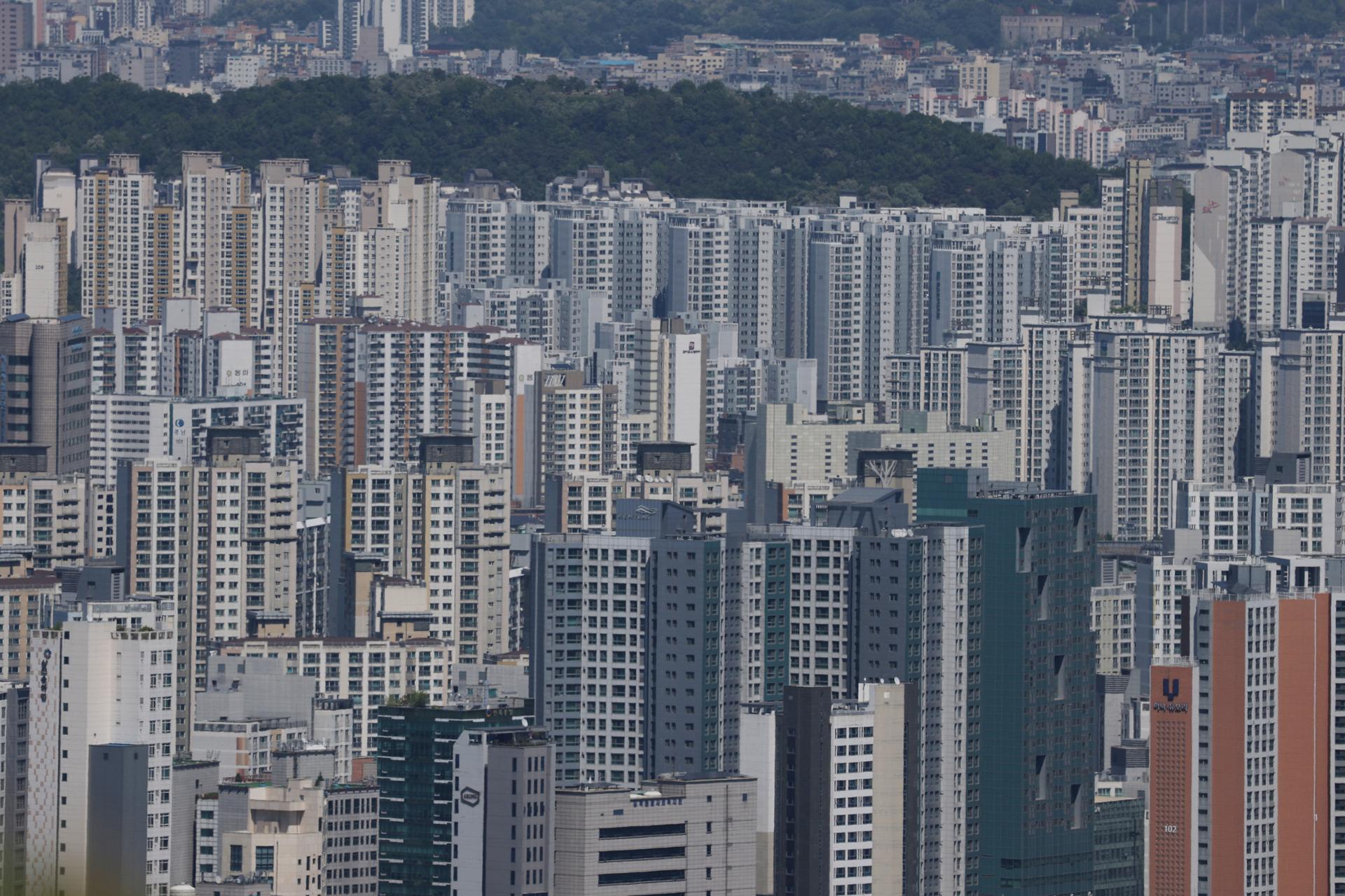
An aerial view of Seoul, Tuesday / Yonhap
Korean conglomerates are facing pressure over their holdings of nonbusiness real estate properties, as the Lee Jae Myung administration moves to treat corporate-owned property as part of its restrictive real estate policy framework and review taxation measures.
According to data released Wednesday by market tracker Leaders Index, the value of nonbusiness real estate held by 181 companies under Korea’s top 50 business groups stood at 106.28 trillion won ($72.88 billion) as of 2025, up 4.2 percent from 101.95 trillion won a year earlier. The 181 companies were selected from 374 affiliates that disclosed their non-business real estate holdings for two consecutive years from 2024 to 2025.
Nonbusiness real estate refers to property that companies do not directly use for production or business operations. Such assets were once subject to heavy taxation, but tax rates were eased in the late 1990s following the Asian financial crisis.
Leading the list was Samsung Group, which held properties worth 12.77 trillion won, accounting for 7 percent of the group’s total assets. It was followed by Lotte Group with 11.52 trillion won, Hanwha Group with 8.82 trillion won, KT with 8.33 trillion won and Mirae Asset with 5.68 trillion won.
Samsung Group saw its holdings fall 8.2 percent from a year earlier, with Samsung Life Insurance accounting for the most with 11.78 trillion won.
Lotte Group saw such holdings rise 11.5 percent year on year, accounting for 7.6 percent of its total assets. Lotte Shopping and Hotel Lotte made up most of the total, holding 6.82 trillion won and 2.79 trillion won worth of properties, respectively.
Among the conglomerates, four groups had nonbusiness real estate accounting for more than 10 percent of total assets. HDC Group topped the list with 15.3 percent, followed by KT&G Group at 11.1 percent, KT Group at 10.5 percent and Hyundai Department Store Group at 10.0 percent. The numbers far exceeded the 50 groups’ average of 2.3 percent.
The groups’ nonbusiness property holdings are emerging as a new risk factor, as the Lee administration views such assets as a kind of unearned income and is considering stronger taxation.
During an economic council meeting on April 9, Lee said, “there is no reason for companies holding such large amounts of real estate when they neither need it immediately nor use it productively,” and the government “should consider measures that would significantly increase the burden of holding such assets.”
“The government will eventually expand its real estate policy to nonhousing properties as well, so this needs to be reviewed in advance,” he said. “We will make it impossible to profit from real estate speculation by any means necessary.”
On Monday, Presidential Chief of Staff for Policy Kim Yong-beom told reporters that the government has begun monitoring of corporate-owned real estate and is reviewing the possibility of sweeping changes to the taxation system.
“The Lee administration’s goal is to ensure that housing is used for living and land for business activities, and it will not tolerate speculative gains made by using such assets beyond their original purpose,” Kim said. “We will overhaul the system to ensure real estate is used for its intended purpose.”
KT’s headquarters in central Seoul / Courtesy of KT
The comments are particularly alarming for KT Group. The group ranks as Korea’s 13th-largest conglomerate by total assets, but placed fourth in nonbusiness real estate holdings. KT Corp., the group’s core telecommunications unit, alone held 7.77 trillion won worth of nonbusiness real estate assets, the second-largest amount among individual companies after Samsung Life Insurance.
A point of concern for KT is that a significant portion of KT Corp.’s profits has been driven by real estate. The company posted 2.47 trillion won in operating profit last year, up 205 percent from a year earlier, but it was driven by a one-off gain of around 400 billion won from apartment sales in the second quarter using a former KT site in northern Seoul.
Certain properties held by KT Alpha, a KT Group affiliate, have risen more than 650 percent in market value from their acquisition prices, potentially putting the group at odds with the government’s policy direction.
If the government increases taxation pressure, such as imposing higher holding taxes, the company’s profitability could be undermined.
“KT is already seeking ways to manage or dispose of some of its real estate assets, and those efforts are likely to accelerate as policy signals become clearer,” an industry official said.