
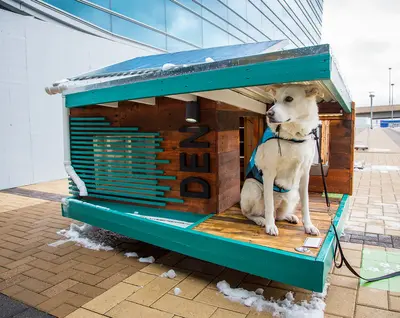
Somewhere in the past few years, the family dog stopped sleeping in a basket in the corner of the kitchen and moved into a room of its own.Think custom-tiled floors, built-in beds and sometimes its own little “spa” for bath time.
This isn’t a one-off rich-person flex either.It’s a full-blown design movement and it’s got a name: Barkitecture.
If you haven’t heard the word yet, you will.It’s the term for architecture and interior design built specifically for pets—doghouses that look like mini modernist homes, “catios” (enclosed cat patios), built-in feeding stations and mudrooms that have turned into dog decontamination zones with heated floors and thermostatic taps so the water’s never too hot for sensitive paws.
What started as a cute Pinterest trend for DIY cat trees has become a line item in how architects and property developers plan homes.
And it’s not small money.It’s a multibillion-dollar change in how we live and it’s happening in South Africa too.
Here’s the thing that explains everything else in this article: people are having fewer kids, later or not at all.It’s a global child-free movement, as many can’t afford the commitment of raising children while others believe the world is too much of a mess to bring children into.
Members of the child-free movement are pouring the same energy (and budget) into their pets instead.
Industry people call it “pet humanisation”—pets have moved from an “animal we own” to “member of the family we plan our whole lives around.”
According to the American Pet Products Association in the US, the pet industry hit $158 billion in 2025 and is expected to climb to around $165bn (R2.7 trillion) in 2026—and it has grown every year for more than 25 years, recessions included.
Zoom out further and the global pet care market is sitting above $289bn billion, on track to hit nearly $500bn by 2034, according to Fortune Business Insights.
Bloomberg Intelligence has made a similar call, predicting the global pet economy will blow past $500bn by 2030.
Covid and global lockdowns played an influential role in increased pet ownership.Lockdown loneliness sent adoption numbers through the roof worldwide.Once people had a dog sleeping at the foot of their bed for two years straight, there was no going back to “just a pet”.
US households owning at least one pet has grown from 82 million in 2023 to 94 million in 2025 (Fortune Business Insights).Pet owners are spending an average of $1 445 a pet a year in the US, with the average cost of owning a dog reaching $2 500, according to Pet Holiday Club.
I don’t know if you’ve taken your dog for a procedure at the vet recently but I have.The cost of pet surgery in South Africa is exorbitant.Your dog’s hip surgery is sure to cost double that of a human requiring the same hip surgery procedure.
But what does that have to do with architecture?Everything, actually.
Once you’re spending that kind of money and emotional energy on an animal, you stop hiding its stuff in a corner and start designing around it.That’s the direct line from “pet humanisation” to “barkitecture”.
Globally, this is showing up as:
Built-in dog spas in mudrooms—raised wash platforms with tiling that matches the rest of the house, not a garden hose out back.
Seamless built-in crates that double up as side tables or bookshelves, so the wire cage doesn’t wreck your interior aesthetic.
“Catios”—fully enclosed outdoor cat patios that give indoor cats a safe slice of the outside world.
Botanical dog gardens, using pet-safe, chew-resistant plants so you don’t have to choose between a nice garden and a dog that eats it.
There are international competitions for this now.Goodwoof in the UK runs an annual Barkitecture contest where architects design and build kennels judged on things like canine wellbeing and design ambition.This year’s brief was “Dogs in Space”.They had an astronaut as one of the judges.
Some might say it’s silly on the surface but it tells you something far more serious about architecture as a profession.They are now taking pets seriously as clients.
South Africans are, statistically, some of the most enthusiastic pet owners on the planet—we’ve got the gardens, the weather and the security-conscious mindset that makes a dog feel less like a pet and more like a non-negotiable part of the household.
Around 45% of South African adults own a pet, and 78% of pet-owning households have a dog (Dogster).
South Africa is home to more than 7.4 million dogs and two million cats. (Dogster)
Local spending on dogs and cats jumped 23% between 2019 and 2022—notice the Covid bump (Dogster).
The local pet care market has crossed R8bn and keeps growing every year (Pet Parent SA).
We spend roughly R5.7bn a year on vet care alone and new pet owners can drop R30 000 to R60 000 on vet bills in the first year (Dogster).
And it’s influencing our property market, which is the bit that should really grab you if you’re in real estate or brokering.
Property24 has flagged barkitecture by name as a growing feature in South African homes—think low-level built-in dog wash stations in laundry rooms and integrated pet beds.
Almost a quarter of South African households owning cats or dogs are actively house-hunting with their pet’s needs on the checklist.Dog owners are chasing bigger homes with secure gardens, while cat owners are leaning toward flats and sectional title units.
Real estate developers are also taking note.New estates in Johannesburg’s northern suburbs are marketing themselves on green space and pet-friendly facilities as a strong selling point.
In sectional title complexes, where pet rules used to be a nightmare of committee politics, some high-end estates run “pet interviews” before approving your dog, complete with a pet CV covering vaccinations and sterilisation.Fine & Country’s regional CEO says: pet-friendly features aren’t a nice-to-have anymore; they’re shaping how homebuyers choose where to live.
What era are we in?I’d call it the Pet-as-Family Era.No more just “pet owner”; you are officially a pet parent.And once you’re a parent, you don’t put your kid’s bed in a random corner; rather, you build them a room.That’s the entire logic behind barkitecture in one sentence.
For property brands, brokers and developers in South Africa, this isn’t a cute trend to mention in passing: it’s a buying decision people are actively making, backed by real rand value.Pet-friendly gardens, wash stations and secure fencing aren’t “extra features” on a listing anymore.
They’re becoming as standard as a checklist item such as a second bathroom or off-street parking.
The dog days are, literally, here to stay.