
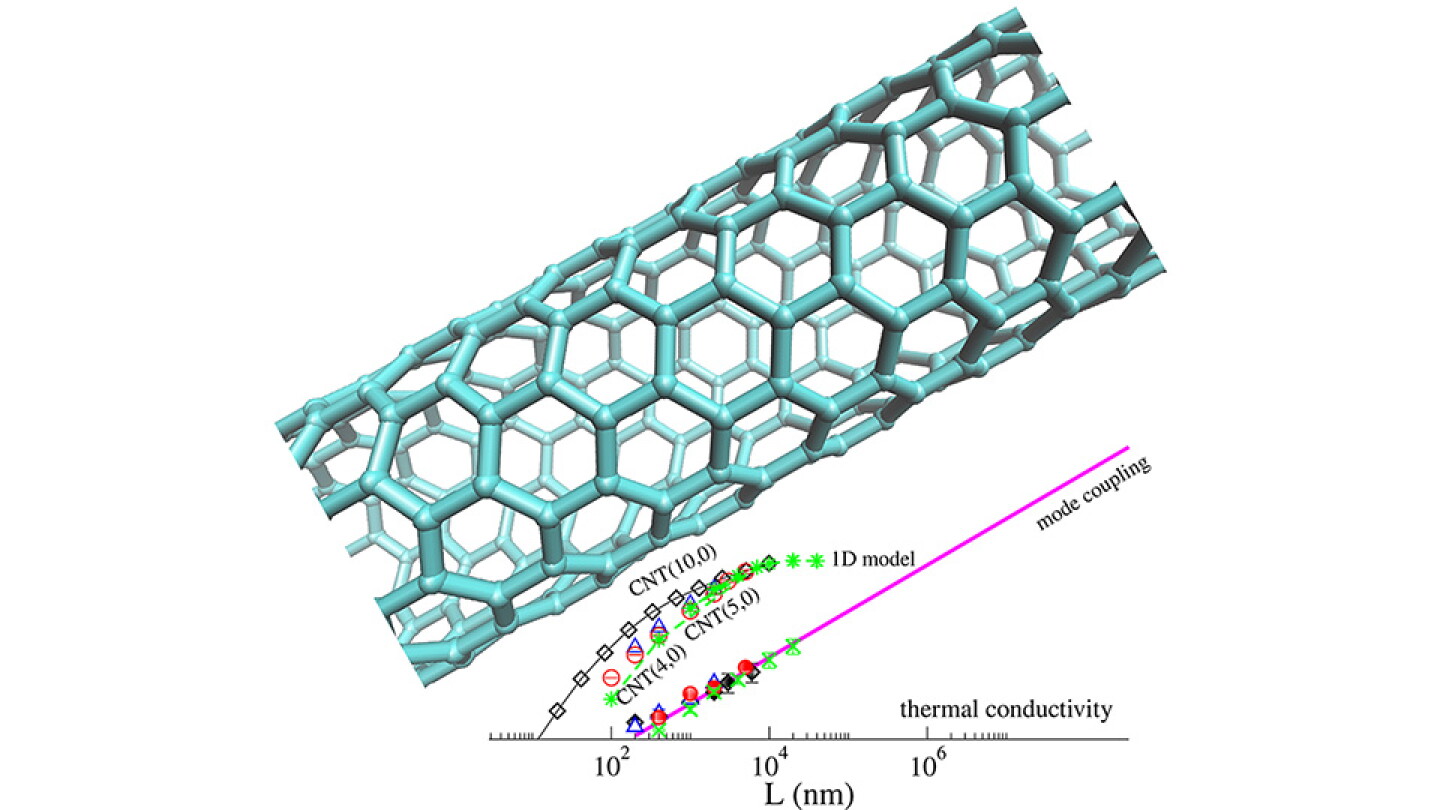
Molecular dynamics simulations provide evidence of the divergent nature of the material’s thermal conductivity.
Carbon nanotubes are exciting materials, owing to their unique properties and potential applications. Chief among these properties is their thermal conductivity, which makes them attractive for heat dissipation in electronic nanodevices. Carbon nanotubes exhibit a divergent thermal conductivity, where the conductivity increases with the length of the nanotube, but for decades, the nature of this divergence has been disputed.
Ren et al. sought to use computational techniques to uncover the thermal behavior of carbon nanotubes.
Previously, researchers used mode-coupling theory to explore the properties of 1D lattices, which could serve as idealized models of carbon nanotubes. This method gives a power law relationship between conductivity and length but has yet to be validated for carbon nanotubes.
To produce additional support for the theory, the authors turned to molecular dynamics simulations. However, they were unable to observe the power law relationship between length and conductivity, because the diffusive mode was too large in the nanotube systems they were able to simulate. Instead, they introduced random velocity exchanges between neighboring carbons in shorter nanotubes, perfectly recreating both the expected 1/3 exponent power dependence of conductivity on nanotube length as well as its prefactor.
While conducted on short nanotube lengths, these results lend credence to the prediction that this diffusive behavior will dominate the thermal conductivity for structures beyond millimeter length scales. It also raises the possibility that other materials might perform even better than carbon nanotubes.
“The precise exponent of 1/3 is a consequence of the asymmetry of the potential energy between two atomic neighbors, but other quasi-1D structures with a symmetric potential are expected to follow an exponent of 1/2 at low enough pressures, which implies an even faster superdiffusive behavior,” said author David Cubero. “We are currently looking for realistic materials which could exhibit this stronger performance. In principle, they could turn out to be the fastest heat conductors conceivable.”
Source: “Heat superdiffusion in carbon nanotubes,” by Yuanyang Ren, Yang Wang, Kai Wu, and David Cubero, Applied Physics Letters (2026). The article can be accessed at https://doi.org/10.1063/5.0338597 .