
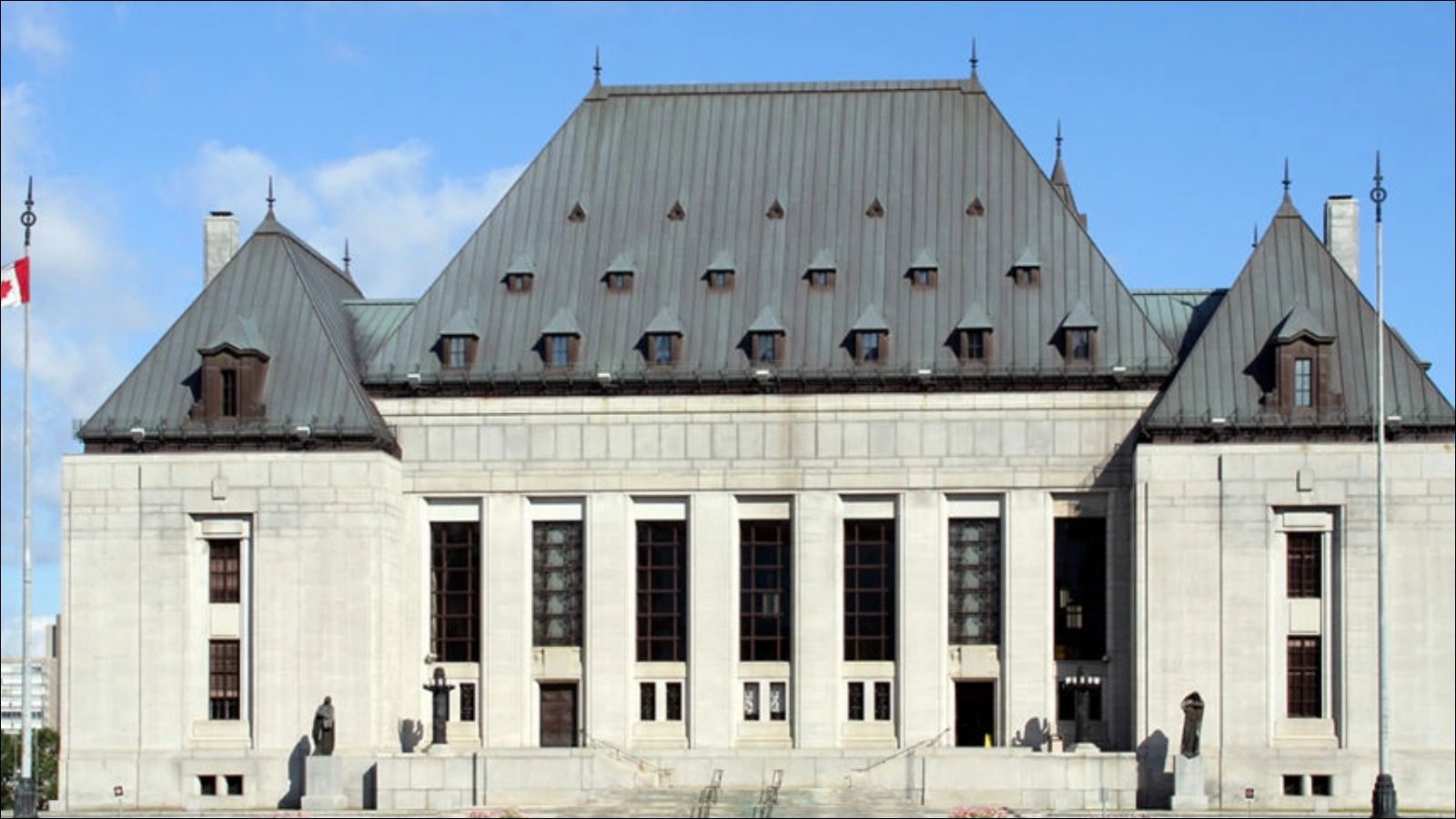
The Supreme Court of Canada’s decision not to hear an appeal of a New Brunswick Indigenous land claim to private property is reverberating across Canada.
Several organizations have welcomed the decision, with the First Nation that sought the appeal being an obvious exception.
Government officials and lawyers say the decision could have implications for a similar case in B.C. But the chief of a First Nation in the group that launched the New Brunswick legal action has vowed to keep fighting for Aboriginal title to the private property.
In the New Brunswick case, the Supreme Court declined to hear an appeal of a lower court decision brought by the Wolastoqey Nation. As is customary with such decisions, the Supreme Court did not provide a reason for rejecting the appeal.
The Wolastoqey is seeking a declaration of Aboriginal title over more than 50% of New Brunswick, including 252,758 privately owned parcels of land. In December, the New Brunswick Court of Appeal ruled that an Indigenous group cannot seek a declaration of Aboriginal title over privately owned land.
Writing the court’s decision, Justice Ernest Drapeau said a declaration of Aboriginal title over private land “would sound the death knell of reconciliation with the interests of non-Aboriginal Canadians.”
The court distinguished between a finding that Aboriginal title exists and a declaration of title, emphasizing that only the latter is enforceable. While courts may find that Aboriginal title exists on private land, Drapeau said a declaration cannot co-exist with fee simple ownership.
Drapeau said a judicial declaration of Aboriginal title would confer those ownership rights, but he could not see how Aboriginal title rights could co-exist with the very same rights vested in fee simple owners.
But Chief Patricia Bernard of Madawaska, one of the six Wolastoqey communities, vowed that the Wolastoqey would still pursue their claim despite the Supreme Court setback.
“The fight for our homeland will continue,” she said in a statement. “Canadians expect that the Supreme Court will eventually need to clarify the law on whether Aboriginal title can be recognized in relation to privately held lands.”
Meanwhile, B.C. government officials and lawyers say the Supreme Court’s decision not to hear the Wolastoqey’s appeal has bolstered the grounds for a pending appeal of a contrasting B.C. court decision concerning Aboriginal title to private land.
In a controversial August 2025 decision, the B.C. Supreme Court ruled that the Cowichan Tribes hold Aboriginal title to hundreds of acres of private property in Richmond, B.C., and other southwestern parts of the province, including Vancouver Island.
The provincial government, City of Richmond and other organizations, including Montrose Properties, which has extensive holdings in Richmond, are challenging the decision.
“I think [the Supreme Court of Canada’s decision not to hear the New Brunswick case] gives us a clear path to an appeal here in B.C., and we’re continuing to pursue that legal option,” B.C. Attorney General Nikki Sharma told reporters.
David Robbins, a lawyer representing the Cowichan, also welcomed the Supreme Court’s decision.
“This is good news because the Supreme Court of Canada has not decided the issue nor upheld the New Brunswick Court of Appeal. It has left the question open for a future case,” said Robbins in a statement released by his law firm, Woodward & Company.
The Cowichan had sought intervenor status, through Woodward & Company, in the New Brunswick case. The B.C. First Nation contends that it would be more appropriate for Canada’s top court to wait and address the question of Aboriginal title to private lands in any appeal involving the B.C. case.
Commercial real estate owners, developers, occupiers and brokers have contended that the Cowichan decision has stalled and scuttled potential projects and deals in Richmond and other parts of B.C.
Montrose is asking the B.C. Supreme Court to reopen the decision on grounds that the unexpected ruling has severely disrupted the Richmond-based company’s business. Law firm MacMillan aired Montrose’s argument during a two-day hearing in a Victoria, B.C. courtroom last week.
Montrose is seeking to reopen the decision rather than be part of an appeal that could take years to come before a court.
“What Montrose ideally would want is that the title findings don’t apply to their property,” I suppose that’s the best outcome,” Joan Young, a MacMillan lawyer who appeared for the company in the Victoria courtroom, told Business in Vancouver.
Montrose President and CEO Ken Low told BIV the company is pleased with the Supreme Court of Canada’s decision not to hear an appeal of the New Brunswick case.
Richmond Mayor Malcolm Brodie has warned that the Cowichan ruling could negatively affect property title in the city and other parts of southwestern B.C.. Brodie and other city officials have come under intense criticism for not keeping Richmond property owners informed about the case.
Pictured: Supreme Court of Canada
Photo: Educaloi