
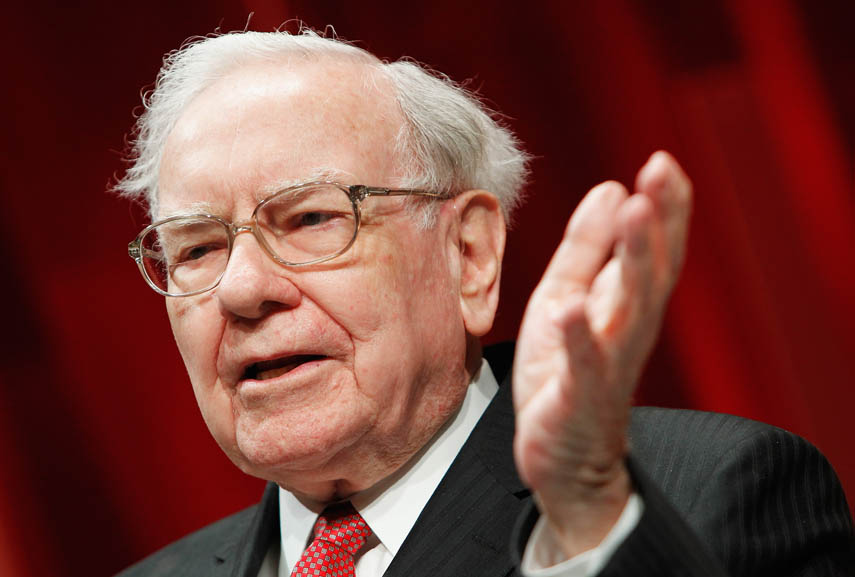
This reflects his ‘contrarian’ instincts: he buys when others are selling.
In his own words: ‘The disarray in markets gave us a tailwind in our purchases. When investing, pessimism is your friend, euphoria the enemy.’6
He has a very simple formula for the stocks he buys.
In his own words: ‘We select our marketable [listed] equity securities in much the same way we would evaluate a business for acquisition in its entirety. We want the business to be (1) one that we can understand, (2) with favourable long-term prospects, (3) operated by honest and competent people, and (4) available at a very attractive price. We usually can identify a small number of potential investments meeting requirements (1), (2) and (3), but (4) often prevents action.’7
He says those who invest only when markets are placid pay a heavy price.
In his own words: ‘We’ve put a lot of money to work during the chaos of the last two years [the global financial crisis]. It’s been an ideal period for investors: A climate of fear is their best friend. Those who invest only when commentators are upbeat end up paying a heavy price for meaningless reassurance. In the end, what counts in investing is what you pay for a business – through the purchase of a small piece of it in the stock market – and what that business earns in the succeeding decade or two.’8
And no matter how dark the investment horizon may seem, he puts matters in their historical perspective and expresses optimism for the long term.
In his own words: ‘Amid this bad news, however, never forget that our country has faced far worse travails in the past. In the 20th Century alone, we dealt with two great wars (one of which we initially appeared to be losing); a dozen or so panics and recessions; virulent inflation that led to a 21.5% prime [interest] rate in 1980; and the Great Depression of the 1930s, when unemployment ranged between 15% and 25% for many years. America has had no shortage of challenges.
‘Without fail, however, we’ve overcome them. In the face of those obstacles – and many others – the real standard of living for Americans improved nearly seven-fold during the 1900s, while the Dow Jones Industrials rose from 66 to 11,497. Compare the record of this period with the dozens of centuries during which humans secured only tiny gains, if any, in how they lived.’9
Source:
1Fortune magazine, December 2001
2Berkshire Hathaway annual report, 2001
3Letter to Berkshire Hathaway shareholders, 2009
4Remarks at Berkshire Hathaway annual meeting, 2024
5Letter to Berkshire Hathaway shareholders, 2009
6Letter to Berkshire Hathaway shareholders, 2009
7Letter to Berkshire Hathaway shareholders, 1979
8Letter to Berkshire Hathaway shareholders, 2010
9Letter to Berkshire Hathaway shareholders, 2009