
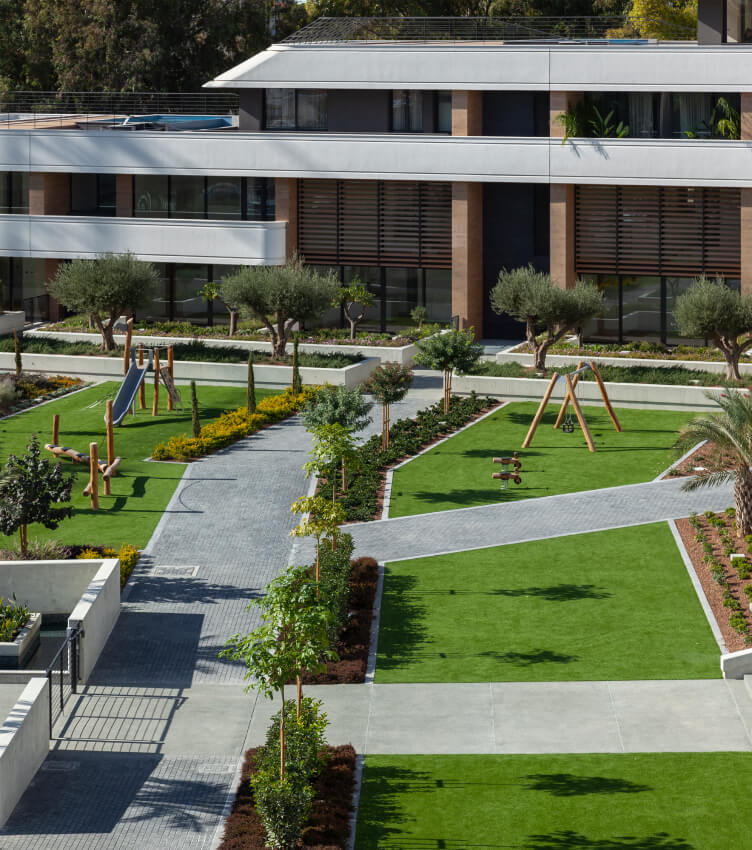

Luxury property no longer means just square footage and marble floors. Buyers have gotten pickier, smarter, and more demanding. What counted as premium five years ago looks ordinary now. This piece breaks down what actually drives the high-end real estate market today: from architecture to the lifestyle services buyers expect before they sign anything.
What “Luxury” Actually Means in 2025
Developers slap “luxury” on anything with a rooftop and a lobby chandelier. The word barely means anything anymore. So what actually defines premium property?
- Privacy — physical, not conceptual. Elevators that open into your apartment. The distance between your front door and the nearest stranger. Baseline, not a bonus.
- Build quality — harder to fake long-term. Triple-glazed windows, HVAC without noise, materials that hold up. The Land of Tomorrow in Larnaka, developed with Foster + Partners, is a useful benchmark: designed around how people inhabit a place over decades, not around unit counts.
- Developer depth — who’s behind the project and for how long. BBF Global Ltd covers 185+ projects across Cyprus, Greece, and Canada, with 1.4M m² sellable area and a 2.4M m² land bank. That scale means accumulated knowledge of what holds value — and what doesn’t.
Location Still Dominates. But Not the Way It Used To
Monaco hasn’t moved. Neither has Mayfair. But the geography of desirable has expanded, and some shifts are permanent.
Dubai rewrote its own rules. The Palm Jumeirah was a marketing exercise in 2001. By 2023, resale prices were outpacing comparable waterfront in Miami — the result of sustained infrastructure investment and a functional framework for foreign ownership.
Greece moved more quietly. Athens’ southern suburbs attracted diaspora capital. Crete and Mykonos captured international villa buyers, with EU residency pathways as an added pull.
The common thread: what attracted money wasn’t sun or scenery. It was legal clarity, lifestyle infrastructure (schools, hospitals, airports) and some form of residency or tax incentive. Remove any one element and the premium evaporates.
Interior Design and Technology: The Invisible Upgrades
Walk into a genuinely high-spec development in 2026 and the giveaways are subtle. No gratuitous gold. What you see instead: restraint, material quality you have to touch to appreciate, technology integrated so cleanly it’s invisible.
Dornbracht fixtures. Gaggenau appliances configured for actual cooking. Lutron lighting that adjusts automatically. BMS systems controlling everything from blinds to underfloor heating from a single app. Buyers at this level expect Crestron or Control4 as standard — not an upgrade. Bad smart home integration in a €3 million apartment is embarrassing. Developers know this.
Sustainability has become table stakes. BREEAM or LEED certification is now expected in new premium builds — not because buyers are driven by ideology, but because energy efficiency directly impacts running costs.
Services: What Premium Buyers Actually Expect
The word “concierge” has been applied so liberally it’s nearly meaningless. An app that books restaurant tables is not the same as a property manager who resolves a blocked drain at 11pm on a Saturday without being asked twice.
The distinction that rarely appears in developer brochures: what happens after you sign. After-sales support, maintenance, rental management, long-term oversight. A buyer who doesn’t permanently occupy their property needs to know it’s managed as if they’re present. That’s an operational infrastructure, not a promise in a contract.
BBF Global Ltd operates precisely as this kind of integrated platform — development, construction, architecture and design, sales, rentals, after-sales support, and long-term property management under one structure, with 300+ employees across Cyprus and Greece and a team speaking 15+ languages. That breadth matters when a buyer’s question shifts from “what am I purchasing” to “who is responsible for this in five years.”
Investment Logic vs. Lifestyle Logic
Be honest about what you’re buying.
A lifestyle property costs money to run and generates no income unless you rent it — which changes everything. An investment property operates on yield, occupancy, management efficiency, and exit strategy. The hybrid can work well or produce mediocre outcomes across all three objectives when managed badly.
The advice most buyers don’t receive early enough: decide which category you’re in before you shortlist, not after. The criteria are genuinely different. A villa that suits your family’s holidays may generate negligible rental income. A high-yield property may sit in a location you’d never choose to live in. Neither is wrong — as long as you knew going in.
What the Premium Market Looks Like From Here
Supply of genuinely high-quality residential product remains constrained across most European markets. Construction cost inflation and planning restrictions haven’t gone away. Demand from international buyers relocating for lifestyle, tax, or residency reasons has remained consistent.
What holds across markets, reliably: build quality that lasts, location that doesn’t degrade, services that function as promised, legal structures that protect the buyer. Everything else is staging.