
 Advisor Perspectives welcomes guest contributions. The views presented here do not necessarily represent those of Advisor Perspectives.
- Dr. Frank Sortino revolutionized risk management by focusing on downside risk and introducing the Sortino Ratio.
- His Desired Target Return (DTR) aligns portfolio risk with investor objectives, improving upon traditional volatility metrics.
- The Sortino Ratio evaluates returns relative to downside risk below DTR, creating a superior framework for evaluating investment performance, especially for hedge funds where the “hedge” typically reduces downside risk.
- Sortino’s portfolio construction framework combines skillful active managers with passive funds for optimal risk-adjusted returns relative to specific DTRs.
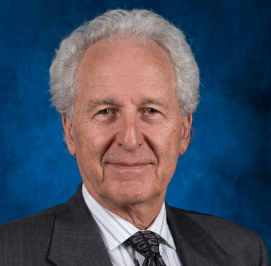
Dr Frank Sortino passed away last month. He was 94.

Frank was a good friend of mine. What many don’t know, in addition to being an educator and very creative financial innovator, Frank also played great saxophone in a band. He was a multi-talented and very kind man.
Frank’s business passion was making investing smarter. His work was groundbreaking for investment decision-making. Most of you have heard of the Sortino Ratio and the importance of distinguishing between downside risk and standard deviation. Frank was the driving force behind the development of the Post-Modern Portfolio Theory (PMPT), which is more widely used than the 75-year-old “Modern” Portfolio Theory (MPT). Here are some of the tools he left for us all to use:
Bad Risk versus Good “Risk”
Standard deviation penalizes home runs. There’s good volatility (great investment returns) and bad volatility (losing money). Frank educated us on the importance of using bad volatility to measure the risk of a portfolio. Most applications used returns below zero to calculate risk, but Frank offered another measure — returns below your Desired Target Return.
Desired Target Return (DTR)
As management to objectives became the industry standard, it was natural to estimate what rate of return you needed to achieve your objectives. Frank named this your Desired Target Return, or DTR, and defined downside risk as the semi-deviation below your DTR.
Downside Risk
Frank earned the name Dr. Downside for redefining risk as a measure of not achieving your objectives, which led to the fairly famous Sortino Ratio.
Sortino Ratio
Prior to Frank’s introduction of his ratio, the most popular risk-to-reward ratio was the Sharpe ratio, which is your return above Treasury Bills divided by standard deviation. Integrating management to objectives with his better measures of risk, the Sortino Ratio divides return above your DTR by downside risk below your DTR. The Sortino Ratio is a crucial component in PMPT and particularly valuable for evaluating hedge fund success for reasons I won’t go into here, other than to say “hedge” generally means limiting the downside.
The Sortino Framework for Constructing Portfolios
Frank put all (maybe just most?) of his innovations into a book by this title that, in addition to showing how to create really good multi-asset, multi manager portfolios, actually includes access to software to implement this structure. In simple terms, the idea is to filter for skillful active managers — if you can find them — and to fill in holes in your investment space with passive funds. It is an active-passive optimization.
We have all benefited from Dr. Sortino’s fine work. I will miss him a lot.
More articles by Ron Surz:
Ron Surz is president of Target Date Solutions, developer of the patented Safe Landing Glide Path and Soteria personalized target date accounts. He is also co-host of the Baby Boomer Investing Show. Surz’s passion is helping his fellow baby boomers at this critical time in their lives when they are relying on their lifetime savings to support a retirement with dignity, so he wrote a book, “Baby Boomer Investing in the Perilous 2020s,” and he provides a financial educational curriculum.
For anyone who relies on TDFs — or advises those who do — Surz’s new book is a must-read guide to understanding the risks, solutions, and future of a secure retirement.
A message from Advisor Perspectives and VettaFi: Discover something new! Click here to register for our upcoming webcasts.