
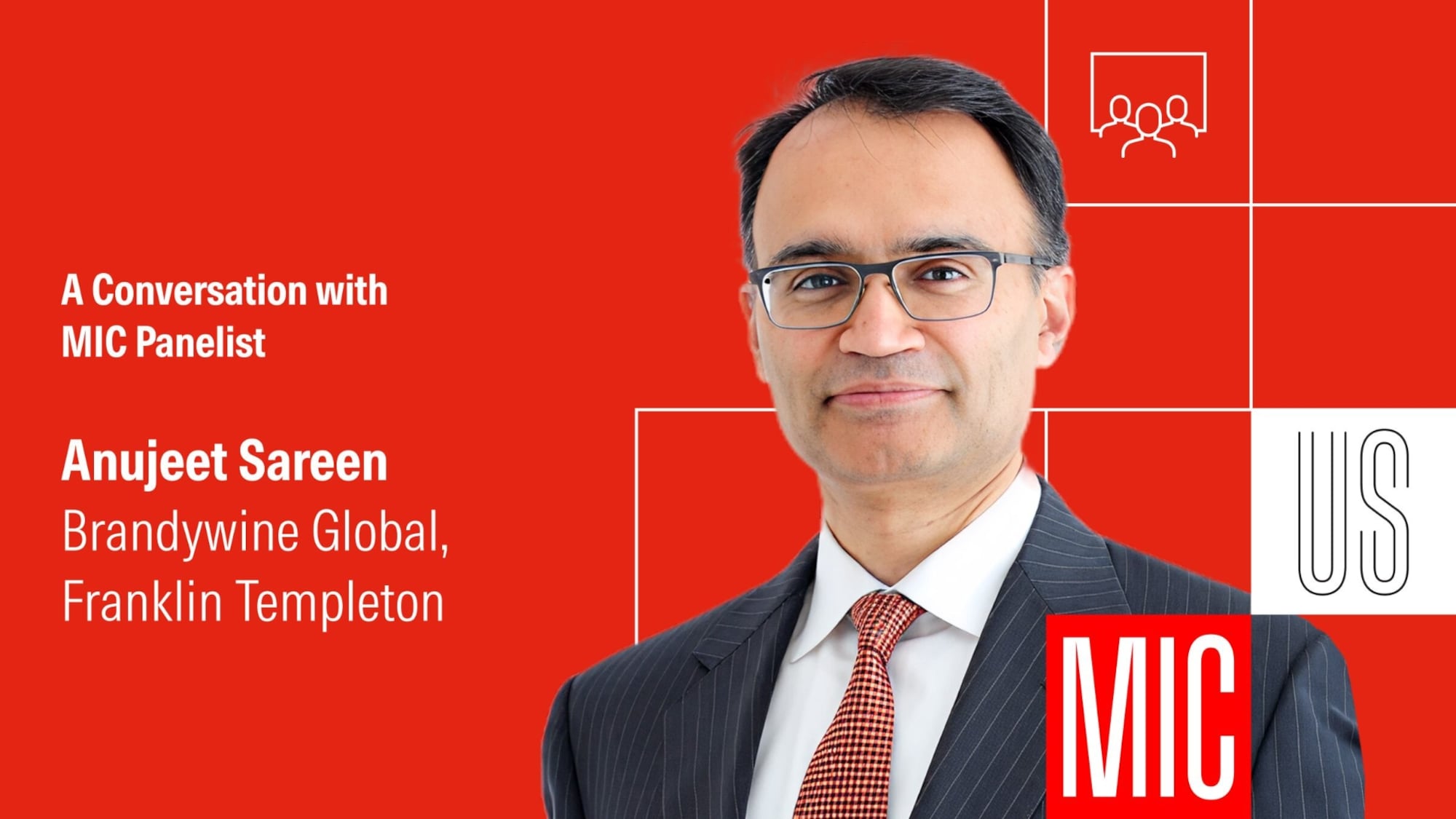
Saraja Samant: Hi everyone. I’m Saraja Samant with Morningstar. 2025 was a standout year for global bond markets, but 2026 has been a different story. Geopolitical tensions, tariff uncertainty, and a weakening dollar all have sent surging volatility through fixed-income markets worldwide. To make sense of it all, I’m joined by Anujeet Sareen, portfolio manager and head of fixed income at Franklin Templeton’s Brandywine. Anujeet, let’s start with the market landscape. How have global bond markets evolved over the course of your career?
Anujeet Sareen: Sure. I started back in the early 1990s, and I’d say there’s several things that have changed over time. The first is that back in the ’90s, fiscal discipline was a real thing. And the last technology boom we had in the US, which was the late ’90s, the US budget deficit disappeared. We ran surpluses back then. The Maastricht criteria meant something in Europe. If you wanted to get into the club, into the Economic and Monetary Union club, you had to have deficits under 3%. Of course, all the emerging-market crises that occurred were also about creating greater fiscal discipline and control. That, of course, has changed quite a bit. We went into the 2000s, and you had George W. Bush start to institute tax cuts and all the spending on the Afghanistan and Iraq wars. Went to the 2010s after the global financial crisis, even more deficit spending, and then, of course, that was punctuated by what happened after covid. We’re in a very different fiscal situation today than we’ve been in for a long time. I’d say that’s one major change. The other major change is that there are a lot more currencies that are free floating. Back in the early ’90s, even the developed world, the British pound, the Swedish krona, those were pegged exchange rates that devalued. And then you had all the different emerging-market currencies throughout the 1990s that moved off their pegged exchange rates. The final one, of course, was China in 2005. It’s a very different, I think, capital-flow regime than we’ve had. I’d say the third difference is most of the crises that we had in the 1990s and 2000s were really about private-debt crises. You had the savings and loan crisis in the US in the early ’90s. You had the tech bust and the TMT credit issues in the early 2000s. Of course, the late 2000s were about the GFC, which was about both the banking systems and the household sector. Well, the private sector just hasn’t borrowed down the last 15 years. It’s been all about debt borrowing in the public sector. That’s a very different place, I think, today than 30 years ago.
Samant: That makes complete sense. Thank you for that. You alluded to higher fiscal deficits, especially looking at the US. Although all the fundamentals point to the story that an investor should go outside the US, we are not really seeing that, especially looking at, say, the high-equity markets in the US. Should a US investor be looking beyond the US markets? And if so, why?
Sareen: Good question. Let me tackle this a couple of different ways. Certainly, from the US Treasury perspective, I think it is worth looking outside the US. The US runs the largest deficit of any meaningful country in the world. We have 6% deficits as far as the eye can see. While other countries also have deficit issues, they’re still smaller than the US. Even countries like Japan and the UK, where there’s been more market focus. The US is just worse, and the entitlement issue is going to make it a real difficult challenge to address. We also don’t seem to have the political capital or will to deal with it. I think that’s a fundamental challenge to the Treasury market. The US dollar, after it went off the gold standard in the 1970s, has traded in a wide range. We’re close to the top of that range today.
It wouldn’t be a surprise if the dollar is down 15%, or even as much as 20% of the next few years as the dollar starts to normalize. Your point’s well taken. There’s a reason the dollar is high. The last 15 years have been marked by US exceptionalism, and that has shown up most dramatically in the performance of US equities. I don’t think that story is gone. I still think it’s there. The US clearly has leadership in the AI space, so it’s not to be dismissed, but it is to acknowledge, though, that the amount of capital that’s come into the US over the last 10, 15 years is extraordinary. The world is long US assets. The US had better be exceptional and deliver on that sort of exceptional promise. I think your point’s well taken. I’m not suggesting the US is about to fall out of bed here if investors are going to flee, but I do think that the marginal dollar, the marginal capital now, is more likely to flow outside the US, where growth is just better than it used to be.
10 years ago, Europe was having all kinds of issues between sovereign crises and banking crises. The Chinese problems in their property sector, well, they’ve been in a downturn now for almost five or six years, so we’re probably closer to the end of that downturn, not the beginning. We have a big semiconductor story. The AI story is spreading outside the US. Korea and Taiwan have been tremendous equity markets. I think there are places that are showing opportunity that we didn’t see previously. I think there is evidence that the US story is starting to turn versus the world.
Samant: Talking about opportunities besides the US. Given these geopolitical tensions and the AI story, are you seeing any particular countries actually benefiting from the current turmoil?
Sareen: Sure. We’ve effectively gone from a world that was very unipolar. The US was the large hegemon that provided security around the world, helped really support and ensure the free flow of capital and trade. That has now changed. You have at least two superpowers between the US and China. You have perhaps a third power source in Europe, with the US clearly moving away from its commitments to Europe, both on a trade and a security side. This sort of fracturing of the world, or this multipolar world, advantages certain countries that are positioned to benefit from it. I would put Brazil near the top of that list. Brazil has a very diversified set of commodities that are in demand in this new world. You can’t just find commodities anywhere. You have to go to certain places, and Brazil’s one of them. They have a good trading relationship with China, with the US, and with Europe.
By the way, it’s not just the fact that they have commodities. In a more multipolar world, you get duplication of supply. The US decides, “Hey, we can’t depend totally on supply from China, so we need to build some of it ourselves.” Well, that boosts demand for commodities and Brazil as a beneficiary. I’d say Australia’s also a country that benefits from that world. They also have a diversified set of commodities, and they will trade both with China and the US, in particular, in that new economic environment.
Samant: Thank you so much. Talking about opportunities, let’s also talk about some countries that you’re aware of or are more cautious toward, just because of the changing market environment and the current tensions that are around the world.
Sareen: I would say that the main theme that we would be focused on that would make us cautious about a country is how much populism is driving policy. Turkey’s a good example of this. Turkey is a place that has really pursued some very unorthodox monetary and fiscal policies to boost demand and consumption. Well, they have an inflation problem. Inflation is north of 30%. I think there are other countries that have pursued economic populism. Some have been more prudent about it. I’d say Mexico has been a little bit more prudent about the mix, even though there are some issues there. Colombia is a place right now that is confronting this. You’ve had an administration that’s been very economically populist, that has blown out their deficit, and the election outcome here will be meaningful in making sure they address this or not. Populism has been on the rise for quite a bit of time across the world.
You could argue it was part of Trump’s ascendancy in the United States as well. Where populism is leading to reasonable policies, I think things are OK; where it’s leading to things that I think create longer-term damage, I think we have to keep a close eye.
Samant: Thank you so much for these detailed insights, and thank you for joining us. We look forward to hearing more from you at the Morningstar Investment Conference this June. Thank you so much.