
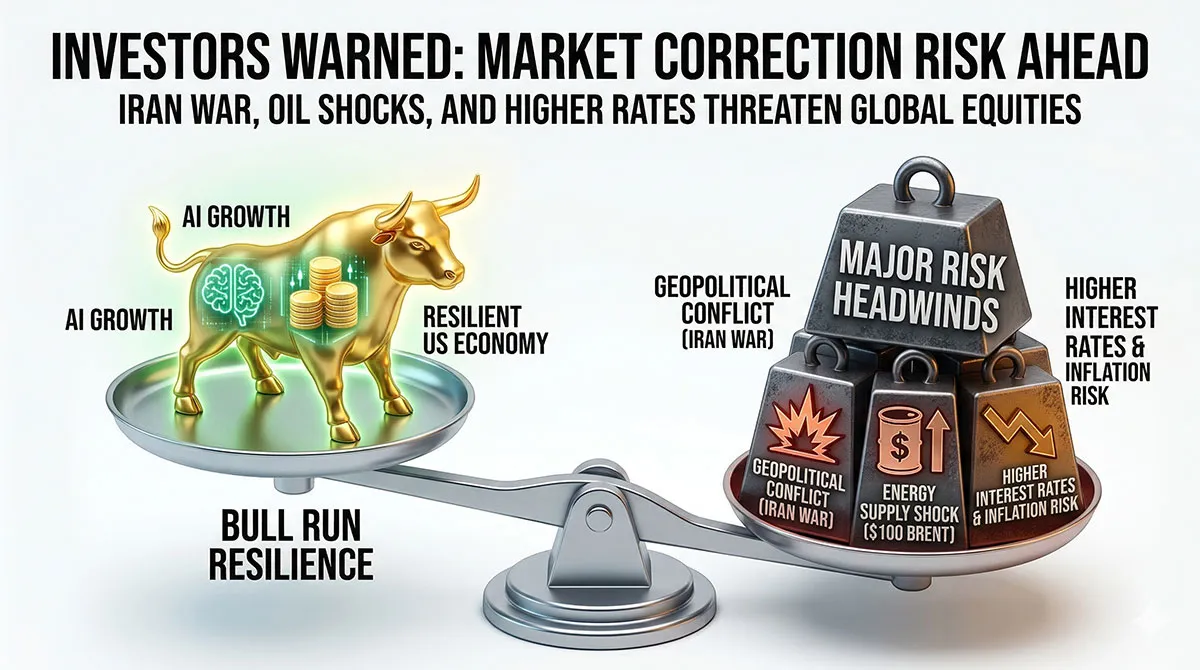
Coming into 2026, analysts had been bullish on the stock market, but the outbreak of the Iran war threatens to put the brakes on the bull run, strategists warned this week.
US equities stand to be impacted by the conflict, which has already seen oil prices spiral and the prospect of rate cuts fade from view.
There are now growing fears that an inflationary spike and higher rates could dent capex, particularly in tech and AI, hamstringing growth and weighing on corporate profits.
While Wall Street is still holding to its year-end targets for the S&P 500 – a quick end to the war could see a return to normalcy – there are now warnings that a prolonged conflict could result in a market correction.
With large parts of the real economy in retreat, much of America’s economic growth and its stock market gains have leaned heavily on extraordinary investment in AI infrastructure.
Much of that investment is debt-financed, and higher rates threaten to curb spending, meaning the market could be significantly exposed if the Fed is forced to deviate from the dot plot, or even hike rates.

Oil Shock ‘Could Send S&P 500 Tumbling’ to 5,400
The S&P 500 could fall to lows of 5,400 this year in a worst-case scenario, analysts at Goldman Sachs have warned.
The investment bank believes that there is a 19 per cent potential downside for the index in the event that disruption to global oil supply becomes extended.
While Goldman maintains its year-end target of 7,600, they have warned that the Iran war poses a significant risk. In a note seen by Reuters on Monday, the bank said:
“The baseline outlook for US equities remains constructive, but the war in Iran adds to the downside risk posed by elevated valuations.”
It comes after Morgan Stanley’s Mike Wilson warned the S&P 500 could fall to 6,300 by April amid the turmoil.
Speaking to CNBC’s Squawk Box programme, he said that the recession risk was still low, assuming oil does not stay above $100 a barrel, but warned that there could be a near term dip.
The S&P 500 was down around 2 per cent year to date, on Tuesday, March 17, showing some resilience.
Investors appear to remain confident in American markets, even as the war rumbles on. Speaking to Bloomberg, Mark Malek at Siebert Financial explained:
“The S&P 500, while slightly on its heels, is only about 4 per cent off its highs from before the conflict.
“That tells me that the market and investor sentiment are holding up. At the end of the day, US markets still offer the best upside opportunities for investment, which is certainly backstopping at least some fear.”
However, while some investors have become accustomed to taking the TACO trade, it’s not clear that the Iran war can be “chickened out” from, or that even in such an event, the fallout could be contained.
Analysts at Bank of America have warned investors may be underpricing the risks posed by the Iran war, and believe a market correction could be brought on by high energy prices.
In a recent report, analysts at the bank said: “Markets are now weighing how long higher costs may last against supportive fiscal policy, lower interest rates and resilient profits. Whether volatility becomes a market correction depends on duration, not headlines alone…
“The key risk today is whether the Iran conflict leads to sustained increases in energy and transportation costs that affect company profits and stock valuations. If those pressures last long enough, markets may reassess growth expectations.”
In other words, markets are seeing upside from the OBBB, strong corporate profits, and US economic resilience, but may not have fully factored in the downside posed by fewer rate cuts and higher inflation.
S&P 500 Target Downgraded
The investment manager Federated Hermes recently downgraded its year-end price target for the S&P 500. While the firm said it was not bearish, they were concerned that some valuations may be too lofty.
The firm now sees the index ending the year on 7,500, upside on today’s price, but a downward revision on its earlier outlook.
Speaking to the Morningstar, Jeff Schulze at ClearBridge said that the uncertainty thrown up by the conflict, and the lack of clarity around how long the war would carry on for, means he believes the bias is now towards downside from here.
But, as the outlet reported, the general view on Wall Street leans bullish with Citi’s Aganga commenting: “Our base case is that the market feed-through of geopolitical risk…will fade over time.”
However, it may be prudent to expect volatility in the near term and to be prepared for a scenario in which the Iran war outlasts consensus, either in terms of the conflict proper or the fallout resulting from it.
While Goldman Sachs maintains its S&P 500 price target, it has warned that markets may not be pricing in the risk to equities. In a client note seen by CNBC, Tony Pasquariello said:
“I worry the stock market is underestimating the potential downside tails.
“The market is certainly smarter than I am, but I’m surprised that market participants aren’t more concerned.”
Markets appear to believe the Iran war won’t be a long one, and that its impact will largely dissipate upon the cessation of hostilities. But as the AEI’s Desmond Lachman writes, that may not necessarily hold true:
“An even more important Iran-related headwind to the US economic recovery might come from higher long-term interest rates. This is especially the case considering that the US went into that war with an unsustainable public finance position.
“Underlining the prospect of higher long-term interest rates is the fact that since the Iran war began, 10-year Treasury bond yields have risen by around 30 basis points to their current level of 4.25 per cent.

“This could be a warning that foreigners are losing their appetite for US Treasury bonds. This is especially the case considering that in normal times of heightened geopolitical and economic stability, investors would have sought the safe haven of the US Treasury market and driven down long-term government bond yields.”
How the Iran War Has Changed the Outlook for Equities
The Iran war threatens to spoil the market’s attempt to extend the bull run through its fourth year. While most Wall Street firms are standing by their year-end price targets, there is a growing chorus of warnings that markets may be underpricing the risk.
This week, JP Morgan warned that if oil prices remain stuck above $90 per barrel, there could be a 15 per cent fall in the S&P 500, as well as damage to the economy.

Goldman Sachs still pegs its base-case year-end S&P 500 target near 7,600, but warns that an extended oil-supply crisis could knock the index down to about 5,400 (a ~19 per cent decline) in a worst-case scenario.
In the medium term, Morgan Stanley’s Mike Wilson likewise projects a near-term dip (to roughly 6,300 by April) given the “perfect storm” of geopolitical tension and macro uncertainty.
Charles Schwab’s scenario analysis paints a similar picture: in a “moderate” conflict lasting a few weeks, energy flows gradually normalise, and US growth is only slightly dented, while in a “downside” case of a protracted war, the S&P could join global equities in a broad bear market.
Most forecasts assume a gentle recovery if hostilities end soon, but with the caveat that lasting disruption could threaten a dip, or in a worst-case scenario, potentially a correction.
The Iran war has already sparked an energy shock, with nearly 20 per cent of global oil and LNG supply now offline, and Brent crude trading around $100 per barrel.
This spike is already changing Fed expectations. Federal Reserve officials reportedly now see the first 2026 rate cut pushed to autumn at the earliest. Higher rates pose a risk to the tech and AI-led rally by making debt-financed investment more expensive and by reducing equity valuations.

However, many of the structural tailwinds remain in place, and many bullish forecasts rest on tax measures passed in the OBBB, expectations of good economic growth, and faith in the AI rally.
That said, if the war drags on, or if its impact is longer lasting than many have priced in, the S&P’s path could be far bumpier than earlier forecasts.