
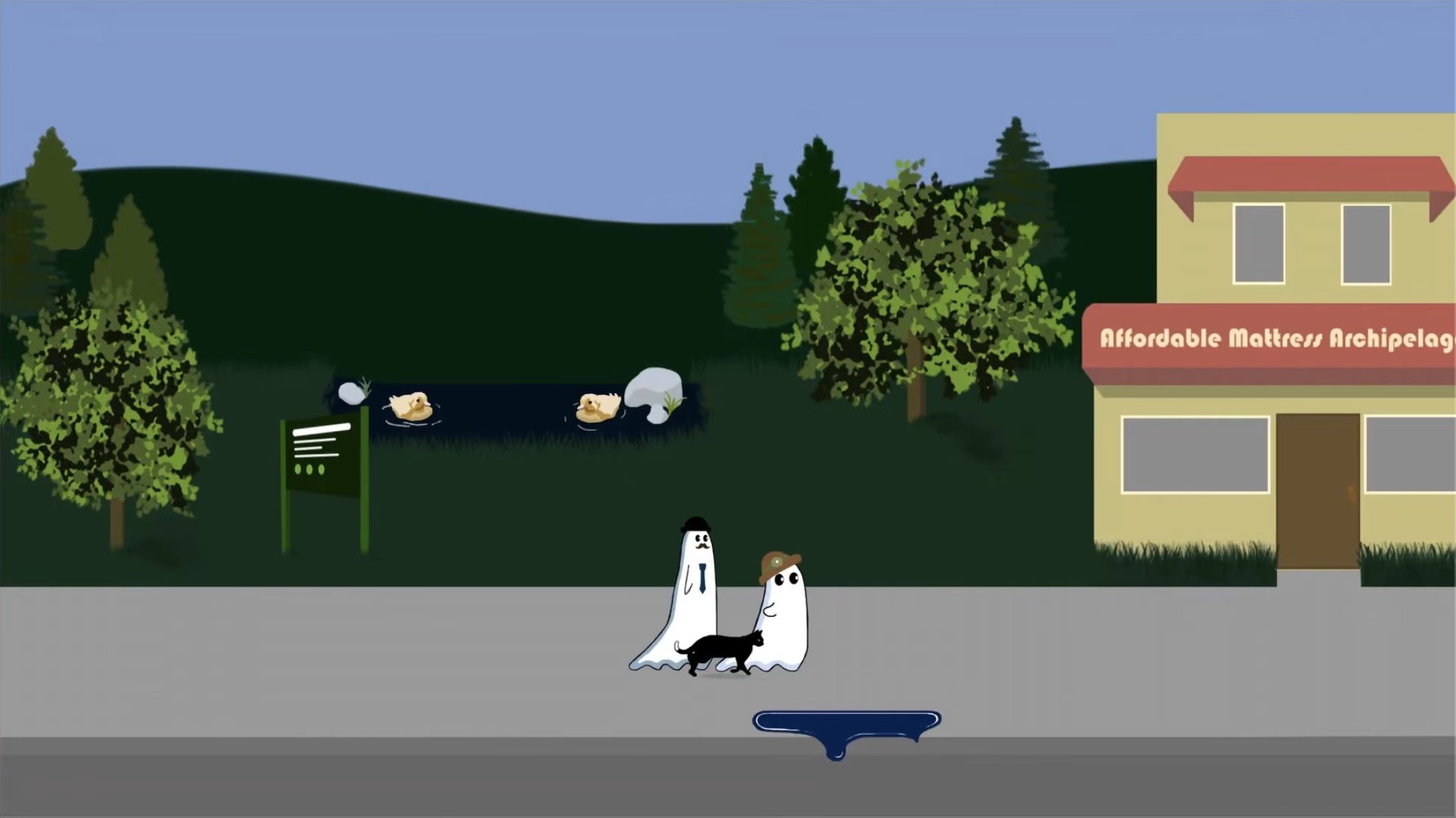
Super Sandwich Games LLC dropped the official gameplay trailer for Soup’s Tail yesterday, giving PC players their first real look at one of the most quietly ambitious narrative indie games currently heading to Steam. The single-player title asks a question most games refuse to sit with: what does it mean to be dead? And it answers it, at least in part, by sitting you down across from the residents of the afterlife and dealing a hand of cards.
Soup’s Tail Gameplay Trailer Shows an Afterlife Built Around Card-Table Encounters
The Soup’s Tail gameplay trailer, now available on YouTube, establishes the game’s premise in plain terms from the developer: explore the mystery of the afterlife, meet new characters, pet the cat, find cards, and earn collectibles. As the story unfolds, players engage the souls and figures they encounter through games of cards — each opponent a character with their own history and reason for inhabiting this liminal space, each card table a structured moment of contact with someone who, like you, is no longer among the living.
That framing — card-play as a social encounter, not a strategic combat system — is what separates Soup’s Tail from the wave of card games that followed Balatro on Steam‘s runaway success. Balatro is poker optimization with no narrative ambition. Daniel Mullins Games’ Inscryption used cards as a horror meta-narrative device. Soup’s Tail appears to use the card table the way a novelist uses a dinner scene: as a container for intimacy, revelation, and the quiet exchange of things left unsaid. The closest structural precedents in games are Signs of the Sojourner on Steam (2020) and Citizen Sleeper on Steam (2022), both of which turned abstract mechanics into social encounter systems — but neither set that encounter in the afterlife, and neither asked players to inhabit the dead person’s point of view.
What Makes This Card Mechanic Different From Inscryption or Balatro
The design choice at the heart of Soup’s Tail resolves a problem that has quietly plagued the narrative death-game genre for years. Games like Spiritfarer by Thunder Lotus and Edith Finch on Steam deliver profound emotional experiences through largely passive mechanics — you walk, you look, you listen. The interactivity is minimal because the designers correctly understood that a wrong move shouldn’t break an elegy. But that passivity has a cost: players receive the story rather than participating in it, which limits the emotional investment that genuine player agency can generate.
Peer-reviewed research on grief and games has found that players make the most meaningful connections with grief narratives when they are required to perform actions, not merely observe them. Research published in Frontiers in Psychology in 2023 found that bereaved players who engaged with games like Spiritfarer identified seven distinct meaning-making themes in their experience, including recalling personal memories of loss and reviewing the meaning of that loss through the lens of in-game encounters. The card-play in Soup’s Tail — a recurring, structured mechanic that gives players a defined role in every character encounter — may be the genre’s best answer yet to the question of how to make interaction serve grief rather than interrupt it.
This is not deck-building. There is no resource accumulation, no run-based progression, no failure state tied to an unlucky draw. From everything the Soup’s Tail gameplay trailer conveys, the card encounters function as conversation — with stakes that are emotional rather than mechanical.
Super Sandwich Games LLC and a Deeply Personal Project
Super Sandwich Games LLC is a small independent studio, and Soup’s Tail carries the texture of a deeply personal project — the kind that smaller studios attempt precisely because a larger team could not afford the creative risk. The decision to set the game in the afterlife and give the player the perspective of the dead person (not a survivor investigating deaths, as in Edith Finch, and not a ferryman guiding others through death, as in Spiritfarer) is a genuine design departure. You are not processing someone else’s death. You are navigating your own.
The visual language the Soup’s Tail gameplay trailer conveys supports this register: dusky, muted tones in warm amber and cooler shadow, character designs that appear expressive and hand-crafted, environments that feel layered with discoverable detail. The aesthetic sits deliberately between the cozy and the unsettling — close enough to comfort to be approachable, strange enough to signal that something real is being worked through here. The audio similarly favors restraint, with ambient texture doing the work that a more conventional game would assign to swelling orchestration.
The title, Soup’s Tail, is worth pausing on. It is evocative and opaque in the way that only titles built around a specific meaning reveal themselves slowly — the kind of name that rewards players who complete the story and return to ask what it meant from the beginning.
When Does Soup’s Tail Release on Steam?
No release date has been announced. Soup’s Tail is listed as “Coming Soon” on Steam, and Super Sandwich Games LLC has not confirmed a window beyond that. Players who want to be notified at launch can add the game to their Steam wishlist — Steam sends an automatic notification email when a wishlisted game releases.
The timing of the trailer release — dropped in July 2026 without a date announcement — is consistent with a studio that is building an audience before it is ready to commit to a launch window, a strategy outlined in Steam’s Coming Soon documentation for indie developers.
Frequently Asked Questions
Is Soup’s Tail a deck-building game like Inscryption or Balatro?
No. Soup’s Tail uses card-play as a social encounter mechanic — a structured way for players to interact with characters they meet in the afterlife — rather than as a strategic deck-optimization system. Inscryption layers its cards over a roguelike combat progression with failure states and run-based advancement. Balatro is a poker-based score-attack game with no narrative focus. Soup’s Tail appears to use the card table the way other narrative games use dialogue choices: as a format for intimacy and revelation. The closest precedents are Signs of the Sojourner and Citizen Sleeper, not Inscryption.
What kind of narrative game is Soup’s Tail — is it like Spiritfarer or What Remains of Edith Finch?
It shares thematic territory with both, but differs in a key structural way: in Spiritfarer, you play a living ferryman guiding souls to the afterlife; in What Remains of Edith Finch, you play a living survivor investigating the deaths of others. In Soup’s Tail, you play as the dead person, exploring the afterlife from the inside. That shift in perspective — from witness or caretaker to participant — gives the game a different emotional center. Research on grief and games suggests that interactive, encounter-based mechanics, as opposed to passive observation, can deepen the emotional processing effect these games produce for players.
When is Soup’s Tail coming out on Steam?
No release date has been confirmed. The game is listed as “Coming Soon” on Steam, and Super Sandwich Games LLC has not announced a launch window. Adding the game to your Steam wishlist will trigger an automatic notification email when the game releases.
What can players actually do in Soup’s Tail beyond the card encounters?
According to the developer’s official gameplay trailer, the game also features exploration of the afterlife’s environments, a collectibles system, and the ability to pet a cat. The exploration component appears to be a significant portion of the experience — players wander through layered environments searching for collectibles while piecing together the broader mystery of the afterlife world Super Sandwich Games has built.