
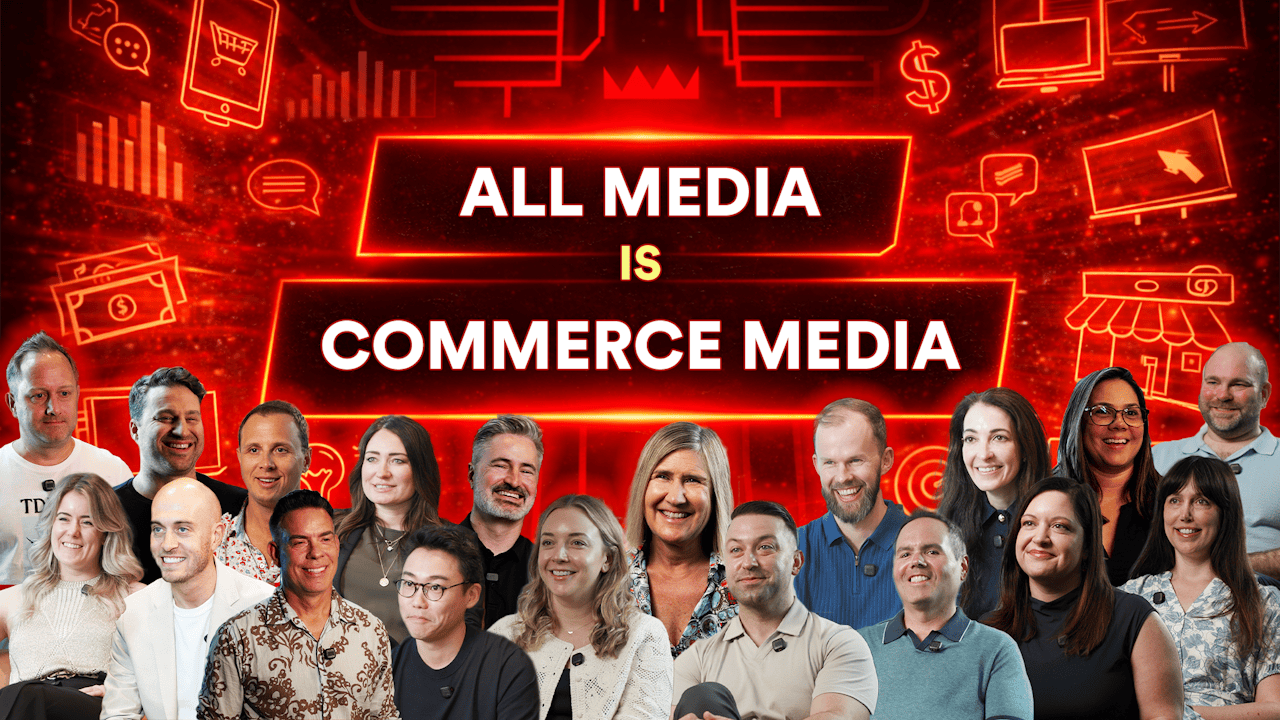
“It is certainly not the brands,” argues Maggie Merklin, chief client officer, Analytic Partners. “It is the retailers and the platforms.”
But others see a more complicated picture. “The retailer may have more leverage because they have the foot traffic of the consumer, but in the world of digital retail media, the brands hold the budgets that actually get to move those dollars,” says Andrew Lederman, global VP, digital commerce, Mondelez International.
This tension runs throughout the episode as retail media enters a new phase. The easy growth is over. The rules are changing. And the industry is being forced to confront what comes next.
The easy money is gone
For the last few years, retail media’s rise has felt unstoppable. Networks launched at pace. Budgets flowed in. Sponsored products became one of the fastest-growing revenue streams in marketing. But contributors throughout the episode suggest the industry is reaching an inflection point.
“We’re in a critical moment for retail media because all of the easy money for retail media is gone,” says Claire Wyatt, general manager, business development, retail at The Trade Desk.
Many retail media networks built their early growth on onsite placements and sponsored listings. The problem? “We’re at a point where a lot of retail media networks are seeing saturation on their site,” adds Wyatt.
At the same time, AI is beginning to reshape how consumers discover products. “AI is really changing the customer journey and so that onsite piece and that traffic that retailers depended on is potentially going to go away,” she says.
What it means is that retail media can no longer rely on the same growth engines that got it to where it is today.
Want to go deeper? Ask The Drum
Power is becoming fragmented
Retail media’s success created another challenge: competition. “With so many retail media networks now available globally, how do you drive differentiation to get people to pick your network over someone else’s?” asks Sean Crawford, managing director, North America at SMG.
The answer increasingly comes down to maturity, capability and proof. Networks are no longer competing simply for consumer attention but for brand investment. And as more networks launch, the leverage equation becomes harder to define.
Retailers have the audience, platforms have the infrastructure, brands hold the budgets. What becomes clear is that no single player controls the entire system any more.
The measurement gap remains
As commerce media matures, accountability is becoming harder to avoid.
“Continuing to make sure that we’re getting the right measurement, that we have objective measurement of retail media performance and tactics across retail media networks” remains one of the industry’s biggest priorities, says Marissa Godlewski, director, digital commerce center of excellence, Church & Dwight.
But measurement alone isn’t enough, says Paul Frampton-Calero, chief executive officer of Goodway Group, who points to a deeper problem: “There’s almost like this 48-hour data-to-action gap. By the time you get the insight… you often lose the shopper.”
The challenge is being able to turn that data into action quickly enough to matter.
Too important to stay siloed
One of the clearest themes in the episode is the need to move beyond channel thinking.
“Getting a consistent read across all channels is what I think every major CMO and CEO is challenged with,” says Joe Macarak, director of measurement partnerships at SiriusXM Media.
Consumers don’t separate brand media from commerce media. They move fluidly between discovery, consideration and purchase. The industry, however, often still operates in silos.
“Last year, we built our connected commerce capability. So that brings both brand media and commerce media under one umbrella,” explains Jason O’Toole, head of connected commerce & media, Gildan/Hanesbrands. “We own from the beginning of the funnel to the end of the funnel all the way to the point of conversion.”
That shift may prove essential as AI continues to collapse traditional distinctions between upper- and lower-funnel activity.
The next phase starts now
Commerce media remains one of the most powerful opportunities in modern marketing. “Commerce media is amazing,” says Godlewski. “You have first-party data. You have the ability to target consumers anywhere. There’s so much possibility with commerce media.”
But possibility alone won’t be enough. Growth will depend on accountability, adaptability and a willingness to rethink where value is created.
The gold rush is over. What comes next is the reckoning.
Watch the full episode of Current Accountability now on The Drum TV.