
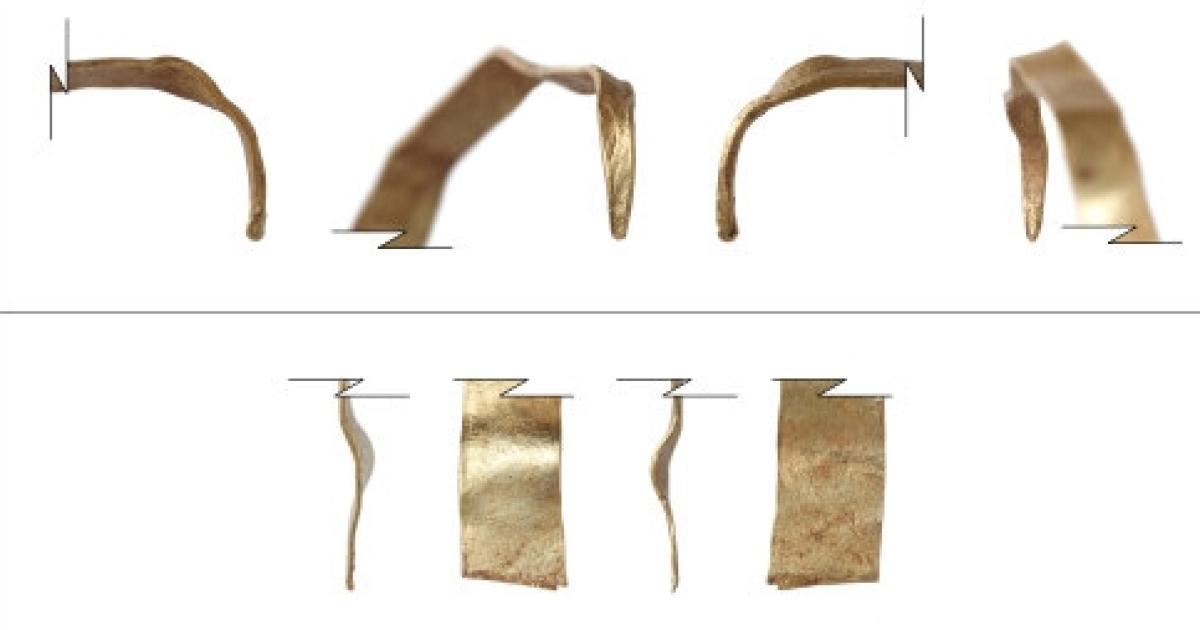
The delicate gold ribbon, found near Hilborough, has been identified by experts as dating from the Middle to Late Bronze Age and is thought to have once formed part of an ornate bracelet or neck torc worn more than 3,000 years ago.

The discovery was made by Paul Davis on September 20, 2025, while metal detecting with the permission of the landowner.
At a treasure inquest held at Norfolk Coroner’s Court, Maeve Sykes, the assistant coroner, formally ruled that the artefact met the legal definition of treasure under the Treasure Act 1996.
An expert report prepared for the British Museum concluded the object qualified because of both its age and its precious metal content, while Norwich Castle Museum has already expressed an interest in acquiring the piece for its collections.

The fragment consists of a long, flat strip of hammered gold which still retains a gentle curve. Experts believe it is most likely part of a large penannular bracelet or torc, although it could equally represent one end of a ribbon torc dating to the Late Bronze Age.
The object weighs just 4.26 grams and is remarkably thin, measuring approximately 0.2mm thick for much of its length, increasing to around 0.9mm in places. It has neatly squared, hammered edges and tapers to a squared-off point, suggesting it once formed part of a carefully crafted piece of prehistoric jewellery.
In a report submitted to the coroner, the British Museum said ribbon-shaped gold ornaments are known from Britain’s Bronze Age and were used to create a variety of decorative objects, including torcs, bracelets and smaller fittings.
The report concluded the fragment dates to between approximately 1400BC and 700BC, placing it firmly within the Middle to Late Bronze Age.

Under the Treasure Act 1996, objects more than 300 years old which contain at least 10pc precious metal are legally defined as treasure. The Hilborough find satisfies both criteria.
The declaration means museums now have the opportunity to acquire the object before it can be returned to the finder and landowner.
Norwich Castle Museum has already indicated it wishes to add the rare artefact to its nationally important archaeology collections, allowing it to be preserved and displayed for the public.
Should the museum proceed, the fragment would become part of a collection that tells the story of Norfolk’s rich prehistoric past and its importance during the Bronze Age, when skilled metalworkers produced elaborate gold jewellery and ceremonial objects.
Discoveries such as this remain comparatively uncommon.
While Norfolk has long been recognised as one of Britain’s richest archaeological landscapes, genuine prehistoric gold finds are rare and provide valuable evidence of the wealth, craftsmanship and social status of communities living thousands of years before the Roman occupation.

Metal detecting has played an increasingly important role in uncovering previously unknown archaeological objects, with finds reported through the Portable Antiquities Scheme helping historians build a more complete picture of Britain’s past.
The Treasure Act ensures nationally significant discoveries are properly recorded and gives museums the first opportunity to acquire them for future generations.
Following the evidence presented at the hearing, Ms Sykes confirmed the gold ribbon constitutes treasure.
The next stage of the process will determine whether Norwich Castle Museum acquires the artefact.