
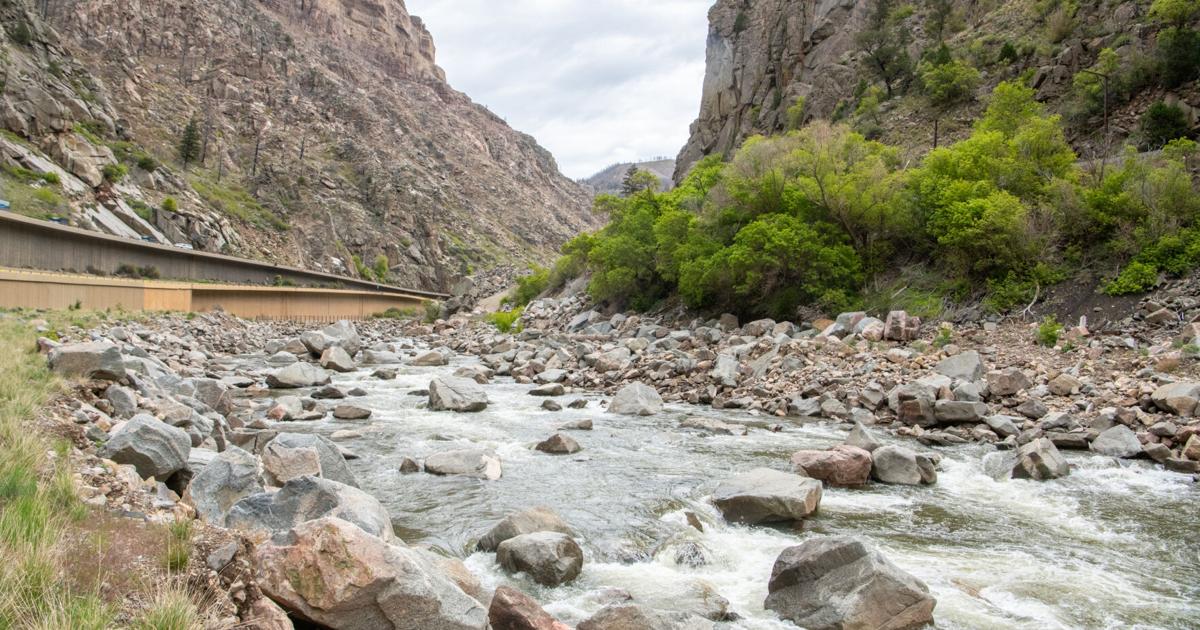

The Colorado River at Glenwood Springs was running at 44% of average on Thursday. The Colorado River Basin’s forecasted inflows to Lake Powell in Utah are currently just 13% of average, the lowest on record.
Featuring a panel of water managers and conservationists, Aspen Journalism on Wednesday co-sponsored an event examining what this year’s drought conditions mean for the Colorado River Basin.
“We’ve never seen a year like this before,” said panelist Raquel Flinker, displaying a graphic showing the water year (October to March) as “the hottest year we’ve seen on record.” Flinker is the director of interstate and regional water resources for the Colorado River District.
The “Confronting Scarcity on the Colorado River” panel discussion was held at Colorado Mesa University in collaboration with the Ruth Powell Hutchins Water Center.
As of Thursday, the entirety of Pitkin County remained in the “exceptional drought” category, according to the U.S. Drought Monitor. That’s the worst category of the drought classifications.
The dark red “exceptional drought” blob currently covers all of or part of 16 counties in the northwest quadrant of the state. The data used to update the map only goes through Tuesday, not taking into account Wednesday’s storms.
However, next week’s updated map is unlikely to change Pitkin County’s drought status as the storm’s biggest precipitation benefits hit the northern Front Range, the Foothills and the area around Estes Park, which saw about 2 feet of snow and two inches of measurable water precipitation, or “liquid water.”
The gauge at the Aspen-Pitkin County Airport measured 0.2 inches of liquid water as a result of Wednesday’s storm, according to the National Weather Service.
Amid the sentiments most used to describe this year’s water supply outlook — “dire, scary, bleak and unprecedented” — there is room for a tiny bit of optimism, according to weather watchers.
The snow that fell across Colorado on Wednesday — preceded by a longer period of cooler temperatures with sporadic rain, snow, sleet and hail — provided some relative good news and drought relief.
“We have emerged out of record low snowpack,” Colorado State Climatologist Russ Schumacher at Thursday’s online meeting of the state’s Drought Task Force. “It’s cause for very minor celebration — but we are still way below average.”
Statewide, Schumacher said snowpack is now about 26% of average, better than where it was last week, at around 18%.
“In March, things looked extremely bad,” Flinker said at the panel discussion, with snowpack at half of the lowest low in more than 100 years of data.
On Wednesday, snowpack “actually met the historical low … which is good — relatively speaking,” Flinker said, showing a graphic with the black line of 2026 intersecting the red line indicating the previous record low.
In addition, while it was thought that the Colorado River hit peak flows at the end of March, “We might peak again,” she said.
Again, that’s only good news in relative terms, Flinker emphasized.
The late March potential peak flow was measured at about 2,500 cubic feet per second (cfs), Flinker said, far below the median peak flow of about 19,000 cfs.
“Who knows … with the snow we got today and yesterday there’s a chance we might go beyond 2,500 cfs.”
The Colorado River Basin’s forecasted inflows to Utah’s Lake Powell, currently at 13% of average, Schumacher said, are still at the lowest on record.
The latest water supply forecast for the Roaring Fork River at Glenwood showed the river at 33% of average.
Those numbers also don’t account for Wednesday’s storm, Schumacher said, which likely provided a small boost.
“We have some reasonably good news lately, but these numbers are still really bad.”
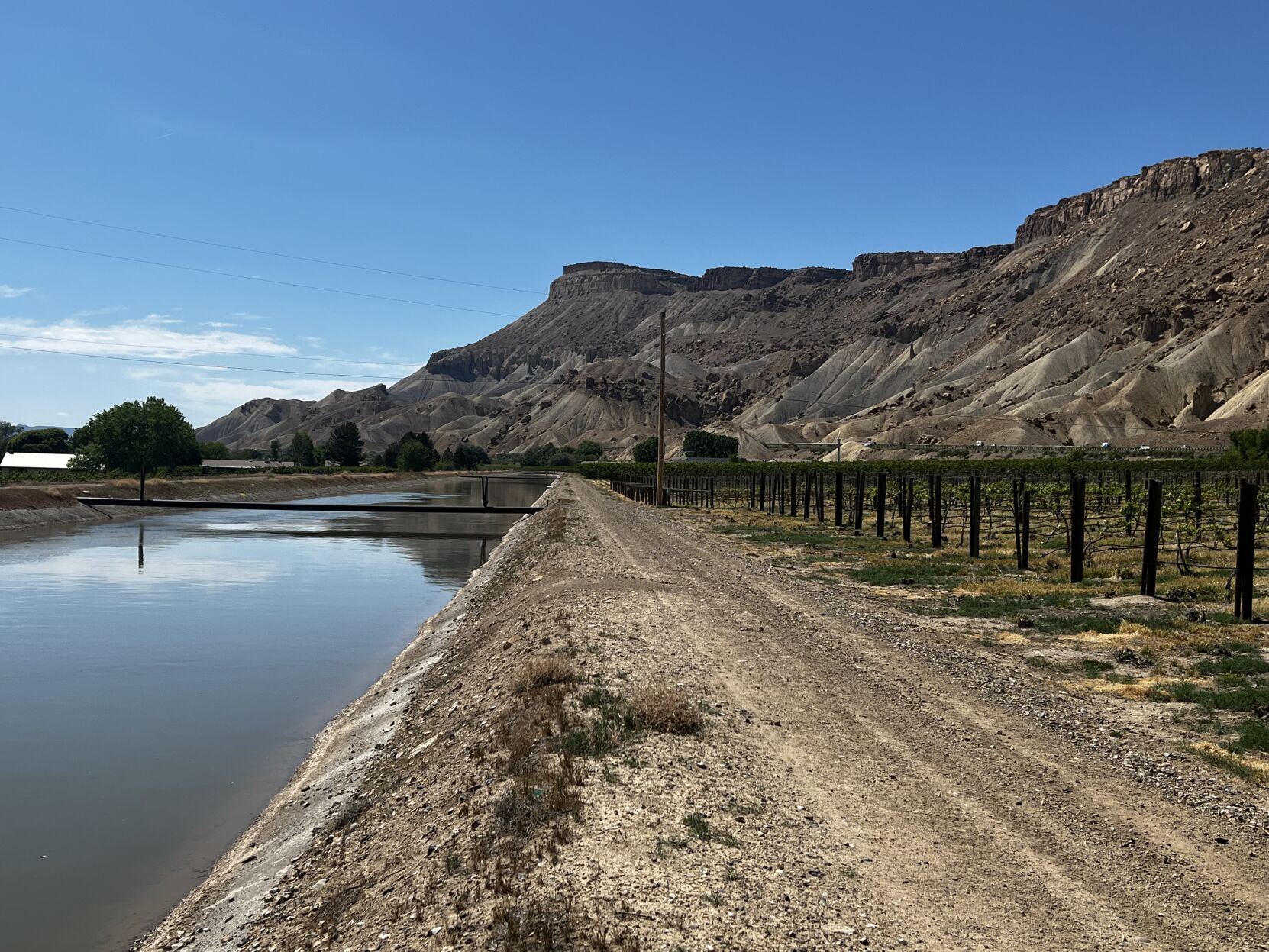
The Government Highline Canal, pictured on Thursday in Palisade, delivers irrigation water from the Colorado River to over 23,000 acres of agricultural land around Grand Junction and Fruita. Canal managers fear it may run dry this year due to extremely low stream-flow forecasts for the Colorado River.
Grand Valley prepares
The prospect of the Government Highline Canal running dry is a very real possibility, Tina Bergonzini said during Wednesday’s panel discussion.
Bergonzini is the general manager of the Grand Valley Water Users Association, which includes the Cameo Diversion Dam and 55 miles of the Government Highline Canal. The canal diverts water from the Colorado River to support agriculture around Grand Junction and Fruita.
“We could be looking at a dry canal this year, and it’s more than just irrigation that will suffer if the canal goes dry,” Bergonzini said.
Municipal water supplies take a hit when there is no water for irrigation, she said. “We are really working hard with our water users in being as responsible with water as we can,” she said.
“It’s pretty grim out there,” said Ben Hoffman, water treatment superintendent and operator for the Ute Water Conservancy District. Hoffman’s district is the largest domestic water provider on the Western Slope, serving more than 88,000 residents in Mesa County.
Hoffman talked about purchasing additional water from Ruedi Reservoir this year and “using our entire water portfolio to really try to not only be OK as a community this year — but we need to make it through next year, and the year after that … it’s going to be challenging.”
Hoffman said Ruedi water is considered an emergency source for his district, though it will likely at some point become a primary source, seeing as they’ve used it three out of the past six years.
“Someday, we intend to and will probably need to use that water on a more routine basis,” he said.
As of Thursday, Ruedi measured 64.6% full.
“We are in the red light flashing emergency zone,” described American Rivers Southwest Regional Director Matt Rice of the state of the Colorado River water supply and efforts to protect power infrastructure on Lake Powell.
The release of up to 1 million acre feet of water from Flaming Gorge Reservoir to avoid a “minimum power pool crisis” at Glen Canyon Dam is a “very short thinking solution,” Flinker said.
Hoffman and other panelists talked about the things they are doing on a personal level — like taking shorter showers and replacing turf lawns with native landscaping.
For water users under Bergonzini’s purview, “I can’t tell you what to do with your lawn. I can just ask you to make the best decision for yourself and for the community,” she said. “Our goal is to save the agricultural economy and infrastructure and way of life which folks have become accustomed to — while utilizing the opportunity to learn and all figure out what we’d better do if this drier climate is our future.”
On conversation efforts, results have been mixed, according to the panelists.
For one, there’s a participation problem with the Colorado River District’s conservation program that includes exactly zero participants among eastern slope water uses.
There’s also the bigger picture reality. As the seven Colorado River Compact states continue contentious negotiations, any conservation efforts in Colorado will be only a “drop in the bucket,” noted Bergonzini.

Aspen Journalism hosted a panel discussion, “Confronting Scarcity on the Colorado River,” on Wednesday in Grand Junction at Colorado Mesa University. The event was a collaboration with the Ruth Powell Hutchins Water Center.
With the lower Colorado River Basin states (Arizona, California and Nevada) consistently using far more water than allocated and remaining reliant on the reservoirs as their savings account — Bergonzini said conservation efforts curtailing agricultural use in western Colorado will have a negligible impact until “the lower basin states commit to reducing usage.”
Rice said conservation programs have complicated data results and are “not a silver bullet.”
For example, letting a field go dry for one season can mean taking four subsequent years to return to previous growing conditions, said Rice.
Still, he noted a conservation program of upper basin sites is inevitable given the challenging and unresolved compact negotiations.
With “room to improve,” Hoffman noted that his district’s water users have reduced their average daily domestic water usage by about 30% over the past 50 years.
On how this year’s low water will impact fish health and what can be done to mitigate negative impacts, “It’s such a challenging year,” Rice said.
“There’s just no water. … We are not going to get out of a year like this unless we work together.”
Litigation over every drop won’t solve the basin’s water woes, Rice added.
Flinker echoed the importance of collaboration, especially if severe drought years become a frequent occurrence.
“Working together is going to be the only way forward,” she said.
Bergonzini said her water users are using every tool they can to protect fish health, but this year, it is “not a management issue — it’s a supply issue.”
Asked about engaging the public, Bergonzini urged people to educate themselves and not take water availability for granted.
“When you lose sight of the value of water as a resource — that’s the first step to losing it,” she said.
Show up to meetings and talk to your neighbors, Hoffman said.
“Know where your water comes from,” advised Flinker.
Extreme heat returns
In terms of the weather ahead, many locations in Colorado next could come close to record high temperatures, Schumacher said.
And, the early summer forecast is leaning toward below average precipitation, though varying in different parts of the state.
“The precipitation over the last few days was great,” he said. “It will boost soil moisture and the remaining snowpack levels and give a bump to streamflow.”
However, Schumacher continued, any added snowpack isn’t going to stick around for long.
On Friday, the Snotel monitoring site on Independence Pass showed 0.4 inches of snow water equivalent, which is 3% of the May 8 median.
The Willow Creek Pass Snotel site on Friday, located near Grand Lake, showed 8 inches of snow water equivalent, 54% of May 8 median and the highest percentage of median for Snotel sites in the Upper Colorado River Basin.
The Schofield Pass site near the Crystal River headwaters on Friday was at 28% of median.
“We are certainly very happy for any moisture — but it doesn’t come anywhere close to making up for the deficit we’ve had. The river flows are extremely low going into summer, and we expect significant drought impacts.”
But, he added, the forecast calling for an active monsoon season and strong El Nino “give some reason for optimism in the longer term,” and hopefully not a “multi-year, punishing drought.”
In the near term, Aspen residents can put away snow boots and bring out the flip-flops.
According to the National Weather Service’s forecast as of Friday, Aspen on Monday will see a high of 80 degrees Fahrenheit — and highs of 84 degrees on Tuesday and 83 degrees on Wednesday.