
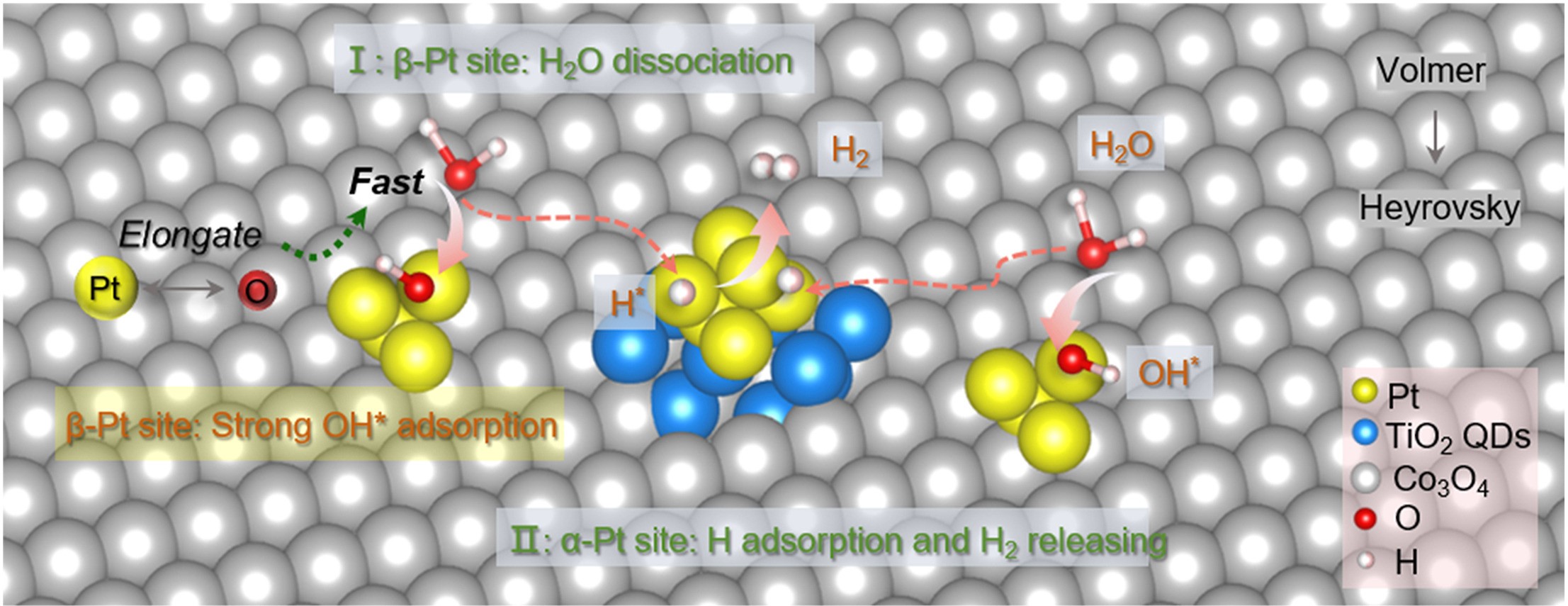
Alkaline water electrolysis is attractive for large-scale hydrogen production because it can use less corrosive electrolytes and may be compatible with lower-cost device components. However, even platinum (Pt), the benchmark HER catalyst, performs much more slowly in alkaline media than in acidic conditions because water molecules must first be dissociated before hydrogen can form. Conventional catalyst design often focuses on single active sites, making it difficult to balance water activation and hydrogen binding at the same time. Due to these challenges, further research is needed to regulate the electronic structure of Pt and design multifunctional oxide supports for alkaline hydrogen production.
A research team from Jilin University, Xi’an Technological University, the University of Waterloo, the University of Saskatchewan, and the Institute of High Energy Physics, Chinese Academy of Sciences, reported the study, published (DOI: 10.1016/j.esci.2025.100461) online in May 2026, in eScience. The work presents a TiO₂ QDs/Co₃O₄ symbiotic oxide support that precisely regulates Pt clusters for alkaline HER, improving both catalytic activity and operational durability in an anion exchange membrane water electrolyzer (AEMWE).
The team introduced TiO₂ QDs into a Co₃O₄-based support and then anchored Pt clusters onto the resulting oxide–oxide interface. Spectroscopic analyses and density functional theory (DFT) calculations showed that the strong interaction between TiO₂ QDs and Co₃O₄ redistributed electrons in the Pt 5d orbitals, producing two types of active sites. The β-Pt–O–Co sites promoted water adsorption and dissociation, while the α-Pt–O–Ti sites favored hydrogen adsorption and release. This division of labor helped overcome the usual trade-off between water splitting and hydrogen binding. Electrochemical tests in potassium hydroxide (KOH) solution showed that Pt/QDs/Co₃O₄ required only 19 mV overpotential at 10 mA cm⁻², lower than commercial Pt/C. At an overpotential of 200 mV, its Pt mass activity was 2.17 times higher than that of commercial Pt/C. In an AEMWE device, the catalyst reached 500 mA cm⁻² at 1.78 V and operated continuously for more than 500 hours.
The authors said the work shows that catalyst supports should not be treated as passive platforms. By engineering the oxide interface, they said, the electronic structure of Pt can be tuned with unusual precision, allowing different Pt sites to take on different tasks during hydrogen generation. They added that this strategy may help bridge the gap between atomic-level catalyst design and practical electrolyzer operation, especially under alkaline conditions where water activation remains a major kinetic bottleneck.
The findings point to a broader design principle for high-efficiency electrocatalysts: building supports that actively shape the electronic environment of metal sites. Because the same support concept also improved ruthenium (Ru)-based catalysts, the approach may extend beyond Pt and offer a general route for designing lower-loading, higher-performance hydrogen catalysts. For industry, the combination of high activity, long-term stability, and device-level validation is especially important. The study provides a practical framework for developing alkaline water electrolysis systems that use precious metals more efficiently while moving closer to durable, scalable clean hydrogen production.
###
References
DOI
Original Source URL
https://doi.org/10.1016/j.esci.2025.100461
Funding information
The support from the National Natural Science Foundation of China (Nos. 51872115 and 22209128) and Jilin University Sci & Tech Outcome – Concept Validation Project (No. 2025GN010) are greatly acknowledged.
About eScience
eScience – a Diamond Open Access journal cooperated with KeAi and published online at ScienceDirect. eScience is founded by Nankai University (China) in 2021 and aims to publish high quality academic papers on the latest and finest scientific and technological research in interdisciplinary fields related to energy, electrochemistry, electronics, and environment. eScience provides insights, innovation and imagination for these fields by built consecutive discovery and invention. Now eScience has been indexed by SCIE, EI, CAS, Scopus and DOAJ. Its impact factor is 36.6, which is ranked first in the field of electrochemistry.