Last Updated:
While Google Pay & PhonePe do not charge a separate transaction fee for international payments, users may still incur costs through their banks. These come in the form of a mark-up




The rollout in South Korea is focused on areas frequented by international visitors such as retail stores, restaurants, cafes, and tourist hubs where QR-based payments are widely accepted.
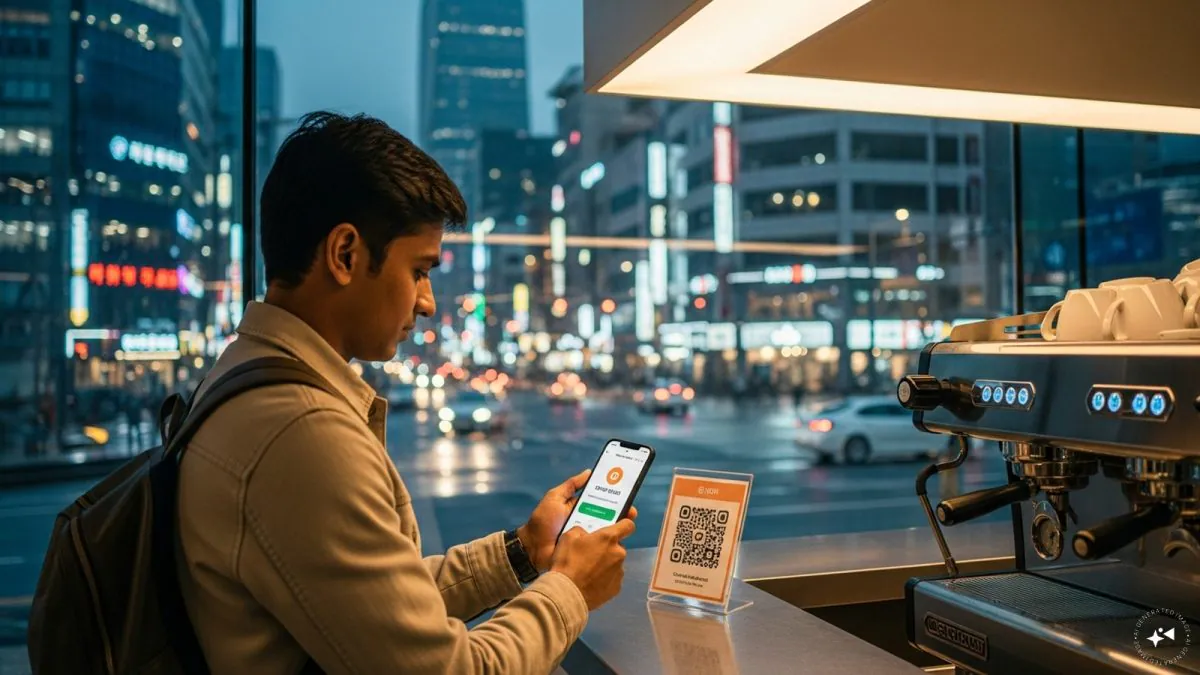
With Indian travellers now able to use the Unified Payments Interface (UPI) in South Korea by simply scanning QR codes, the move marks not just a convenience upgrade but also India’s growing ambition to expand its digital public infrastructure and reshape how its citizens transact globally.
Both India and South Korea have signed a Memorandum of Understanding (MoU) to link their electronic payment systems using UPI-based QR codes at participating merchants. In return, South Korean visitors to India will be able to use their domestic QR payment systems for transactions.
How UPI Works Abroad For Indian Users
For Indian travellers, using UPI internationally is designed to feel almost identical to using it at home. Payments are made by scanning a QR code at participating merchants, with the transaction debited directly from the user’s linked bank account in India.
Behind the scenes, however, the system is more complex. Cross-border UPI transactions rely on partnerships between India’s payments network and local payment systems in the host country. These integrations ensure that when a user scans a QR code in South Korea, the system can process the payment in Korean won while deducting the equivalent amount in Indian rupees.
The appeal lies in familiarity. Travellers no longer need to navigate unfamiliar payment methods or carry large amounts of cash, reducing friction in everyday spending.
Where Can You Use UPI In South Korea?
The rollout in South Korea is focused on areas most frequented by international visitors. This includes retail stores, restaurants, cafes, and select tourist hubs where QR-based payments are already widely accepted.
South Korea’s advanced digital payments ecosystem makes it a natural fit for UPI integration. Many merchants already use QR-enabled systems, allowing relatively seamless adoption.
“The international expansion of UPI into South Korea is built on its integration with ZeroPay, enabling Indian travellers to access a wide and practical acceptance network across everyday use cases…This ensures that travellers can seamlessly make day-to-day purchases, from groceries to souvenirs, without relying on cash. The food and beverage (F&B) ecosystem is another key area of strong adoption…UPI also extends into transport and public infrastructure, reflecting the depth of South Korea’s digital payments ecosystem. This transforms UPI from a mere payment option into a comprehensive travel utility tool,” says Rohit Mahajan, Founder & CEO, plutos ONE — a licencsed Bharat Bill Payment System Technical Service Provider and fintech start-up.
More than 187,000 Indians visited South Korea between January and November 2025, said Myong Kil Yun, regional director for India and SAARC countries at Korea Tourism Organization. According to the agency, the number would have crossed 200,000 by the year-end.
How Much Is The Cost, Limit, And Currency Conversion Rate?
One of the biggest questions for travellers is cost. While UPI transactions themselves are typically free within India, international usage involves currency conversion and, in some cases, nominal fees.
While UPI apps such as Google Pay and PhonePe do not charge a separate transaction fee for international payments, users may still incur costs through their banks. These typically come in the form of a foreign exchange mark-up applied during currency conversion.
According to Extravelmoney, the overall charges can include a transfer fee of 2.5%, an exchange rate mark-up of about 2%, and additional conversion charges ranging between 3% and 5%. This mark-up is added over the wholesale exchange rate and is how banks and payment networks earn from cross-border transactions.
In terms of limits, international UPI payments broadly follow domestic thresholds, with some variations. The standard per-transaction cap for most UPI payments is Rs 1 lakh, which generally applies to payments made by Indian users to foreign merchants as well.
However, the National Payments Corporation of India (NPCI) has increased limits for certain high-value categories. In some cases, such as foreign remittances, the cap can go up to Rs 2 lakh. From September 15, 2025, NPCI raised the per-transaction limit to Rs 5 lakh for categories like travel, insurance, and credit card bill payments, with a daily cumulative cap of Rs 10 lakh.
UPI’s international footprint is also expanding steadily and is currently available in countries including Singapore, the UAE, Nepal, Bhutan, Mauritius, and France.
Could UPI Replace Forex Cards And Credit Cards?
For many Indian travellers, forex cards and international debit or credit cards have long been the default options abroad. These come with their own challenges such as hidden fees, currency conversion charges, and the need to preload or manage balances.
UPI simplifies this by linking directly to a bank account, eliminating the need for preloading. It also offers real-time transaction visibility, which can help users track spending more effectively.
“With about 200,000 Indian tourists travelling to South Korea in 2025 and growing, UPI is reducing the number of times that Indian tourists use currency cards and credit cards. UPI allows for instant currency conversion, thus eliminating the cost of converting currency and making the travel experience more convenient for younger and digitally savvy Indian tourists,” says Ravi Gosain, President of the Indian Association of Tour Operators (IATO).
What Method Works Better In Which Country?
UAE
UPI is available in the UAE through a partnership between NIPL and NeoPay, a subsidiary of Mashreq Bank. Indian users can pay at outlets with NeoPay terminals, though coverage is still limited. Indian travellers can still carry a forex card as a back-up.
Bhutan And Nepal
Bhutan was among the first countries to adopt UPI in 2021, followed by Nepal in 2022 through partnerships with local payment operators. UPI usage here is relatively seamless, aided by stable exchange rates — Rs 1 equals BTN 1 and about NPR 1.5 — making spending easier for Indian travellers.
BENELUX & Switzerland
UPI has been enabled in Belgium, the Netherlands, Luxembourg, and Switzerland via a collaboration with European payment services provider Worldline. Payments are QR-based, but adoption remains limited, so a forex card is still recommended.
France
UPI is gradually expanding in France, with availability at select tourist spots like the Eiffel Tower. However, usage is still limited. Forex cards or zero-mark-up credit cards remain more reliable options for most transactions.
Singapore
UPI was linked with Singapore’s PayNow system in February 2023, enabling instantaneous payments and low-cost cross-border fund transfers between the two countries. The linkage is a joint initiative by the Reserve Bank of India (RBI) and the Monetary Authority of Singapore (MAS). Travellers can use UPI at many retail outlets and tourist locations by scanning QR codes, with real-time currency conversion shown before payment.
How India Is Expanding Its UPI Footprint Globally
South Korea is the latest addition to a growing list of countries where UPI is gaining acceptance. This expansion is part of a broader strategy to position UPI as a global payments standard, particularly in regions with strong travel and trade links to India. UPI processes over 18 billion transactions monthly domestically, which marks a 32% year-on-year growth — one of the largest real-time payment systems in the world.
Currently, UPI powers 85% of all digital transactions in India and nearly 50% of all real-time digital payments globally, according to the International Monetary Fund (IMF) report.
Exporting this system allows India to extend its influence in the global fintech ecosystem while offering tangible benefits to its citizens abroad.
How Does Cross-Border UPI Actually Work?
At its core, cross-border UPI is about interoperability, which is a standards-based approach to enable different IT systems to exchange data and share functionality with minimal user intervention. Interoperability plays a major role in healthcare, government and public safety.
In context of UPI, interoperability works with India’s payment system connecting with foreign networks through bilateral agreements and technical integrations.
When an Indian user scans a QR code abroad, the system authenticates their bank account in India, converts the amount at real-time exchange rates, checks regulatory compliance, and completes the payment to the foreign merchant within seconds.
For merchants, these systems offer a single integration that supports UPI alongside cards and local wallets, making it easier to accept multiple payment methods without complex set-ups.
“Interoperability of UPI is accomplished by Indian tourist association NPCI International working with the payment systems of South Korea. Thus, UPI allows for QR payments by Indian tourists in South Korea. The back-end converts currency and handles settlement. Tourists will have a simple scan-and-pay process to pay when they are travelling to South Korea,” explains Gosain.
Security remains a key focus. Tokenisation helps protect financial data during cross-border transactions, while multi-factor authentication and encryption standards ensure payments are authorised and safeguarded against fraud.
Users can typically choose whether to pay in Indian rupees or the local currency, with exchange rates shown upfront. This transparency is particularly useful for travellers and low-cost remittance use cases.
For businesses, choosing the right payment partner depends on factors such as geographic coverage, regulatory compliance, settlement speed, and ease of integration.
Security remains a key component. UPI transactions continue to require authentication through PINs or biometric verification, maintaining the same safeguards used domestically.
UPI’s expansion into South Korea is part of a larger story about India’s growing digital influence. By exporting its payments infrastructure, India is not just enabling transactions, it is setting standards.
As more countries integrate with UPI, the possibility of a globally interoperable, real-time payments network becomes more tangible. For India, this strengthens both economic and strategic ties, while reinforcing its position as a leader in digital innovation.
April 27, 2026, 11:47 IST

Stay Ahead, Read Faster
Scan the QR code to download the News18 app and enjoy a seamless news experience anytime, anywhere.