
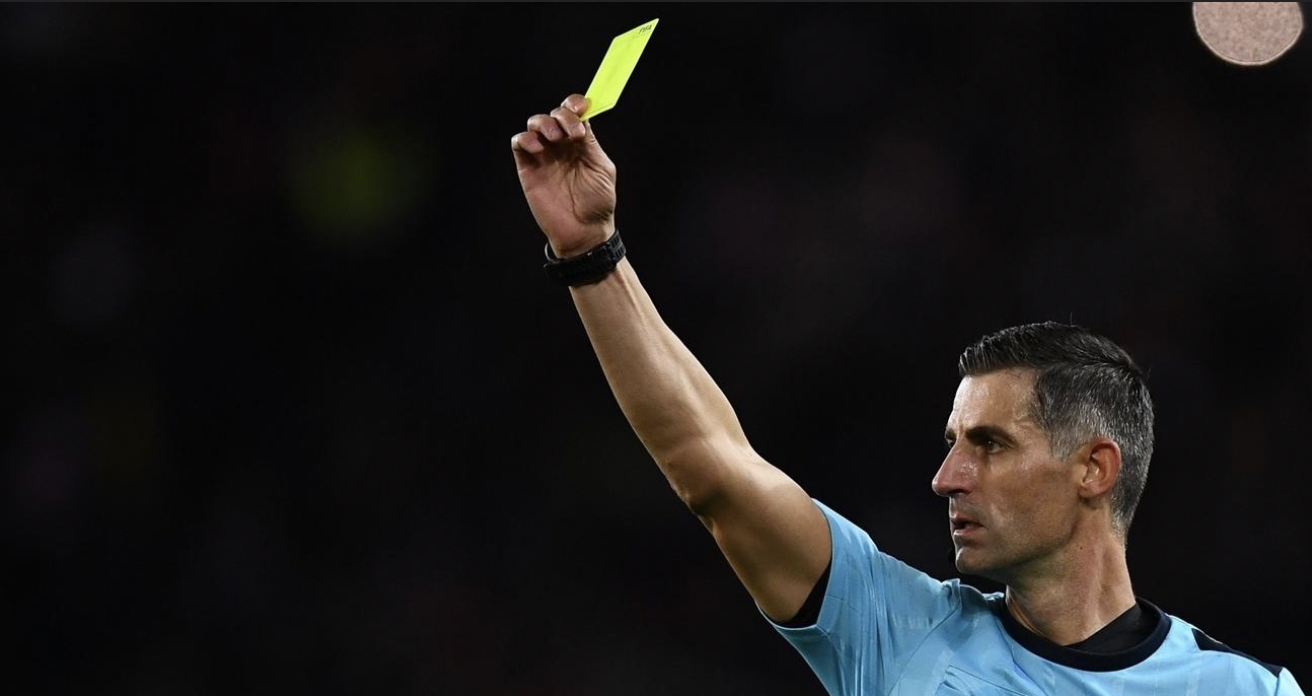
Year after year, betting offers keep growing: more and more markets, more and more events to monetize, but betting on a yellow card is no longer betting on sport.
By Kornelija Tiesnesyte, advisor to the Lithuanian anti-doping agency and chair of the Follow-up Committee of the Macolin Convention.
This month, The Athletic reported that at least two players at the FIFA World Cup were flagged to their national federations after unusual betting on yellow cards.
The bookings came in league matches, not at the tournament. In one case, large bets had been placed on a player being shown a card in the first half. Soon after, he committed three fouls in under five minutes and was booked.
Those of us who monitor sports betting see these alerts arrive all the time. So instead of asking how to watch the yellow-card market more closely, we should ask a different question: why do we still allow it?
Betting on a yellow card is no longer betting on sport. Not on talent, not on performance, not on the result of a match. It is betting on a punishment. On a player pulling off his shirt after a goal. On a foul that any player can commit in a second, without changing the score.
More match-fixing alerts than ever before
Detection has never been higher: more than a thousand football matches were flagged as suspicious in 2025. But detecting is not proving. How do you show that a card taken to waste time was meant to settle a bet, not just tactics on the pitch? In the logbook of the Group of Copenhagen, the Council of Europe’s international network for monitoring suspicious betting, alerts tied to yellow cards rose from four in 2024 to twenty-four in 2025. Most lead nowhere. Detecting without being able to act does not protect sport. It only records the damage.
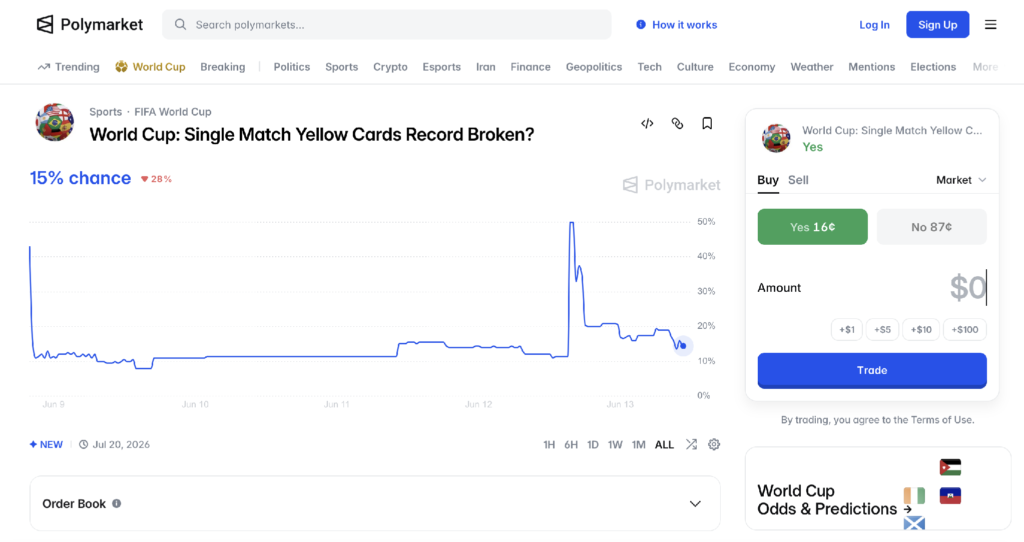
On June 9, Polymarket, a controversial American prediction market site, was taking bets on whether this World Cup would break the record for yellow cards in a single match: sixteen, set by Germany and Cameroon in 2002 and matched by Portugal and the Netherlands in 2006. Do we really want a match falling apart into a brawl to become a betting opportunity?
Some in the betting industry argue that banning yellow-card bets would only push bettors toward illegal operators. The evidence points the other way. Finland, France, Germany, the Netherlands, Portugal and Switzerland already ban so-called “negative bets,” including bets on yellow cards. In France, this has not slowed the market: sports betting turnover grew thirtyfold between 2010 and 2025, while the illegal market stayed marginal. Drawing this line has driven no one away.
And these markets bring in almost nothing. A recent study presented to the World Lotteries Association found that yellow-card betting makes up just 0.2 percent of the revenue of the operators who offer it. These bets could vanish tomorrow at almost no cost to operators. What would vanish with them is one of the easiest openings for the criminals who fix matches and bet on them.
The Follow-up Committee of the Macolin Convention has just published guidelines on reasonable betting: plain criteria to help regulators weigh the risk of each type of bet and rule out the most dangerous ones.
This is not a crusade against betting. It is a call for proportion and common sense.
Because this goes beyond yellow cards. Year after year, the offer keeps growing: more and more markets, more and more events to monetise, more and more moments turned into bets. But a yellow card is not a market.
The question is not whether better tools will let us detect these bets. The question is why we keep allowing them. The whole world is watching the same match.
It is time to draw the line.
Josimar regularly opens its columns to independent guest contributors who wish to comment on the most pressing issues in world football. These columns solely reflect the opinion of their authors. Their publication does not constitute an endorsement on Josimar’s behalf, but a way to encourage and promote debate within the football community.