
Crystal Palace will have a good chance of winning the UEFA Conference League on Wednesday, when they face Spanish side Rayo Vallecano in the final to be played in Leipzig’s Red Bull Arena.
Given that English clubs have been victorious in this competition twice in the last three years, this would not really come as a huge surprise, but for Palace it would be a huge achievement, as it would only be the second major trophy that the Eagles have won in their history.
This follows a memorable day a year ago when Palace won the FA Cup after a shock 1-0 victory against the overwhelming favourites Manchester City. A goal from Eberechi Eze and a penalty save by Dean Henderson created “a seismic moment for both the club and South London”, according to Palace chairman Steve Parish.
Oliver Glasner led the team to this unprecedented success, followed up by victory in the Community Shield against Liverpool, so the Austrian is arguably the best manager in Palace’s history, a position that would be cemented with European silverware.
Unfortunately, Glasner has already announced that he will leave the club when his contract expires this summer. His replacement will have big shoes to fill.
It could have been even better for Palace if they had been allowed to take their place in the Europa League, but UEFA demoted them to the Conference League after ruling that the club had breached multi-club ownership regulations, a decision that was subsequently confirmed by CAS (the Court of Arbitration for Sport).
This was because John Textor, who owned a 43% stake in Palace at the time, also had a sizeable shareholding in Olympique Lyonnais, after the French club similarly qualified for the Europa League.
UEFA do not allow teams under the same ownership to play in the same competition, but OL took precedence over Palace, due to a higher finish in their domestic league.
Palace were understandably frustrated, arguing that the decision “shows that sporting merit is rendered meaningless”. They added, “our manager and players earned the right to play Europa League football, but we have been denied that opportunity.”
They certainly didn’t pull their punches: “It appears that certain clubs, organisations and individuals have a unique privilege and power.”
There was more, “This growing and unhealthy influence has shattered the hopes and dreams of Crystal Palace supporters, and does not bode well for aspirational teams all over Europe competing to progress when rules and sanctions are unevenly applied in the most flagrant way.”
The MCO dispute brought the question of Textor’s involvement in Palace to a head, culminating in the sale of his stake in June to New York Jets owner, Robert “Woody” Johnson, who is also a former US Ambassador to the UK.
Johnson becomes the club’s largest shareholder with 45%, while Josh Harris and David Blitzer each own 18%, and Steve Parish has 10%. However, importantly, the club is run by a general partnership model, whereby each of the four has 25% voting rights.
Given the various financial and regulatory difficulties experienced by other clubs in Textor’s Eagle Holdings group, namely Olympique Lyonnais, Brazilian club Botafogo and Belgian club RWD Molenbeek, Palace fans were probably not unhappy to see the back of the man that PSG president Nasser Al-Khelaifi described as a “cowboy”.
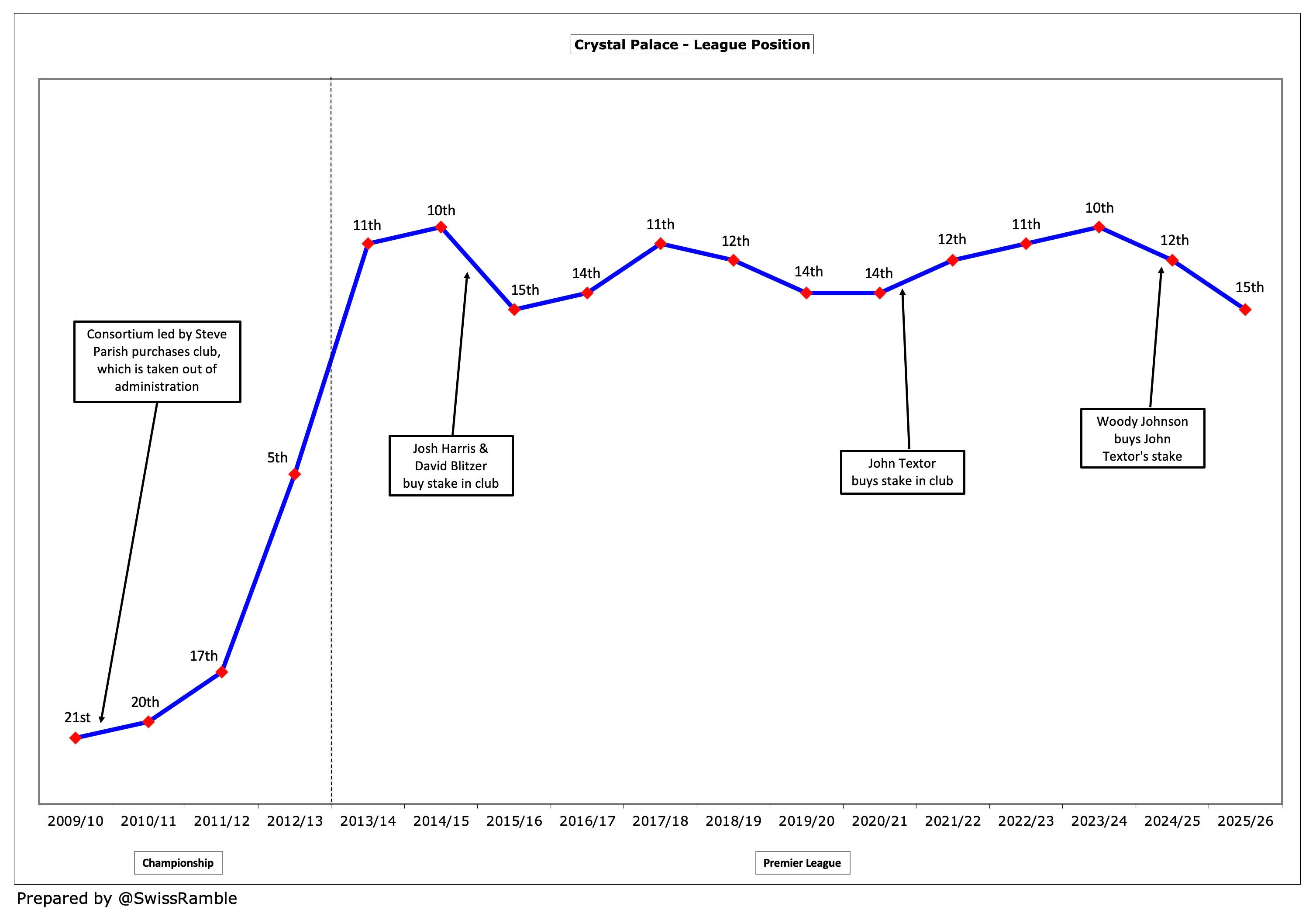
Palace’s recent improvement in cup competitions is impressive, but their consistency in the league is also fairly remarkable, especially for a club with relatively limited resources, as they have finished between 10th and 15th thirteen years in a row following promotion to the Premier League in 2012/13.
Parish described this as “testament to the club’s dedication and commitment to this long-term focus”.
Palace have clearly come a long way, as they had experienced some tough times financially, as noted by the chairman, “This club’s been in administration twice (in 1999 and 2010) – that’s an overriding concern, always. We need to make sure the club will be OK.”
Palace have set their sights on higher objectives since those dark days.
Parish again, “The club’s core strategy is to develop and improve the infrastructure of the club, increase revenues while building the strongest and most competitive squad possible with the goal of consistently challenging top teams in the Premier League, FA Cup, EFL Cup and European competitions.”
The obvious question is how a club of Palace’s size can legitimately aspire to mount such a challenge?
We shall look into the latest available accounts from the 2024/25 season to better understand their business model, identifying the club’s strengths and weaknesses.
In addition to the FA Cup win, Palace finished in 12th place in the Premier League in 2024/25, i.e. their customary mid-table position, though they set a new club record of 53 points. They also reached the quarter-finals of the Carabao Cup, where they were eliminated by Arsenal.
Palace also enjoyed a very successful season off the pitch, as they swung from a £32.9m pre-tax loss to an £8.3m profit, mainly due to a significant increase in profit on player sales from £1.3m to a club record £66.1m.
Revenue rose £6.4m (3%) from £190.2m to another club high of £196.6m, though this was more than wiped out by operating expenses, which grew £28.2m (13%) from £210.9m to £239.1m. As a result, the operating loss more than doubled from £20.7m to £42.5m.
In addition, net interest payable was up £1.5m (12%) from £13.6m to £15.1m.
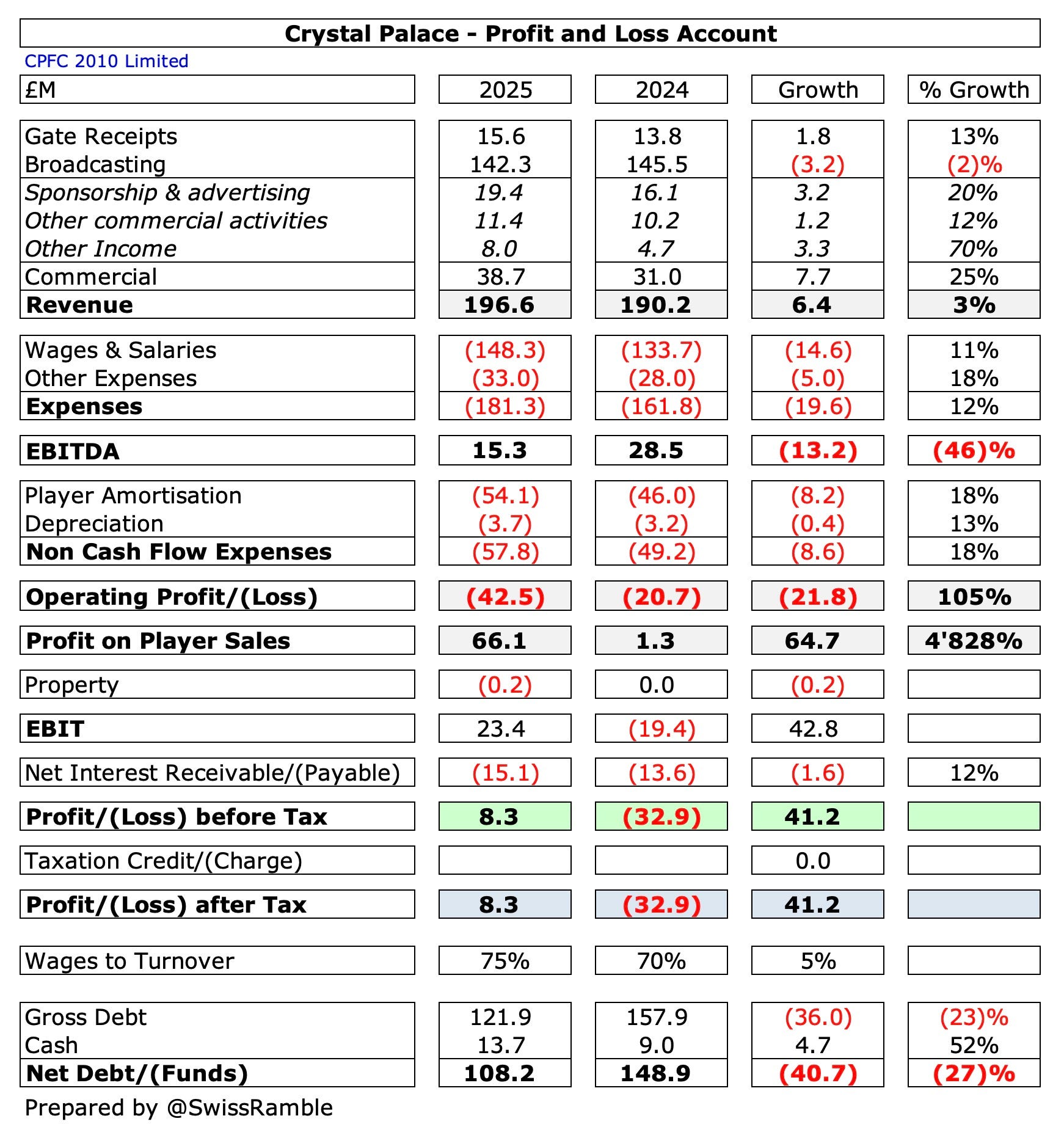
The revenue growth was driven by commercial, which rose £7.7m (25%) from £31.0m to £38.7m, while gate receipts increased £1.8m (13%) from £13.8m to £15.6m. On the other hand, broadcasting fell £3.2m (2%) from £145.5m to £142.3m, due to a lower league position.
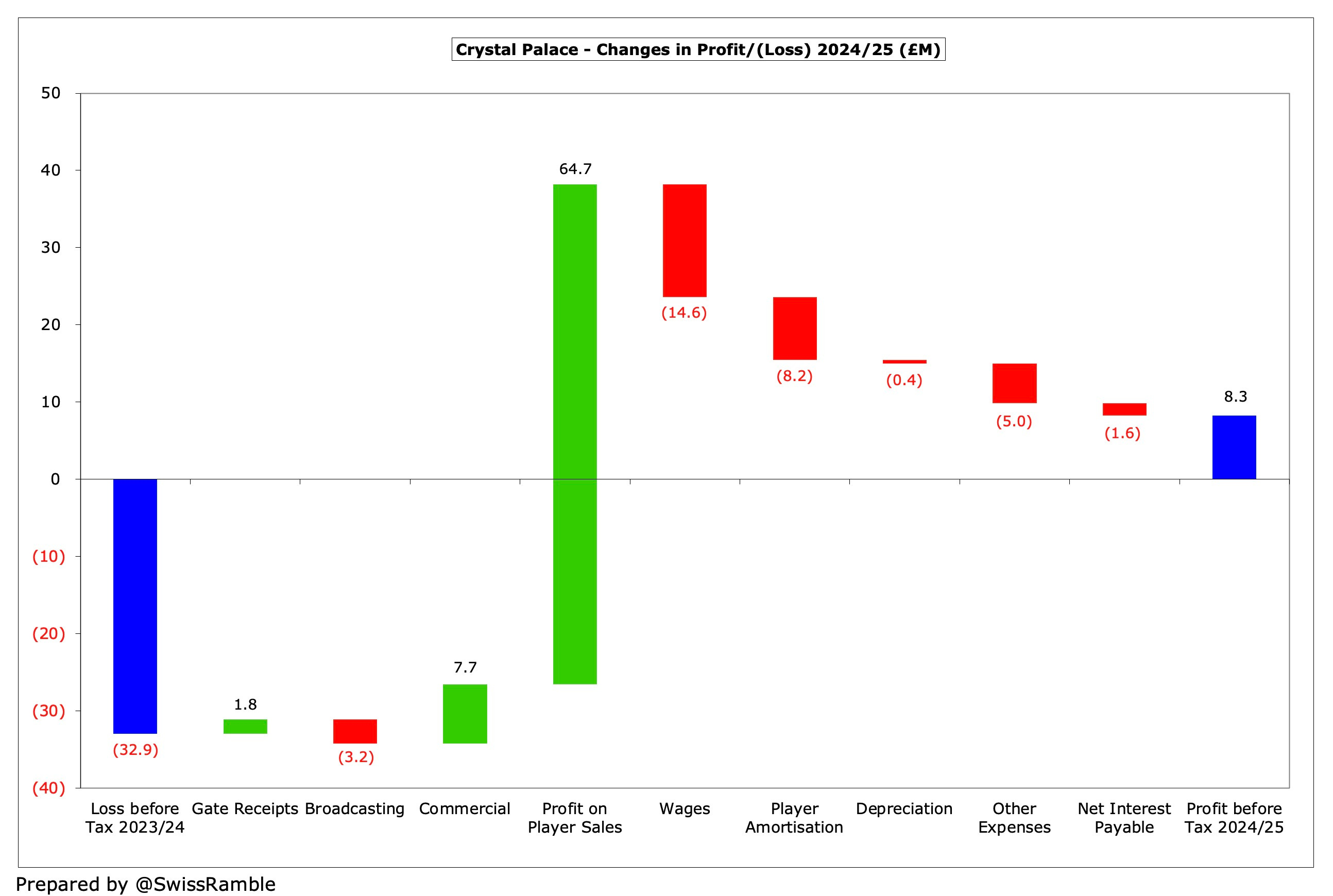
There was a steep rise in staff costs, as wages rose £14.6m (11%) from £133.7m to £148.3m and player amortisation increased £8.1m (18%) from £46.0m to £54.1m, both big new highs for the club.
In addition, other expenses were up £5.0m (18%), rising from £28.0m to £33.0m, while depreciation increased £0.5m (13%) from £3.2m to £3.7m.
Palace’s £8.3m pre-tax profit was effectively the third best result in the Premier League in 2024/25, only behind Liverpool and Bournemouth, who made £15m apiece.