
Politicians from the two biggest right-wing opposition parties and an Olympic committee head have been accused of being involved in taking gratifications from the head of the Zondacrypto cryptocurrency exchange in exchange for influence peddling.
In December 2025 Zondacrypto came under close scrutiny after customers began reporting being unable to access their funds. The firm, which advertised itself extensively in the Polish media and sponsored sporting events subsequently collapsed, with prosecutors now estimating the losses at at least 2.4 billion złoty (€553 million) and the company’s CEO Przemysław Kral going into hiding abroad before agreeing in May to cooperate with the investigation.
The firm’s assets are still being pursued following reports that they included bitcoins worth millions the keys to which were in the possession of the previous CEO and founder of the company who disappeared several years ago and has not been found since.
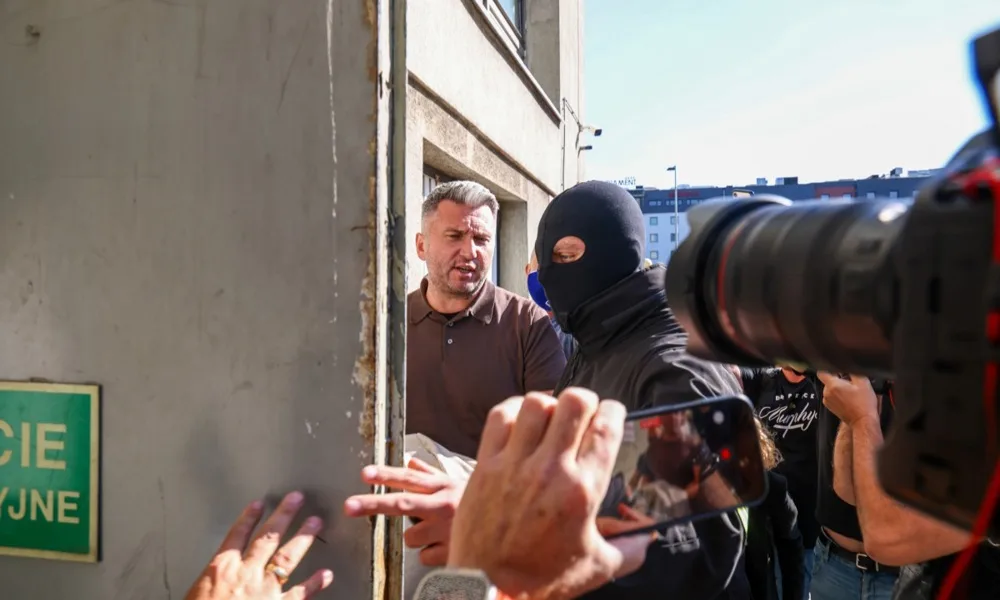
On August 27 the head of the Polish Olympic Committee (PKOl) Radosław Piesiewicz was detained after reports emerged that he had been given an expensive gold watch worth €40,000 by the head of Zondacrypto in exchange for influence peddling with the state consumer protection authority (UOKiK). He was charged the same day with paid protection and with satisfying one group of creditors to the detriment of others, and remanded in custody for three months on August 29.
The PKOl official denies the allegations and says he bought the watch with his own money, with Kral simply helping facilitate the purchase.
This year, as Zondacrypto fell into crisis, it emerged that the company had failed to provide promised bonuses to Polish athletes following the winter Olympics.
Prime Minister Donald Tusk, who leads Poland’s coalition government, announced on August 28 that he would ask the Sejm to vote again on overturning the presidential veto of legislation regulating the Polish cryptocurrency market, which has already been vetoed three times by President Karol Nawrocki.
Nawrocki has justified his vetoes of the government legislation by arguing that it goes beyond the contents of the EU’s Markets in Crypto-Assets (MiCA) regulation by giving extra and arbitrary powers to government officials.
But Tusk has suggested that the president might be connected to the Zondacrypto affair because, allegedly, the exchange had lobbied against the government’s legislation.
That has though been complicated by text messages published by conservative broadcaster TV Republika, whose editor-in-chief Tomasz Sakiewicz corresponded with Kral on December 6, 2025. They show that the head of Zondacrypto wanted the legislation signed rather than vetoed.
“That would have completely eliminated my competition in Poland,” Kral wrote.
But this has not stopped Tusk who has claimed that the events around the legislation suggest a scandal of gigantic proportions.
In his view, “this is no longer some ordinary bribe or one politician being bought off. It looks like a system, a well-organised system, in which the same names are appearing that we already know from other troubling cases.”
Tusk was referring to names of opposition politicians such as former Law and Justice (PiS) justice minister Zbigniew Ziobro, Michał Moskal MP who is a close ally of PiS leader Jarosław Kaczyński, a former minister Jacek Sasin as well as Przemysław Wipler from Confederation Liberty and Independence (Konfederacja) and in his remarks he attempted to conflate PiS with the affair.
“Today, there is no doubt that this grim business, this dirty business, was very closely connected with the entire PiS milieu, and the traces of financing and strange flows of money between this business and PiS-affiliated media and leading PiS politicians are becoming increasingly clear and increasingly disturbing,” said Tusk.
He further accused the former and present President as well as a past Prime Minister of having been beneficiaries of funding from Zondacrypto.
“You have caused a great deal of harm and got yourselves involved in a very dirty business. I am talking about all those who benefited from this money: former president [Andrzej Duda], current president [Karol Nawrocki], and former prime minister [Mateusz] Morawiecki,” he said.
In parliament in December 2025 Tusk warned that the crypto market was open to exploitation by foreign intelligence services and organised crime groups. Though no concrete evidence has thus far been produced of any Russian involvement.
PiS figures have denied any wrongdoing in relation to Zondacrypto arguing that no indictments have been produced against the party’s politicians. They also believe that the involvement of Tusk’s ally, the lawyer and MP Roman Giertych, in securing crown witness status for Kral means that the issue is being used to implicate political opponents and protect the government.
Though reports have appeared in the Polish media that there is evidence, maybe including recordings of conversations, of PiS MPs liaising with Kral over the legislative process involving the cryptocurrency market and allegations have appeared that money was being sought to fund party campaigns.
Thus far we only know for certain that Kral did fund a CPAC event during President Nawrocki’s successful election campaign and also provided funds to foundations run by Zbigniew Ziobro and Przemysław Wipler.
Nevertheless some on the political Right in Poland have accused their colleagues of having been naive.
Krzysztof Bosak, one of the leaders of Konfederacja, said on August 26 that he had been among those who warned colleagues about the exchange long before the affair reached the media.
Former security adviser to President Nawrocki Sławomir Cenckiewicz went further and said that he had repeatedly warned about Zondacrypto and that parts of the Right had been credulous. “Let this be a lesson, a cleansing one,” he wrote.
Though both President Nawrocki’s aides and PiS politicians have said that the government was trying to deflect attention away from the fact that it had itself done little over Zondacrypto.
“I would have expected the prosecutor’s office and the Polish state authorities under Donald Tusk to start acting when people were actually losing money, rather than only once the issue began heating up in the media,” said Marcin Przydacz, head of the president’s international policy office.
Przydacz said that he was confident the scandal did not involve the President’s entourage and pointed to the government’s lack of action.
“There are no concerns whatsoever when it comes to the president’s people or our political circle. I understand that the prosecutor’s office is conducting an investigation here, although I would have expected the prosecutor’s office and the Polish state authorities under Donald Tusk to start acting when people were actually losing money, rather than only once the issue began heating up in the media,” he said.
In his view, “what we are clearly dealing with here is fraud; fraud committed by Zondacrypto and its owners against investors. It is strikingly reminiscent of the Amber Gold affair. Back then, Tusk’s state also failed because it did not warn people, did not act appropriately, and did not shut down an institution such as Amber Gold.”
Przydacz was referring to a scandal in 2012 during the time of a previous government led by Tusk when a financial pyramid that offered more than 10 per cent on deposits in gold bullion collapsed leaving thousands of savers with nothing. The Tusk government at the time was accused of being slow in reacting despite warnings from security services and of Tusk party politicians benefitting from activities promoted by Amber Gold and of being involved in promoting a failed airline financed by the company which was used to siphon off money deposited by savers.
Zondacrypto advertised in many mainstream outlets and had sponsored the popular medical charity WOŚP. TV Republika has argued that providing advertising space cannot be equated with participation in the activities being investigated.
Commentators point to the fact that the participation of Tusk’s attorney and MP Roman Giertych who has been at the centre of a number of actions against the opposition undermines the credibility of the government’s case.
They are puzzled as to exactly why Kral would choose to concentrate his efforts on lobbying the opposition rather than the parliamentary majority and whether the tainted businessman was not involved in setting a trap for politicians of the Right.
Nevertheless the affair is an embarrassment to PiS because the PKOl official detained was a close associate of former minister Jacek Sasin and because there is evidence of Michał Moskal having visited Kral abroad and then having become active in the legislative process with regard to crypto-assets.
There have also been reports of Kral having attempted to help Marcin Romanowski, the deputy justice minister who left Poland after being threatened with being arrested for his alleged abuses of power while in office. A meeting is alleged to have taken place in Budapest in March at which a plan was discussed for Romanowski to obtain residency in the United Arab Emirates, which never materialised. Romanowski has left Hungary and his current whereabouts have not been confirmed.
The fact that Nawrocki has been vetoing legislation to regulate the crypto market may be a coincidence, after all he had promised he would not sign legislation he believed to create burdensome regulations for business. But it is a coincidence which opens him up to suspicions which the present government is stoking up in media outlets that support it.