
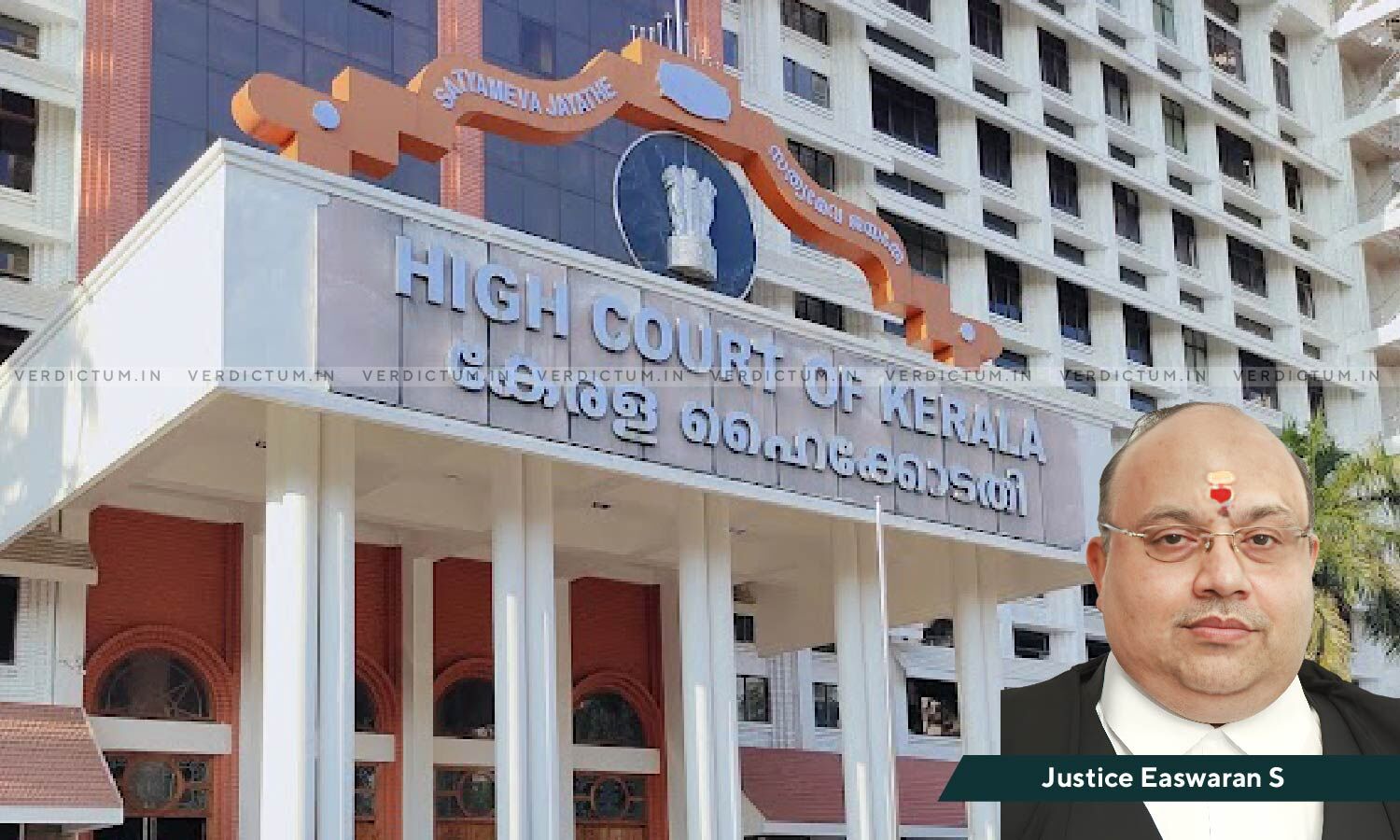
The Kerala High Court held that a decree holder cannot travel beyond the scope of a decree to proceed against the independent properties of a judgment debtor’s wife based on the personal law governing the parties. The Court clarified that neither the personal law of the parties, the Code of Civil Procedure, 1908, nor the Transfer of Property Act, 1882 (TPA), permits a decree holder to attach a spouse’s self-acquired or separate assets simply on the allegation that she was privy to a fraud committed by her husband.
However, the Court highlighted that the decree holder is not without a legal remedy, as an executing court retains the power to conduct an inquiry under Section 53 of the Transfer of Property Act, 1882, to determine whether a property transfer executed by the judgment debtor in favor of the wife was a fraudulent transaction intended to defeat creditors. If such a transfer is declared void, consequential alienations made to subsequent purchasers will automatically crumble due to the erosion of title.
A Bench of Justice Easwaran S. observed, “…this Court could not find any provision either in the personal law of the parties nor under the Code of Civil Procedure, 1908, nor under the Transfer of Property Act, 1882, enabling the petitioner/decree holder to proceed against independently, the properties of the wife of a judgment debtor. Irrespective of the nature of the personal law governing the parties, once a decree has been passed by the Court, the decree holder cannot travel beyond the scope of the decree and then proceed against the parties based on the personal law. This being the common law principle, this Court has no hesitation to hold that the order impugned does not suffer from any infirmity warranting exercise of jurisdiction under Article 227 of the Constitution of India”.
Advocate Abdul Raoof Pallipath appeared for the petitioner and Advocate C. S. Rajani appeared for the respondent.
The brief facts of the case involve the petitioner, a decree holder who obtained a foreign decree dated April 8, 2021, from the Ajman Court, UAE, directing the first respondent (judgment debtor) to pay AED 3,40,000 (equivalent to ₹75,75,200) under an assignment agreement.
After the judgment debtor escaped to India to avoid arrest, the petitioner filed an execution petition before the District Court, Thalassery on January 17, 2023. Shortly before the filing, the judgment debtor gifted his property to his wife on December 8, 2022, who subsequently mortgaged it to a bank and later sold it to a fourth respondent. Alleging that the wife was privy to a fraud meant to evade execution, the decree holder filed an application seeking attachment of her other personal properties.
Thereafter, the Additional District Court, Thalassery rejected the decree holder’s application via an order dated August 27, 2025, holding that the Code of Civil Procedure contains no provision enabling the attachment of independent properties belonging to a judgment debtor’s wife. Aggrieved by this rejection, the decree holder invoked Article 227 of the Constitution of India to file an Original Petition before the High Court of Kerala.
The High Court held that regardless of the personal law governing Mohamedan parties, a decree holder cannot travel beyond the scope of the decree once passed. However, citing prior precedent, the Court reasoned that executing courts are fully empowered under Section 53 TPA to examine whether the gift deed executed 42 days prior to the execution petition was designed to defeat creditors.
The Court sustained the lower court’s order dismissing the attachment of independent properties, but granted the petitioner full liberty to request the executing court to conduct a Section 53 inquiry regarding the gift deed, directing that any finding of fraud would render subsequent sales invalid.
Cause Title: Abdul Basith Kurikkalakath v. Shafi Mohammed @ Shafi Mohamed Khalid (Neutral Citation: 2026:KER:64246)
Appearances:
Petitioner: Abdul Raoof Pallipath, E. Mohammed Shafi, Prajit Ratnakaran, Ganga A. Sankar, Krishnapriya R., Anju Dony, Advocates.
Respondents: C. S. Rajani, V. R. Kesava Kaimal, M. Sasindran, Sohail Ahammed Harris P.P., Advocates.