
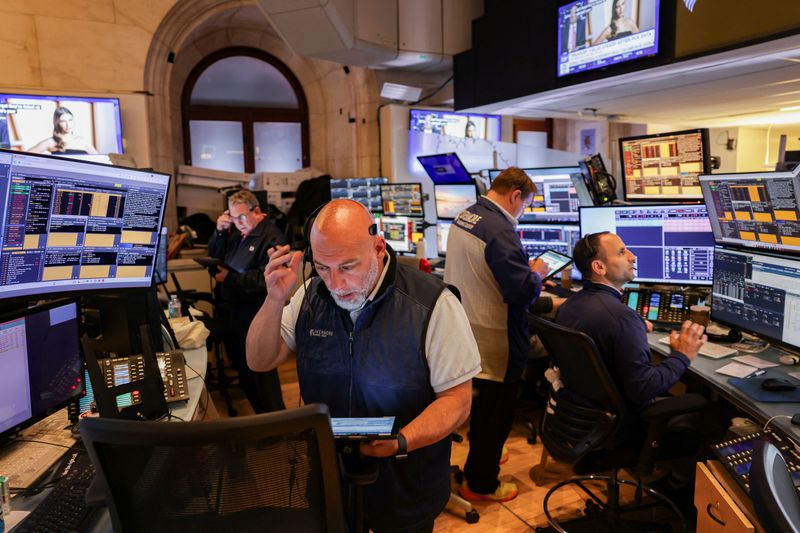
Investing.com – Futures linked to the main indices on Wall Street float above the flatline, staying resilient despite a new exchange of attacks between the U.S. and Iran. Hopes for an imminent peace deal fade despite a slate of upbeat comments over the weekend. Oil prices once again march higher, hovering well above pre-war levels, while gold prices dip as worries abound over an energy-driven inflationary wave.
1. Futures rise
U.S. stock futures pointed higher on Tuesday, with traders, returning to their desks for a holiday-shortened week, assessing fresh U.S. strikes on Iran.
By 03:42 ET (07:42 GMT), the had risen by 281 points, or 0.6%, S&P 500 futures had climbed by 41 points, or 0.6%, and had jumped by 220 points, or 0.8%.
“The market looks minded to continue pricing de-escalation in the Middle East – notwithstanding some occasional surgical strikes from the U.S.,” analysts at ING said in a note.
The main averages on Wall Street were closed on Monday for Memorial Day.
U.S. stocks advanced in their last session on Friday, with the blue-chip in particular notching a fresh record high close. Investors have been tracking rapid developments in the Middle East, as well as a solid batch of quarterly corporate earnings and ongoing enthusiasm around artificial intelligence.
2. U.S. launches new strikes on Iran
The U.S. military carried out what it described as “defensive” strikes in southern Iran, sinking two Islamic Revolutionary Guard Corps vessels trying to lay mines in the Strait of Hormuz. The attacks sparked a retaliation from Tehran, which fired missiles at U.S. planes. American attacks then hit missile launchers near Bandar Abbas, the Wall Street Journal reported, citing a U.S. official.
Recent optimism that Washington and Tehran may be approaching a lasting agreement to end their nearly three-month old war eased.
U.S. Secretary of State Marco Rubio flagged that discussions on a deal with Iran could “take a few days, adding that the Strait of Hormuz will eventually be fully reopened to “one way or the other.”
Over the weekend, news reports said both sides had agreed in principle on a deal, while President Donald Trump later said talks were proceeding “nicely.” However, Trump also warned of a resumption and escalation in fighting should a deal not be reached.
3. Oil gains
Oil prices moved higher, clawing back some losses recorded on Monday that were sparked by the reported progress in negotiations between the U.S. and Iran to reopen the Strait of Hormuz. , the global oil benchmark, were last up by 2.4% at $98.39 a barrel, after having slumped below $100 earlier this week.
Still, Brent remains well above pre-war levels of around $70 a barrel, keeping the prospect of energy-induced inflationary pressures in play.
Investors’ focus has been fixed on the status of the Strait of Hormuz, a vital waterway off Iran’s southern coast through which a fifth of the world’s oil flows. The strait has been all but shuttered to tanker traffic since the U.S. and Israeli launched a joint assault on Iran in late February.
4. Gold slips
Against this backdrop, the U.S. dollar has been well-supported. Traders have flocked to the greenback as a perceived safe haven during the crisis, thanks in part to the notion that the American economy — as a major energy exporter — could be relatively immune to an oil price surge.
The , which tracks the currency against a basket of six of its peers, has climbed by 1.3% over the past three months. On Tuesday, it last edged down by 0.2%.
, meanwhile, have been weighed down in this environment. A stronger dollar can make bullion more expensive for overseas buyers, while energy-induced inflationary pressures may persuade central banks to hike interest rates — a trend which would not bode well for a non-yielding asset like gold.
At 04:09 ET, had fallen by 0.8% to $4,533.55 an ounce.
5. Lenovo shares hit record high
Shares of Lenovo Group () surged to a record high after the world’s largest PC maker posted stronger-than-expected quarterly earnings, fueled by robust demand for AI servers and a rebound in the personal computer market.
Hong Kong-listed Lenovo shares jumped at one point by 18% to HK$18.7 — their highest level ever, adding to a 20% surge on Friday after the company reported a spike in quarterly revenue that topped analyst estimates. The stock closed up by 15.1% at HK$18.13 on Tuesday.
The company said revenue for the March quarter rose to $21.6 billion, while net profit surged 479% to $521 million.
Lenovo’s infrastructure solutions business, which includes AI servers and data-center products, posted 37% revenue growth, making it the company’s fastest-growing segment amid booming demand for artificial intelligence computing.
Its core PC, tablet, and smartphone division was helped by resilient consumer demand and market share gains ahead of expected price increases linked to memory chip shortages.