
For an institution celebrating its Platinum Jubilee, the degree certificates came as an anticlimax for several reasons.
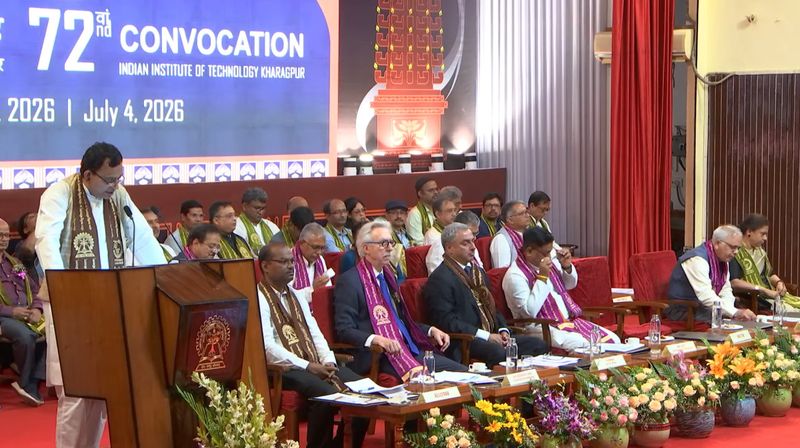
Kharagpur (West Bengal): Indian Institute of Technology (IIT) Kharagpur held its 72nd convocation on Friday, July 4, awarding 3,936 degrees to graduating students across undergraduate, postgraduate and doctoral programmes as the institute continued celebrations marking its platinum jubilee.
The degrees include 539 Ph.D., 908 M.Tech., 801 dual degrees, 628 B.Tech. (Honours), 181 four-year B.Sc., 209 two-year M.Sc., 163 MBA, 59 PGDBA, 73 LL.M., 31 LL.B., besides several other postgraduate and specialised programmes.
The convocation, held in the institute’s Platinum Jubilee year marking 75 years since the establishment of India’s first IIT, was expected to be a celebration of its historic legacy and the achievements of its graduating students. Instead, the ceremony drew attention for West Bengal Higher Education Minister Jagannath Chattopadhyay’s sharp political criticism of the Mamata Banerjee-led West Bengal government.
Chattopadhyay accused the state government of presiding over an “institutional collapse” in higher education. “During the past decades, the state witnessed deliberate as well as institutional collapse,” he said.
In a political broadside against the previous West Bengal government, the minister alleged (2:31:07) that educational institutions had suffered from irregularities and violence, claiming that “moral bankruptcy and structural breakdown led to systemic failure” and that “merit had been replaced with muscle” and “inquiry with intimidation”.
“During the past decades, the state witnessed deliberate as well as institutional collapse. The revelations of obnoxious incidents in academic institutes had shaken the conscience of the society to its core,” Chattopadhyay said, adding, “Moral bankruptcy and structural breakdown led to systemic failure. It was a predictable outcome that replaced merit with muscle and inquiry with intimidation.”
He also claimed that West Bengal’s Gross Enrolment Ratio in higher education and the number of colleges per lakh population had become “abysmally low” and that the majority of state universities were functioning in an ill-equipped manner.
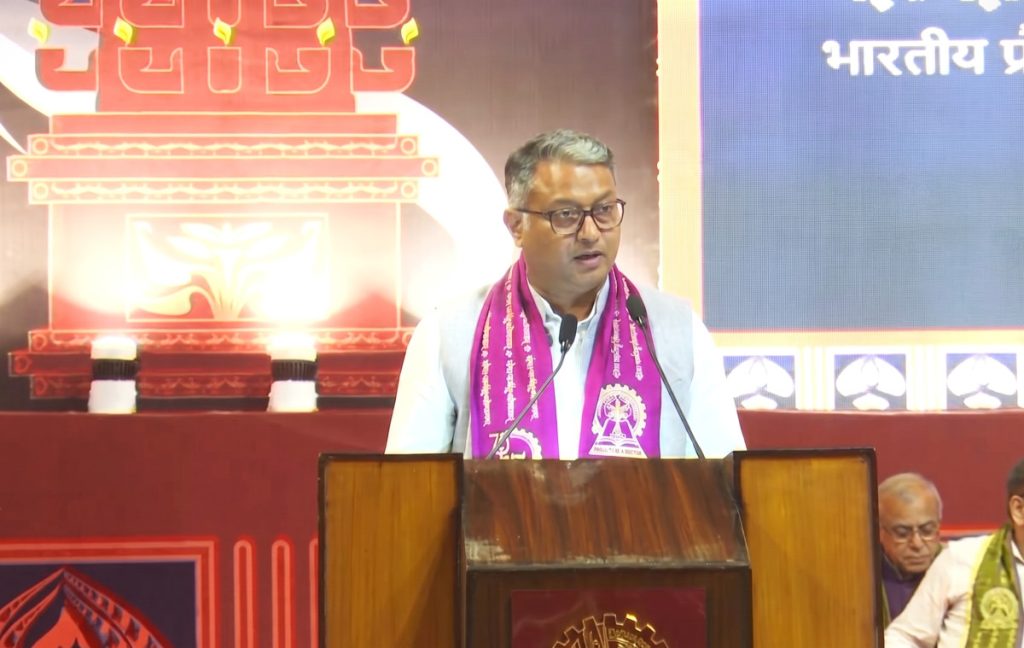
West Bengal Higher Education Minister Jagannath Chattopadhyay addressing the convocation.
A political speech as free speech in doubt
The remarks marked a departure from what is generally expected of a convocation address. Such ceremonies traditionally celebrate graduating students, recognise academic achievements and encourage young graduates as they step into professional life. Speakers often reflect on the future of education, scientific research and innovation and public service.
Direct political criticism of a government, particularly one of the state in which the institution is located, is relatively uncommon at such occasions. That contrast was especially striking because of IIT Kharagpur’s history.
Established in 1951 on the site of the former Hijli Detention Camp, where Indian freedom fighters were once imprisoned, IIT Kharagpur transformed a symbol of colonial repression into a centre of learning and innovation.
At its first convocation in 1956, Prime Minister Jawaharlal Nehru described the institute as a symbol of free India’s aspirations, celebrating the transformation of a colonial prison into a centre of learning. Over the next 75 years, the institute grew into what is often described as the “mother of the IIT system”.
The Platinum Jubilee year, therefore, offered an opportunity not only to celebrate graduating students but also to reflect on the institute’s contribution to nation-building, scientific research and technological innovation.
Instead, much of the public discussion following the ceremony centred on the political content of the minister’s speech. The remarks were seen by some as portraying the state’s higher education system in an unduly poor light before a global audience, rather than celebrating its achievements.
The entire convocation proceedings were broadcast live and have since been made available as a three-part series on YouTube, making the remarks accessible to audiences well beyond those present at the venue.
IIT Kharagpur Director Professor Suman Chakraborty cautiously defended the minister’s remarks, calling them his “prerogative”, while acknowledging that the essence of a convocation lies in celebrating academic achievement. “Distinguished guests, naturally, express their individual perspectives and those are entirely their prerogative,” he said.
However, a senior professor told The Wire that convocations, once largely insulated from partisan politics, are increasingly becoming platforms where political narratives compete with academic celebration.
“Because public institutions in India rely heavily on government funding and oversight, political accommodation is often seen as a practical necessity rather than a choice,” he said, while drawing a contrast with more autonomous university systems as seen in the West. “For politicians, such occasions are more than ceremonial; they are opportunities to advance their party’s political messaging.”
Nicholas Dirks, American historian and president and CEO of the New York Academy of Sciences and former 10th Chancellor of the University of California, Berkeley, who was the guest of honour at the convocation, warned that academic freedom is indispensable to the health of universities.
“Academic freedom is not just critical for fields in the humanities and social sciences to thrive; it is also fundamental to scientific excellence,” he sad to The Wire, arguing that the willingness to experiment, cross disciplinary boundaries and take intellectual risks depends on institutional freedom and autonomy in academic decision-making.
Dirks suggested that concerns over academic autonomy are by no means unique to India. He warned that universities in the United States, too, are facing increasing political pressures that threaten their independence. “Trump administration policy on US universities has had multiple negative impacts, from restricting – often completely arbitrarily – visa authorisation for students and faculty, to cancelling research grants, politicising the grant-making process and reducing the overall number of grants,” he said.
“This is a warning signal for all nations that wish to have a thriving university system,” he added.
Students disappointed
For the graduating students and their families, the day marked the culmination of years of effort and sacrifice. Yet the Platinum Jubilee convocation of India’s oldest IIT may ultimately be remembered as much for the political debate it generated as for the degrees it conferred.
Data obtained through Right to Information (RTI) applications shows that IIT Kharagpur recorded 11 student suicides between 2021 and 2025, the highest among the IITs during that period. The convocation held no formal remembrance for students who might have been present to receive medals and degrees had their lives not been cut short.
Asked whether the institute had examined the underlying causes behind these deaths, Chakraborty did not directly address the question. Instead, he outlined the institute’s preventive measures. “At IIT Kharagpur we have moved towards a preventive rather than reactive framework through structured mentoring, strengthened counselling services, early identification mechanisms, faculty sensitisation, peer support systems, continuous student engagement and integrated wellbeing initiatives,” he said.
Pertinently, India’s premier engineering institutions are confronting a silent emergency. Between 2011 and 2026, 160 students died by suicide across the IIT system, with 69 deaths recorded in the last five years alone. RTI data shows that 65 of those deaths occurred between 2021 and 2025, 54 of them involving male students. Marginalised students, despite constituting only about one-fifth of the student population, bore nearly twice the suicide burden of their peers.
A woman student from Jharkhand described caste as an undercurrent that continues to shape campus life, alleging that students from marginalised communities are often looked down upon by their elite-caste peers, particularly those from economically disadvantaged backgrounds.
“People think getting into an IIT is the hardest part. For many of us, surviving campus life can be just as difficult,” she said. “You try to ignore it, but every now and then you’re reminded that your background still defines you in some people’s eyes. Everyone has a breaking point.”
For an institution celebrating its Platinum Jubilee, the degree certificates came as an anticlimax. Printed on what appeared to be ordinary A4 sheets, they lacked the sense of permanence and distinction many graduates associate with a once-in-a-lifetime milestone. One student mocked the design and quality of the certificates, saying, “Even my board certificates were better designed. Look at the certificates given by foreign universities.”
When an IIT is India’s premier institution, holding what looks like a casual printout in your hand feels shameful, he rued.
The distribution, too, was brisk, almost perfunctory, leaving several attendees with the impression of a routine school ceremony rather than the culmination of years of study at one of India’s premier engineering institutions. For many graduates, a degree certificate is a lifelong keepsake. On an occasion marking 75 years of IIT Kharagpur, the ceremony fell short of that expectation.
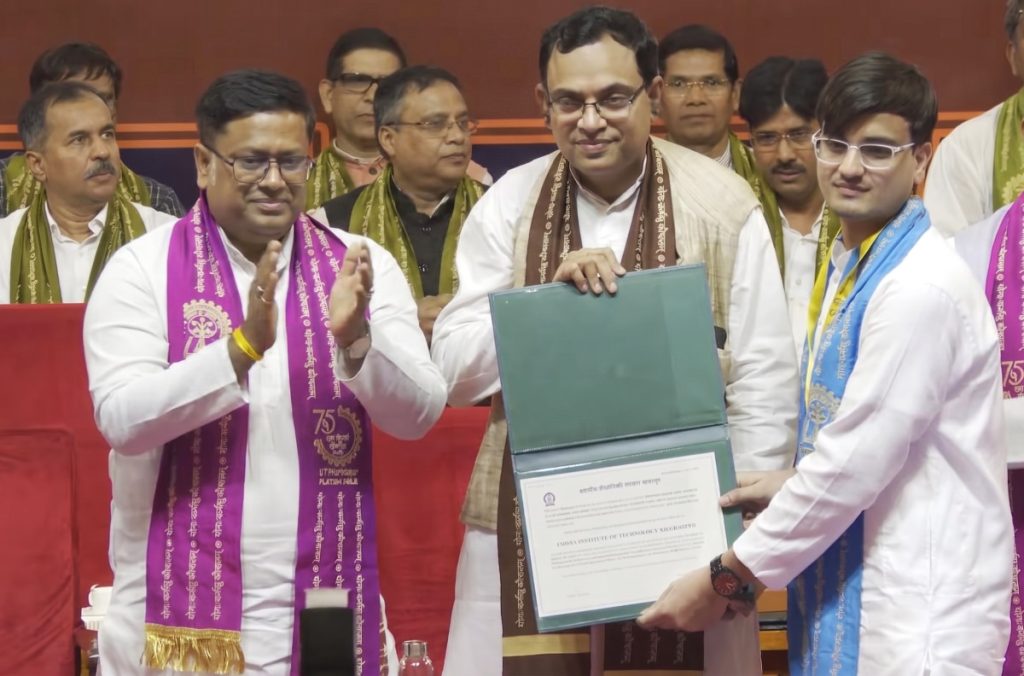
Atif Faizan, a Bachelor of Technology graduate in Electronics and Telecommunication Engineering, was awarded the President’s Gold Medal for graduating with the highest CGPA.
Director Chakraborty, in his response, said the institute had taken the feedback “with seriousness” and was exploring ways to make future convocations “even more memorable” through improved design, an enhanced ceremonial experience, greater alumni engagement and stronger institutional storytelling.
The Platinum Jubilee convocation showcased the institute’s extraordinary academic achievements, but it also exposed uncomfortable questions about politics, student wellbeing, institutional culture and even the symbolism of the ceremony itself. For an institution that has shaped generations of engineers, scientists and innovators, the enduring legacy of its 75th year may ultimately depend less on commemorating its past than on how it responds to the expectations of those who will define its future.
This article went live on July ninth, two thousand twenty six, at eighteen minutes past seven in the evening.
The Wire is now on WhatsApp. Follow our channel for sharp analysis and opinions on the latest developments.