
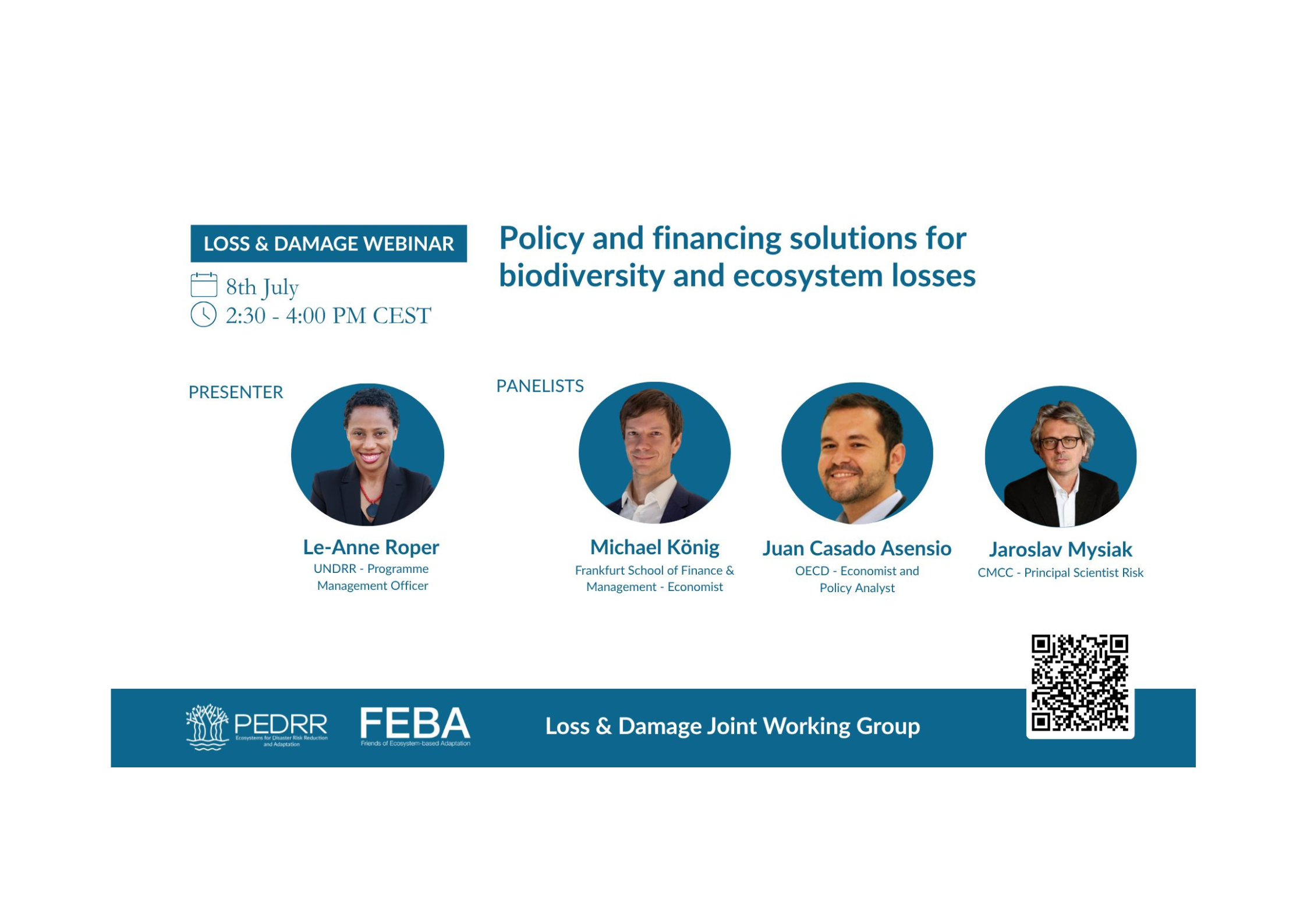
To explore how policy and finance can help address these growing challenges, the PEDRR–FEBA Joint Working Group on Loss and Damage hosted the fourth webinar in its “Loss and Damage – Every Loss Matters” series: Policy and Financing Solutions for Biodiversity and Ecosystem Losses.
Moderated by Le-Anne Roper (UNDRR), the session brought together leading experts from the Euro-Mediterranean Centre on Climate Change (CMCC), Frankfurt School of Finance & Management, and OECD to discuss how biodiversity and ecosystem losses can be better recognised—and financed.
During the opening, participants from across regions and sectors highlighted their interest in innovative finance, ecosystem insurance, biodiversity protection and understanding ecosystem-related loss and damage, demonstrating the growing global momentum behind these issues.
Nature is an investment in resilience
Jaroslav Mysiak (CMCC) highlighted the often-overlooked economic value of healthy ecosystems.
Forests, wetlands, coral reefs and mangroves provide critical services such as flood protection, water regulation and climate regulation—yet these benefits rarely have a market value. When ecosystems degrade, societies pay the price through higher disaster losses, damaged infrastructure and reduced livelihoods.
Drawing on the NATURANCE Initiative, Jaroslav presented three emerging approaches that could transform how we finance resilience:
Nature as the insured asset, where ecosystems themselves are insured to enable rapid restoration after disasters.
- Nature as risk reduction, where insurers reward ecosystem restoration through lower premiums, resilience credits and improved underwriting conditions.
- Managing nature-related transition risks, through financial products linked to carbon markets and broader nature-related financial risks.
-
Overall, according to Jaroslav, insurance should move beyond paying for disasters after they happen and instead help finance ecosystem restoration that prevents future losses.

The biodiversity finance gap is about more than money
Michael König-Sykorova (Frankfurt School of Finance & Management) argued that biodiversity finance is constrained not only by limited funding, but also by weaknesses throughout financial and governance systems.
He explained that many corporations continue to prioritise short-term financial returns while biodiversity risks remain poorly integrated into business strategies, executive incentives, enterprise risk management and financial reporting.
He also highlighted major inconsistencies in public finance, where environmentally harmful subsidies continue to outweigh investments in sustainable land use and biodiversity conservation.
Rather than focusing solely on mobilising additional finance, Michael emphasised the need to:
- reform harmful subsidies;
- strengthen biodiversity governance;
- improve institutional capacity; and
- showcase successful nature-positive business models that policymakers and investors can replicate.
As he concluded, demonstrating that nature-positive finance works in practice will be critical for accelerating broader investment.
Making biodiversity finance easier to access
Juan Casado-Asensio (OECD) presented new evidence showing that although international biodiversity finance has steadily increased, it remains too small, too fragmented and too difficult to access.
He highlighted several persistent challenges:
- biodiversity finance is concentrated among relatively few donors;
- current tracking systems struggle to identify funding specifically addressing biodiversity-related loss and damage;
- biodiversity is often treated as a co-benefit rather than a primary objective; and
- private finance remains only a small fraction of total biodiversity investment.
He also noted that many countries continue to face significant barriers to accessing available funding due to complex application processes, limited institutional capacity and fragmented funding mechanisms.
Looking ahead, Juan called for:
- stronger biodiversity finance tracking;
- dedicated funding windows for ecosystem loss and damage;
- greater mobilisation of private finance; and
- improved integration between climate and biodiversity financing.

Communities must be at the centre
During the panel discussion, speakers agreed that Indigenous Peoples and local communities (IPLCs) must play a much greater role in biodiversity finance.
Although many funding mechanisms recognise IPLCs as priorities, only a very small proportion of finance currently reaches them directly.
Panelists stressed the importance of:
- involving communities in decision-making;
- strengthening local institutional capacity;
- simplifying access to finance;
- improving consultation processes; and
- ensuring local knowledge shapes financing decisions.
The discussion also highlighted the importance of recognising non-economic losses, including traditional ecological knowledge, cultural identity, spiritual values and community cohesion.
While these losses cannot always be monetised, speakers agreed they should still be explicitly assessed and incorporated into resilience planning using community-defined indicators alongside conventional financial metrics.
Looking ahead
The webinar concluded that closing the biodiversity finance gap will require more than increasing investment.
It will also require stronger governance, better coordination across sectors, improved tracking of biodiversity-related loss and damage, and innovative financial mechanisms that reward ecosystem restoration while reducing future climate risks.
Above all, speakers agreed that biodiversity should no longer be treated as an environmental co-benefit—it must become a central pillar of climate policy, disaster risk reduction and sustainable finance.
As climate and biodiversity crises continue to converge, investing in healthy ecosystems is increasingly recognised as an investment in resilience, livelihoods and long-term sustainable development.
You can watch the full recording of the webinar here.
The PEDRR-FEBA webinar series will end in September with a final session exploring locally-led action for protecting communities and ecosystems. Registration details to come soon.