
In February, Concord Police arrested a Romanian man in the Hannaford parking lot. Inside his car, they found hundreds of cloned debit cards, piles of cash and little machines used to skim access data from card machine readers.
Teofil Bortos, who faced felony charges for forgery and identity fraud, had on multiple occasions gone into the store and bought something small, like a bottle of water. He then used the cashback feature on the register to withdraw large amounts of cash. The cards were in fact duplicates, clones of other people’s debit cards, connected to their real bank accounts but made with stolen information.
While skimmer fraud like this one is relatively rare in New Hampshire, according to Concord Police Detective Steven Carter, fraud and scams on the whole are on the rise in the area and statewide.
Avoiding them goes beyond ducking unknown phone calls or being skeptical when the “anti-tamper” sticker has been scratched off a gas pump.
Carter has led fraud investigations in the city for years and currently serves on a U.S. Department of Homeland Security task force that investigates transnational organized crime. He was honored as the department’s 2026 officer of the year for his work.
The Monitor sat down with Carter to understand more about how scams and fraud in the Concord area are playing out and what people can do to protect themselves and others.

Tap to pay
A skimmer is a device that attaches to or embeds within a credit card reader, and when a customer inserts their card, it downloads their payment information.
Skimmers started as a kind of overlay layered on top of a machine, but they’re getting harder to detect. Newer technologies, Carter said, are stuck inside card readers, like on a gas pump or at a register, and don’t need to be retrieved for the scammer to pull customers’ data. These “deep insert skimmers” may also use a pinhole camera to record PINs, and they are most common on ATMs and gas pumps.
Carter’s biggest piece of advice for avoiding skimmer theft is to always tap to pay rather than inserting a card.
“That’s the safest way to use a debit or credit card right now,” Carter said. “That, to my knowledge, hasn’t been exploited yet.”
Other signs to look for are a card terminal that’s bigger or chunkier than you’re used to, or one where the backlighting feature on the number pad doesn’t work. These can be red flags indicating that a skimmer is stuck on top of a traditional reader.
When possible, credit cards are also generally a safer option than debit.
Skimmers are primarily going after debit cards because of their cashback features, Carter noted. Furthermore, when trying to get money back, it can be easier to go through a credit card company and cancel a transaction than to retrieve money already withdrawn from a bank account with a debit card.
Crypto ATMs
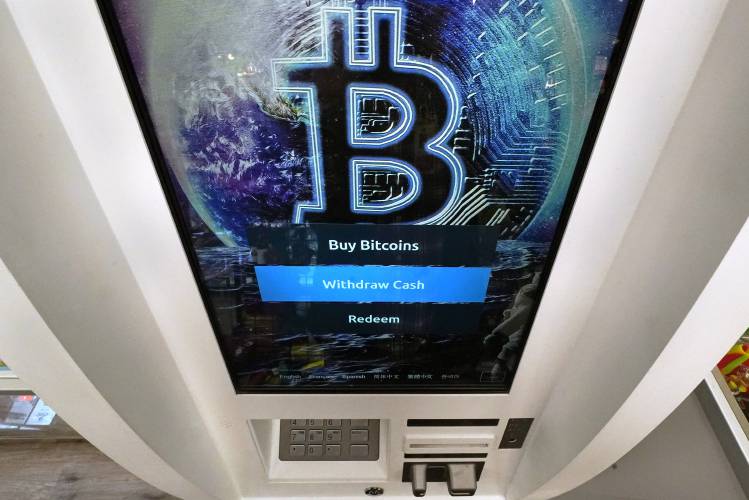
Cryptocurrency ATM scams are rising quickly in Concord and across the state.
Here’s how the scheme often goes: Someone will get a phone call, text or email with an urgent demand. For example, victims are often told they’re wanted by police, maybe because they didn’t pay a fine, but that if they pay the amount immediately, they won’t have to go to court.
Impressing a sense of urgency and claiming to be an authoritative institution are hallmarks of these scams.
If the interaction doesn’t start with a phone call, it will often proceed there, Carter said. The scammer will say to stay on the line. This is so they can make sure the victim follows through on a money transfer, and so the scammer can get a sense of whether police are involved.
Scammers will direct the victim to a cryptocurrency ATM, a machine most often found in convenience stores that allows users to convert regular currency into digital.
Once victims put payment into a cryptocurrency, scammers will tell them where to transfer that money.
“It’s tough, because once the money’s in that machine, it’s gone,” Carter said.

In another setup, a victim might be told that the government has detected a breach in their bank account and wants to protect their financial assets. They’ll be told to move all their money from their bank account to a “secure” crypto account, which actually belongs to a scammer.
Scammers in general tend to target older people, but especially with crypto, Carter said. People who don’t fully understand how the technology works are more likely to be misled.
State lawmakers passed a cap this year on how much money can be deposited into a crypto ATM at a time, limiting the amount to $2,000.
With some stipulations, regulations now also force crypto ATM companies to refund any scam victim who makes a report to the police within two weeks.
Before the state imposed regulations, more of these ATM companies sought to set up shop in New Hampshire, Carter said. Companies pay convenience stores “rent” to keep their machines up in the store.
“Pretty much any convenience store has one in Concord right now,” Carter noted. “Last time I checked, we had more than 20.”
Often, he noted, store owners don’t fully know what the machines can do when they agree to host them. Some store clerks, he added, are getting better at spotting potential victims of scams – people feeding thousands of dollars at a time into a machine – and alerting police.
Carter said he doesn’t encounter many legitimate crypto ATM uses.
“I don’t know that anyone that uses cryptocurrency would ever have a need to use an ATM – the fees they charge are so high,” he said. “The main users that I’ve seen are victims of scams.”
‘An overwhelming uptick’
Cards and crypto aren’t the only types of scams and fraud hitting local residents hard.
Romance scams, where someone on the internet, often overseas, starts up a relationship with a victim and then convinces that person to wire them large sums of money, remain common.
There are also instances where scammers convince people in the area to acquire large amounts of cash or purchase gold bars, which are then picked up in person by a courier from their home.
These are often “grandson in jail” tricks. Someone, often an older person, will get a phone call from a scammer who purports to be a police officer saying a family member has committed a crime and needs bail money. The family member then collects a sum of cash, which the scammer picks up.
When they call back their actual local police department, the scam becomes clear.
“The frightening part,” Carter said, is that these kinds of schemes involve victims “having face-to-face contact with these scammers.”
Carter warned that anyone who gets a phone call where an authority expresses a sense of urgency and demands payment — whether they claim to represent your bank, law enforcement or another institution — should hang up and call the known public number for that institution. If the issue supposedly involves a family member, call that family member directly.
The detective himself gets texts or emails daily, he said, where someone claiming to represent Apple or Amazon says there’s a large charge on his account and he must take action to protect his finances.
In a ruse employed by scammers in a major case Carter investigated, information from gift cards is carefully stolen and recorded, then placed back on shelves. Once an unsuspecting customer buys the gift card and loads it up, the scammer can remotely use the card to make purchases, often of tech products like Apple iPhones.
Concord is sometimes able to leverage federal resources to investigate these crimes, including through Carter’s partnership with Homeland Security.
Still, cases are rising.
“Unfortunately, there’s some where there’s not a whole lot we can do,” he said. “But it’s definitely an overwhelming uptick.”
Beyond tapping to pay, avoiding calls from unknown numbers and thinking twice about crypto ATMs, there’s another major step people can take to help avoid and root out scams: Alert local police, Carter said, even if the issue seems minor.
“If you see a one random charge on your credit card and just call the bank and they fix it and it’s done, we don’t always find out about that,” Carter said. “Most fraud, I would say, goes unreported.”
If there’s an unauthorized charge on your credit or debit card, Carter said, don’t just report it to your bank or card company. Call your local police department. Even if the issue is easily resolved, reporting it could help investigators track down fraudsters and their patterns.
“The trends are changing all the time, so it takes us time to get kind of on top of things,” Carter said.
The latest skimmer fraud in the area involves a group from New York buying multiple gift cards at a time using stolen debit cards via tap-to-pay. It’s something shoppers and cashiers should keep an eye out for, he said.
People in Concord lost several million dollars to scams and fraud last year, Carter said. The largest case amounted to $1 million, but the smallest sums stolen could be less than $100.
Most of the time, unauthorized debit or credit charges are somewhat small. Card owners might not even notice them or, if they do, think to report them. But they add up.
“When you really compound all of the small transactions happening,” he said. “It’s alarming how much financial loss is happening, even in an area like this.”