
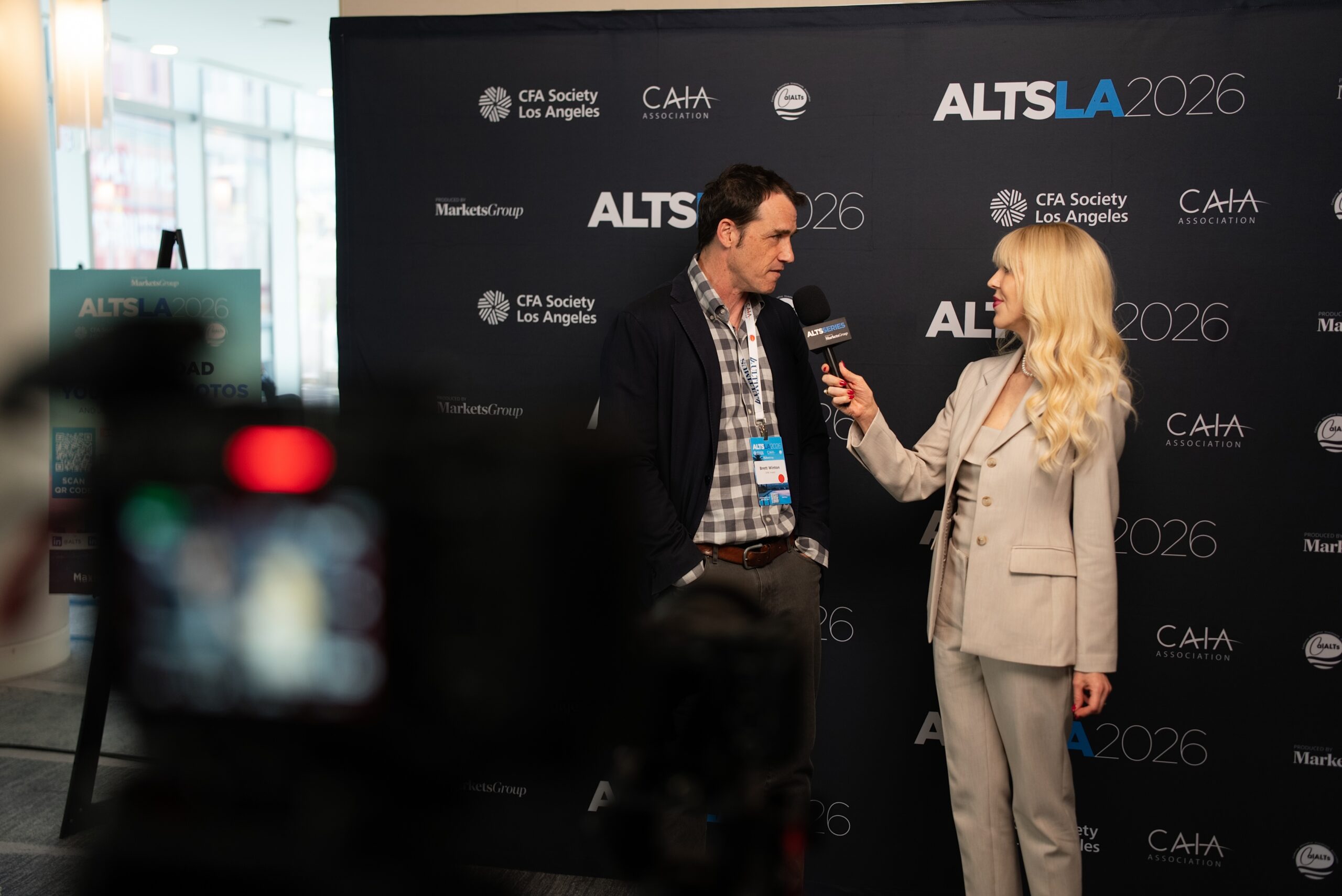
ALTSLA 2026 brought 1,400 attendees and 100-plus speakers to Los Angeles for three days of alternative investments. The leaders in the space showed up – and 21 of them stood with me on the Sidelines.
The most respected voices in alternatives told me exactly what they think. About private credit at the inflection point. About AI in the first inning. About women’s sports as the small caps of sports. About what keeps them up at night and what they’re betting on next.
Conviction was rare in 2026. Conviction is what I captured.
🔥 Request the agenda for ALTSNY 2026 — June 17, New York City
Here’s what they said.
Bitcoin to Four Times. AI in the First Inning.
Tim Draper didn’t hedge. The founder and managing partner of Draper Associates put his money where his mouth is — on Polymarket — that Bitcoin will hit four times its current price by 2028.
His reasoning is supply and demand. Halvings cut new supply. The pattern has held. He sees no reason it won’t hold again.
The line that landed harder was about responsibility. “If you’re responsible for other people’s money and you’re a treasurer of some big company and you don’t have Bitcoin, you have all your money in one or two banks — you’re being irresponsible.”
The Confederate dollars story made it stick. Draper’s father gave him a million-dollar bill at age 10. It turned out to be Confederate currency. Worthless. The lesson: a currency is only worth what people trust. And trust in the dollar, in Draper’s view, is on borrowed time.
Brett Winton, Chief Futurist at ARK Invest, brought the same conviction energy to a different question. “We’re in the first pitch of the first inning,” Winton told me. He framed today’s AI moment as 1996 for the internet. Most of the disruption hasn’t happened yet.
The prize on the table, in Winton’s view, is a $20 trillion enterprise value pie that four foundation model companies — OpenAI, Anthropic, xAI, and Google — are competing for. The rest gets disrupted.
What helps Winton sleep at night is the worry of others. When investors panic about the AI capital expenditure of Amazon or Meta, he sees an entry point. “There’s a lot of volatility out there that causes people to be really worried, and that means we’re able to get access to these assets at prices well under what we think their fair value is.”
Two voices. Two convictions. One bookend on the conference.
Private Credit’s Stress Test
If AI was about what’s coming, private credit was about what’s already here. And what’s being tested in real time.
Stephen Biggs, Managing Director and Head of Alternative Investments at The Mather Group, put the framing in one sentence. “This is not the liquid part of your portfolio.”
Biggs called what’s happening in private credit “a tiny correction” rather than a structural break — for now. His real concern is the education gap. Allocators piled into the asset class over the last decade. Many didn’t fully understand the redemption mechanics they were buying into. Now they’re finding out the hard way.
Darren Chappell, CIO of Capstone Partners, came at it from the discipline angle. “There’s no alchemy here,” Chappell said. Private credit funds make multi-year loans. They’re now wrapped in quarterly liquidity vehicles. That mismatch isn’t a bug. It’s the structure.
His advice anchored on something he learned at a hedge fund earlier in his career. “Position sizing is arguably more important than entry price.”
Chappell described private credit today as “a sentiment- and liquidity-driven stress test.” So far, the asset class is passing. He’s watching closely.
The institutional voice in this conversation belongs to Debby Slack Cherney, CEO of San Bernardino County Employees’ Retirement Association. SBCERA has scaled from $9 billion to $17 billion under her leadership — “a testament to a great investment team and a terrific board of trustees,” Cherney said, deflecting credit the way the best leaders do.
What she came to ALTSLA carrying was bigger than headlines. Her CIO, Donald Pierce, is retiring after a long and distinguished tenure. Markets Group will honor him next month. Cherney’s confidence in what comes next was unwavering. Thomas Kim has been named Deputy CIO. Senior investment officers are stepping up. The culture Pierce built isn’t going anywhere.
“It’s been a year of transition — but we’re ready,” she said.
On private credit specifically, Cherney noted the headlines have been “debunked a bit” through the conversations at ALTSLA. SBCERA’s allocation is sizable. She isn’t worried.
Andrea Auerbach, Partner and Global Head of Private Investments at Cambridge Associates, came at the inflection from the secondaries angle. “Secondary transaction activity is still less than 5% of overall private market activity. It’s going to grow.”
She founded Cambridge’s secondaries practice a decade ago. The thesis then was the same as now. As private markets scale, allocators need more tools to shape portfolios. Buy. Sell. Reposition. Auerbach also issued a clean-eyed warning about evergreen and interval funds. “There’s a lot more to understand.” The fine print on liquidity caps is where investors are getting caught.
Anna Snider, Managing Director and Head of Global Manager Selection at Bank of America Global Wealth and Investment Management, joined me for a follow-up conversation a couple weeks after the conference. Her question framed the entire piece. “Is the illiquidity premium still worth it?”
Snider’s answer was yes — with conditions. Bank of America underwrites every private markets manager to a minimum 300 basis points illiquidity premium over public market equivalents. “That’s pretty industry-wide and pretty much the minimum we think you should lock up your capital for.”
But Snider drew a sharp line on evergreen structures. They have utility for wealth clients. They will not match drawdown-fund returns over the long term.
Five voices. Five angles. One conclusion. Private credit isn’t broken. It’s being stress-tested. And the allocators who did their homework are holding their seats.
The Small Caps of Sports
Sports is one of the hottest asset classes in alternatives right now. Goldman Sachs is publishing on it. KKR is paying $1 billion to buy Arctos Partners. The NFL just opened to private equity. Blue Owl, RedBird, Sixth Street, Carlyle — all in.
The crowd is rushing into men’s leagues at billion-dollar entry points.
Sylvia Kwan and Jason Wright are not in the crowd.
They were the only two voices on the Sidelines at ALTSLA 2026 making the case for the niche-within-the-niche — women’s sports as a serious institutional allocation. And they were doing it before the rest of the institutional world has caught up.
Kwan opened her Sidelines interview on Day 1. “Courtney, I’m all in on investing in women’s sports.”
The CEO and CIO of Ellevest wasn’t talking about a social impact play. She was talking about valuation. “Investing in women’s sports is a non-correlated asset with tremendous upside potential.”
Kwan’s case is structural. Phenomenal viewership. An untapped fan base. The most interesting opportunities, in her view, sit beyond just teams — analytics, ecosystem services, the infrastructure layers being built around the leagues themselves. While the rest of the industry chases mature franchises at peak multiples, Kwan is positioning early in a category Deloitte projects will reach $3 billion globally in 2026 — a 340% increase since 2022.
Then Kwan delivered what became the through-line for our Women’s History Month coverage. “My advice to the next generation of women in finance is don’t play by the old rules — because those rules are changing. The finance industry has to change to meet us, not the other way around.”
That was Day 1.
Two days later, Jason Wright stood with me on the Sidelines and put the same thesis in eight words. “Women’s sports is the small caps of sports.”
When I told the Managing Partner and Head of Investments at Ariel Project Level that Sylvia Kwan had told me on Day 1 she’s all in on women’s sports investing, his response was immediate.
“Sylvia, we need to talk.”
The numbers behind his thesis are the kind that make institutional readers sit up. The WNBA averages 970,000 viewers per regular season game. The NHL averages 450,000. The average WNBA team is valued at $250 million. The average NHL team is $2.2 billion. Wright sees a five-year quadruple in WNBA team values as far more probable than another double for the Dallas Cowboys.
His thesis isn’t just teams. It’s the whole ecosystem — analytics businesses, youth sports roll-ups, staffing companies, health outcomes infrastructure. “That’s sort of the plan for our fund.”
When Wright’s Sidelines interview hit LinkedIn, Kwan asked me for his email.
That’s what happens in this room.
I had one more question for Jason Wright on the Sidelines, and it nearly broke me to ask it. I asked him to name the women who inspired him.
He didn’t hedge.
Stacey Dietsch and Vivian Riefberg at McKinsey, who helped him find his footing early in his career. Mellody Hobson at Ariel, who outworks him every single day. His mother — a flight attendant flying turnarounds between Tokyo and JFK while his father built his business — “a picture in grit and balance.” His 14-year-old daughter. His partner Jasmine — “a creative, PhD pharmacist, and someone whose worldview challenges and inspires me daily.”
His message about the women who inspired him, supported him, and helped him along the way moved me so deeply I had to gather myself before asking my final question.
The line that stayed with me for weeks was the one he closed with. “If you don’t have a woman mentor, you’re missing out on a key lens into how you should operate and move in society.”
Debby Slack Cherney named Wright’s keynote her personal highlight of ALTSLA. “Personally really inspiring,” she told me.
She isn’t alone.
AI: From First Inning to Sinister Scenarios
AI ran through nearly every Sidelines conversation. The convictions ranged from Brett Winton’s optimism to genuinely alarming warnings.
Sandip Bhagat, Chief Investment Officer at Whittier Trust, brought the warning. “This shock to the system goes beyond inflation, interest rates, and the bond and stock market.”
Bhagat described the 2026 macro picture as one with two simultaneously jarring shifts. First, geopolitical risk centered in the Middle East, with physical assets — energy infrastructure, power grids — under attack in ways markets aren’t priced for. Second, an AI scenario he called sinister and existential. “AI already is so good that machine intelligence is ready to displace human intelligence. And with that could come mass unemployment.” The number Bhagat floated for US unemployment in a few years: 10 percent.
His prescription. Diversify. Don’t concentrate exposure in any single sector at risk of obsolescence — software being the most obvious example.
Madeline Hume, Associate Director of Research at AlphaCore Wealth Advisory, joined me a couple weeks after the conference. Her angle was structural — what allocators in the wealth channel need to be asking GPs that they weren’t asking three years ago.
“Redemption windows are a feature of these products, not a flaw,” Hume told me. The diligence questions she’s now insisting on go beyond “have you thought about an outflow cycle.” They’re asking what’s actually in the liquidity sleeve, what the counterparty exposure looks like, and under what conditions credit lines could change.
Hume came up at Morningstar before AlphaCore, and that lens shapes how she evaluates managers today. “This stance is really critical as we look at this major mega trend in the convergence of public and private markets.”
Jeremy Heer, Managing Director at the University of Illinois Foundation, closed the AI conversation with the line that hit hardest on LinkedIn — and the most useful framework for thinking about where value will accrue.
His four-layer AI taxonomy. The bottom: energy, chips, compute, power, critical minerals — the bricks and mortar. Above that, foundation models. Above that, orchestrators (the Databricks and Snowflakes). At the top, vertically integrated proprietary data with a real moat. Heer’s view is that the top and the bottom are where value accrues. “It all comes down to tokens per watt, right? How many tokens get reduced per watt of energy.”
But the line that earned the most engagement of any Sidelines clip from ALTSLA 2026 was Heer’s answer when I asked what keeps him up at night.
“It’s what you don’t know that you don’t know that really hurts you.”
Liquidity, Governance, and the Macro Reset
Beneath the headline conversations on private credit and AI, a quieter but equally important set of voices reframed how allocators should think about risk in 2026.
Ju Hui Lee, Chief of Financial Risk and Performance at the United Nations Joint Staff Pension Fund, gave me the cleanest thesis statement of any speaker. “Liquidity is a strategic point and not just a defensive mechanism.”
Lee oversees risk for $95 billion in assets supporting beneficiaries across the world. Her stress testing approach moves beyond single-region scenarios to map how macro variables connect across markets. “The key question is not to find the right one, but how resilient our portfolio is.”
Neil Gilfedder, CIO at Edelman Financial Engines, brought the wealth-channel reality check. “The times when you may not get your money out are exactly the times when you’ll want it most.”
Gilfedder pushed back gently on Tim Draper’s Bitcoin call from the previous day. “I’m an economist by training. I struggle to see why it should go up for more than reasons of market psychology.” Edelman lets clients hold Bitcoin. Gilfedder isn’t taking the four-times-by-2028 bet.
Shannon Comstock, Portfolio Manager of Hedge Funds and Fixed Income at the W.K. Kellogg Foundation, named the trap the rest of the industry talks around. “Uncorrelated strategies tend to turn correlated exactly when you need them the most.”
Her solution is mosaic, not monolith. Discretionary global macro. Trend following. Compliance carbon trading. Reinsurance. Different uncorrelated bets that won’t all break the same way at the same time.
Gina Sanchez, CEO of Chantico Global and Chief Market Strategist at Lido Advisors, joined me a couple weeks after ALTSLA. The sharpest insight from her hot panel. “Governance alpha. Not a stock. Not an asset class. Not a sector bet.”
Sanchez argued the biggest source of negative alpha in institutional portfolios isn’t manager selection. It’s boards and trustees getting into the weeds and backseat-driving their investment teams. The biggest source of positive alpha is the inverse — set the right risk parameters and get out of the way.
On the AI capital expenditure question, Sanchez was unequivocal. “CapEx persistence is not the same as CapEx profitability.” The next five years, in her view, are about valuation discipline reasserting itself.
Patrick Murphy brought Pentagon authority to the macro conversation. The Former Acting Secretary of the US Army — and former Congressman — now runs the Geopolitical Unit at Hilco Global, which together with Aurex manages roughly $660 billion in assets.
Secretary Murphy’s framing for allocators uses an army term. “In the army we say go left of boom.”
Geopolitical risk, in his view, is no longer cocktail party chatter. It’s baked into balance sheets — through tariffs, nearshoring, critical minerals strategy, energy infrastructure. Secretary Murphy named defense as the single biggest opportunity he sees right now. “Investing in defense industries was taboo. That’s no longer the case.” NATO allies are committing to 3.5 percent of GDP on defense spending. Critical minerals — “not just the chips that we manufacture in Taiwan and soon in America, but things like aluminum” — are the unsexy story sitting underneath every headline.
His message to allocators carried the weight of someone who has run a $185 billion organization at scale. “You’ve got to have that baked in to make those decisions in a tactical way that’s going to affect your bottom line six or 12 or 18 months from now.”
Shameek Konar, Head of Energy at Ara Partners, brought the energy-transition reality check. “The political winds have shifted on clean energy. The data hasn’t.”
Konar’s decision rule for allocators is two questions. Is it cheaper than the alternative? Is it cleaner? “If it’s cleaner — great, do it.” Pay attention to regulation, because infrastructure investments live and die by it. The transition isn’t a straight line. It’s an all-of-the-above reality — EVs, hydrogen, gas, hybrids — coexisting for decades.
The Community That Built ALTSLA 2026 Sidelines
ALTSLA isn’t just a conference. It’s a community. Three voices closed the loop on what makes this room different.
Laura Carney, CEO of CFA Society Los Angeles, named what AI can’t replace. “No robot is going to build a relationship for you.”
Eleven years into ALTSLA, Carney’s message to the next generation was direct. The skills that matter most are curiosity, active listening, financial acumen, and the ability to express yourself clearly. The CFA designation is a foundation worth building on. The door for women in finance is open. “Come into the industry. We need you in it.”
Angela Ty, Board President of CalALTs and Partner at CohnReznick, named the dynamic that pulls allocators back year after year. “When LPs are in the room, everyone else follows.”
CalALTs has been quietly building the alternatives community in California — connecting GPs, allocators, asset managers, and service providers. Ty’s framing for 2026: more intimate settings, more allocators at the table, more reasons for the community to show up.
CAIA Association CEO John Bowman and Managing Director Aaron Filbeck chose ALTSLA 2026 as the global launchpad for The World Rewired — a seminal new report built from eight global leadership forums and a survey of 14,000 CAIA members. Bowman called the moment “the most interdependent reset this industry has ever seen.”
The report drops alongside a new podcast. Two more chapters are coming in 2026 — systems thinking in June, debuting at ALTSNY, and the rise of the Gulf in September, debuting in Abu Dhabi.
A Word on the Women in This Room
Multiple Sidelines guests came back to one theme without prompting. Jason Wright on his mentors. Sylvia Kwan on the rules changing. Ju Hui Lee on confidence as a valuation question. Shannon Comstock on the Women in Alternatives Breakfast. Madeline Hume on the value of unconventional career paths.
The full conversation — nearly 30 women in alternatives, one shared message — lives in our Women’s History Month video and companion piece, Don’t play by the old rules.
If you missed it, watch it.
What’s Coming Next: ALTSNY 2026 Sidelines
The conversations at ALTSLA don’t end at ALTSLA. They continue at ALTSNY in New York City on June 17 – where John Bowman has already confirmed CAIA will be unveiling the next chapter of The World Rewired report on systems thinking.
The leaders in the space will be in the room. I’ll be on the Sidelines.
🔥 Request the agenda for ALTSNY 2026 — June 17, New York City
A Note of Thanks to Our Partners
ALTSLA 2026 wouldn’t be ALTSLA without our co-hosts. A huge thank you to CAIA Association, CFA Society Los Angeles, and CalALTs — whose partnership year after year is what makes this room what it is.
And to the 21 leaders who stood with me on the Sidelines and shared their conviction on camera — thank you. Your voices are what readers come for.