

(Kitco NewsWire) – Spot gold and silver prices are sharply lower in late-afternoon U.S. trading Thursday, as resilient U.S. economic data, firmer Treasury yields and a stronger U.S. dollar overwhelmed support from this week’s softer inflation reports and renewed Strait of Hormuz risk. At the time of writing, spot gold was trading near $3,975.20 an ounce, down 2.07%, while spot silver was trading near $55.39, down 3.93% on the session.
Gold’s session range was $3,969.00 to $4,067.10, with the metal breaking below the $4,000 area and settling near the lower end of its range. Silver’s session range was $55.21 to $58.04, with the metal breaking below the $56.00 to $57.00 support band and extending its underperformance against gold.
North American equities closed lower as weakness in chipmakers and AI-linked momentum stocks outweighed gains in defensive sectors. The S&P 500 fell 38.63 points, or 0.5%, to 7,533.77, the Nasdaq Composite lost 387.28 points, or 1.5%, to 25,881.95, the Dow Jones Industrial Average declined 105.67 points, or 0.2%, to 52,552.97 and the Russell 2000 slipped 1.69 points, or 0.1%, to 2,974.57. In Canada, the S&P/TSX Composite fell 76.05 points, or 0.21%, to 35,340.15.
European equities were mixed. The STOXX Europe 600 rose 1.02 points, or 0.16%, to 643.73, London’s FTSE 100 gained 56.32 points, or 0.54%, to 10,572.24, France’s CAC 40 slipped 4.57 points, or 0.05%, to 8,377.86 and Germany’s DAX fell 84.04 points, or 0.34%, to 24,915.49.
Positioning after the latest economic data shifted away from the immediate dovish reaction to CPI and PPI. Headline CPI fell 0.4% in June and final-demand PPI fell 0.3%, but Thursday’s retail sales and jobless claims reports showed the economy has not rolled over. Retail sales rose 0.2% in June, while initial jobless claims fell by 8,000 to 208,000. Fed funds pricing still points to a hold at the July 29 meeting, with hold odds near 90%, but the market moved toward a higher probability of a September hike as Treasury yields climbed. The 2-year yield settled above 4.16%, the 10-year yield rose above 4.57% and DXY moved back near 100.7. That mix left gold exposed to liquidation after the $4,000 level failed.
The Strait of Hormuz situation is best characterized as restricted and highly stressed transit under active military pressure, not a normalized shipping environment. The U.S. intensified strikes against Iran and reimposed a naval blockade on Iranian ports, while Iran retaliated with missile and drone attacks against U.S.-allied targets and called the strait a red line. Shipping through the waterway has been disrupted, with some vessels using U.S.-controlled routes, some switching off tracking systems and others staying put. Oil retained a war-risk premium despite pulling back late in the session, with Brent testing the $84.00 area and WTI trying to settle below $79.00. For gold, the geopolitical bid was outweighed by the inflation-rate channel; for broader markets, the day’s trade was oil still elevated, yields higher, dollar firmer, equities lower and precious metals under pressure.
Traders are watching follow-through in Fed-rate expectations after the retail sales and jobless claims data, next week’s Fed communication and any further disruption to Hormuz shipping lanes. A sustained move below $4,000 keeps the focus on whether gold can hold the $3,930 to $3,950 support zone, while another crude-oil spike would keep the market focused on whether energy inflation can offset the softer June CPI and PPI readings.
The key outside markets see Nymex WTI crude oil prices lower and trading around the $79.00 area, while Brent crude was near $84.00. The U.S. dollar index is firmer and trading near 100.7. The yield on the benchmark 10-year U.S. Treasury note is trading above the 4.57% area.
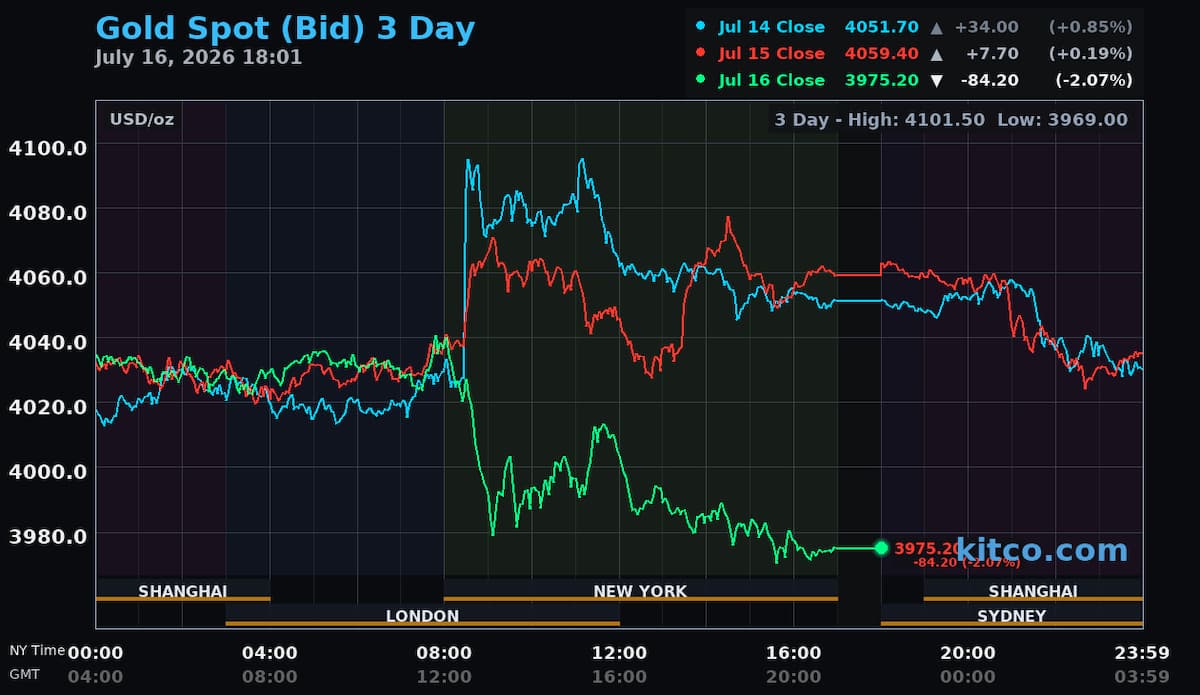
Technically, spot gold bears have the overall near-term technical advantage as prices broke below the psychologically important $4,000 level and closed near an 11-day low after repeated failures at the 20-day moving average. Bulls’ next upside price objective is to push prices back above $4,000, with a sustained move targeting the $4,020 to $4,040 resistance band and then $4,065. Bears’ next near-term downside price objective is a break below $3,969, with deeper downside targets at the $3,930 to $3,950 support zone and then $3,886. First resistance is seen at $4,000 and then at $4,040. First support is seen at $3,969 and then at $3,950.
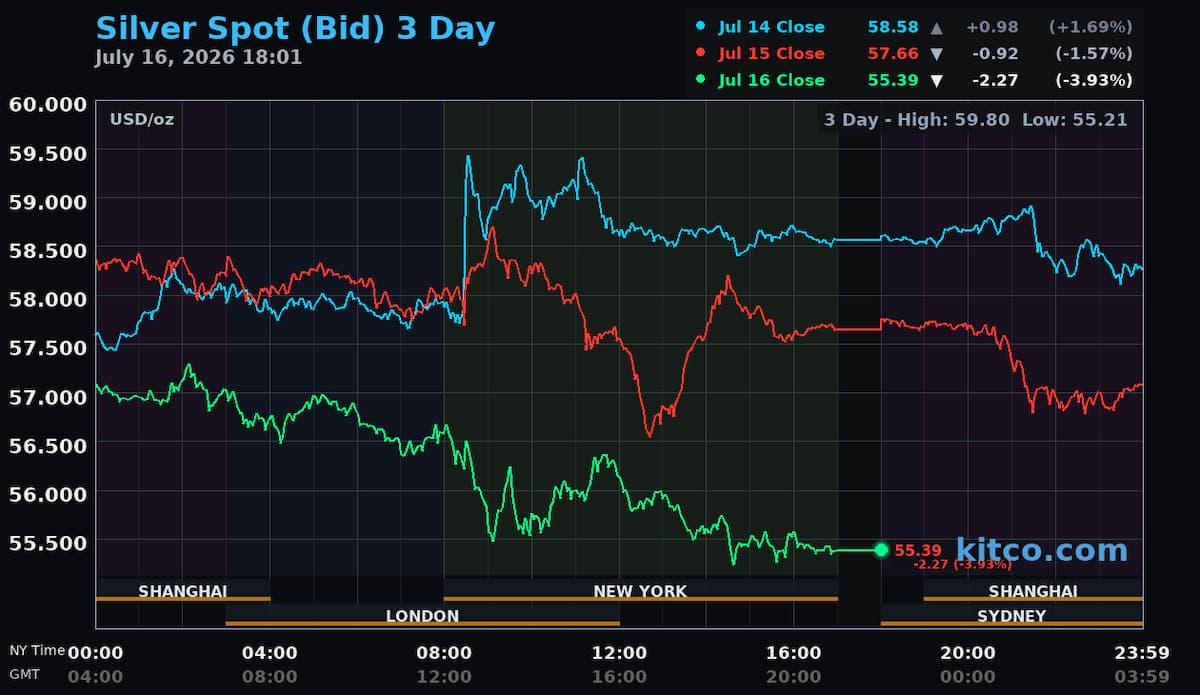
Spot silver bears have the overall near-term technical advantage as prices broke below $57.52 and moved through the $57.13 channel-floor area, weakening the short-term structure. Silver bulls’ next upside price objective is to drive prices back above $57.52, with a move above that level targeting $58.83 and then $60.41. The next downside price objective for the bears is a break below $55.21, with deeper downside targets at $54.80 and then $53.42. First resistance is seen at $57.13 and then at $57.52. Next support is seen at $55.21 and then at $54.80.

Disclaimer: The views expressed in this article are those of the author and may not reflect those of Kitco Metals Inc. The author has made every effort to ensure accuracy of information provided; however, neither Kitco Metals Inc. nor the author can guarantee such accuracy. This article is strictly for informational purposes only. It is not a solicitation to make any exchange in commodities, securities or other financial instruments. Kitco Metals Inc. and the author of this article do not accept culpability for losses and/ or damages arising from the use of this publication.