A nascent megathrust: Imaging the Haida Gwaii thrust
The deep, east-dipping reflections that we interpret as underthrusting oceanic crust and sediment beneath the QCT, topped by a décollement, are the most important observation from the seismic imaging data (
Figs. 2 to
6). The underthrusting material can be traced for ~26 to 30 km past the deformation front to just west of the interpreted QCF (extrapolated linearly to depth) and for ~180 km along strike (
Figs. 2 to
6). The character of these reflections changes between profiles, from a high-amplitude series of reflections [QCF05 (
Fig. 4) and QCF06 (
Fig. 5)] to a high-amplitude base reflection and a faint top reflection [QCF16R (
Fig. 2) and QCF04 (
Fig. 3)] and to a high-amplitude top reflection and low-amplitude base reflection [i.e., QCF01B: CMP 23,000 to 28,000 (
Fig. 6)]. The differences in character are possibly related to variations in the physical properties (i.e., lithology or pore pressure) within the underthrusting sediment package that influence the acoustic impedance (
41,
42).
We interpret this décollement as the Haida Gwaii thrust, which separates underthrusting oceanic crust and sediments from the overriding QCT material and which ruptured in the 2012 earthquake (
18,
27). This direct imaging of the Haida Gwaii thrust beneath the QCT shows that it is a throughgoing fault, extending for at least 30 km past the deformation front and for at least 180 km along strike (
Figs. 2 to
6). The existence of a throughgoing detachment fault beneath the QCT provides important constraints on slip models of the 2012 earthquake, validating those with substantial slip on a low-angle fault beneath the QCT (
25). Furthermore, this subsurface geometry suggests that hypothetical models of larger earthquakes in this region are also possible, with potential slip over a greater area of the plate-boundary thrust (
25). The Haida Gwaii thrust likely extends farther to the north and south of this study, but a more thorough mapping using all available data is needed to constrain its complete geometry along the plate boundary.
Behavior of the QCT in response to oblique convergence
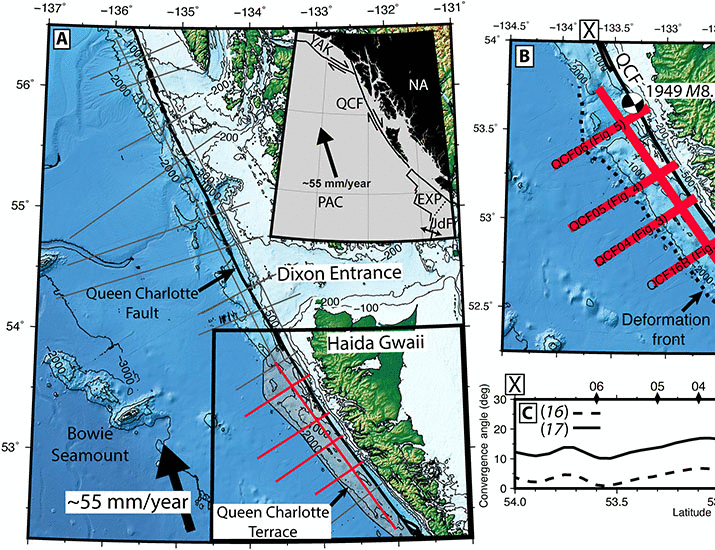
Oblique convergence increases from north to south along the QCPB, from near 0° in the northern section to potentially upward of ~25° offshore Haida Gwaii (
Fig. 1C) (
16, 17). The most recent Euler pole estimate, based on high-resolution bathymetric data and tectonic geomorphology along the QCF, suggests less convergence offshore Haida Gwaii, with obliquity closer to ~5° to 10° (
Fig. 1C) (
16). Thus, the estimated magnitude of modern convergent plate motion in the southern QCPB differs greatly between studies, ranging from ~5 to 25 mm/year (
16,
17). The seismic profiles presented here are spaced at ~15 to 25 km along strike but show substantial variability in the crustal structure of the QCT (
Figs. 2 to
5). The outer slope of the QCT contains thrust structures with offset and folding that reaches the seafloor (
Figs. 2 to
5). The inner slope of the QCT also contains predominantly thrust structures, although they have little to no seafloor expression and are generally covered by slope sediments (
Figs. 2 to
5). Growth strata in the slope sediments deposited on the back of some thrust ridges suggest that there may be a complicated deformation history, as several packages of growth have intermittent stages of uplift while others show contemporaneous uplift (
Figs. 2 to
5). In conjunction with the underthrusting crust beneath the QCT, this thin-skinned thrust system acts as the main accommodation mechanism for convergence along Haida Gwaii (
Figs. 2 to
5).
Except for the frontal thrusts on QCF06, we observe complicated fault geometries and horizons that are difficult to trace laterally (
Figs. 2 to
5). The lack of both simple convergent structures and spatially continuous horizons within the outer slope stand in contrast to simpler accretionary prism geometries observed in some parts of convergent margins with similar incoming sediment thicknesses, like Cascadia or Hikurangi (
43,
44). Surface processes may play a role, as the outer slope tends to have rougher bathymetry than the inner slope, which could inhibit the quality of imaging, leading to the observed character (
Figs. 2 to
5). However, we suggest that this contrast is more related to the high obliquity of the plate boundary (
Fig. 1C) and that the complexity of the frontal thrusts is likely the result of some strike-slip motion sliding equivalent strata out of plane (
Figs. 2 to
5). With two-dimensional (2D) profiles alone, it is extremely difficult to constrain the exact amount of along-strike motion on the frontal thrusts, but profile QCF01B shows that the shallow structure of the central QCT is highly complex along strike with both strike-parallel shortening and extension, confirming that at least a small portion of the strike-parallel motion is accommodated within the QCT (
Fig. 6). Notably, portions of the inner slope tend to feature simpler deformation patterns than the outer slope, with tilted and folded strata that are more laterally continuous (
Figs. 2 to
5). This possibly suggests that earlier thin-skinned thrusting had less oblique motion accommodated by those faults compared to the current frontal thrusts.
The innermost portion of the slope, within ~5 km of the QCF, is dominated by near-vertical faults that are steeper than the thrust structures in the rest of the QCT and likely experienced strike-slip motion (
Figs. 2 to
5). On QCF16R and QCF04, these faults have steep traces with minimal dip slip and some tight folds, and they lack a surface expression (
Figs. 2 and
3). On QCF05 and QCF06, the faults form the core of seafloor ridges just west of the QCF and appear to have mostly reverse slip with uplift based on the overlying folds (
Figs. 4 and
5). The folding and some small-scale faulting within the ridges almost reach to the seafloor, but it is unclear whether this deformation is recent or whether it is near the seafloor because of a lack recent sedimentation (
Figs. 4 and
5). We do interpret duplexed crustal material beneath these ridges on the basis of the overall geometry, and the spatial correlation of the duplexed material and the uplifted ridge suggests that there is a potential connection between them (
Figs. 4 and
5). The duplexing could have uplifted the material above, forming the ridges by activating or reactivating the steep faults. However, the timing of this potential connection between the duplexing and slip on the near-vertical faults remains unclear, so it may have occurred early in the system’s history or may represent more recent deformation.
Progressive localization and backstop behavior of the QCF
Our study provides regional-scale synoptic imaging of the main QCF zone offshore Haida Gwaii. The main fault structure has a near-vertical trace in the shallow subsurface, generally expressed as a narrow zone with low reflectivity or minimally offset strata consistent with previous work suggesting localized deformation (
Figs. 2 to
5) (
16,
18). At the mapped QCF surface trace location (
16), each MCS profile features a coincident seafloor expression (
Figs. 2 to
5). The subsurface extent of the QCF we can interpret reaches ~1.5 to 2.0 s twtt beneath the seafloor (
Figs. 2 to
5). Although the strata to the west of the QCF are folded, there is minimal evidence for convergence or extension across the main fault itself, indicating that the QCF is a pure strike-slip system along this portion of the QCPB (
Figs. 2 to
5). We estimate that the QCF has a slight east dip in the shallow subsurface, from ~85.7° to 89°, which is steeper than the ~40° to 60° dips determined by recent seismicity studies of the region (
27). This indicates that while the shallowest QCF is near vertical, the deeper QCF may have a listric geometry (
27). The width of the QCF’s low reflectivity zone, which we interpret as the fault damage zone, varies between profiles, from ~370 m on QCF06 to ~820 m on QCF16R (
Figs. 2 and
5). This range of widths may reflect lithologic differences or locally differentiated sedimentary environments that affect the size of the damage zone, as the sharp QCF trace observed on QCF05 could reflect slip through recently deposited, soft sediments, which would promote extreme localization compared to other lithologies (
Figs. 2 to
5). Beyond this narrow damage zone, the QCF has highly localized deformation, with the only nonlocalization features being a small flower structure on QCF05 (
Fig. 4E) and an adjacent active strike-slip fault on QCF04 (
Fig. 3E).
The proximity of the steep, likely strike-slip faults located west of the QCF indicates that the early behavior of the system may have been more distributed than its modern state. Many transform plate boundaries have slip distributed across several fault strands instead of being localized to one fault. Early deformation offshore Haida Gwaii appears to have been distributed across several strands close to the QCF before progressively localizing to the main QCF trace. This transition could have been related to the initiation of thin-skinned thrusting within the QCT, as the thrusts and strike-slip faults are not colocated. This progressive evolution toward strain-partitioned behavior has been observed in analog models of high-obliquity transpression, where early deformation has slip accommodated across many oblique faults before evolving toward strain partitioning and localization (
45–
48).
Shallow deformation east of the QCF is less intense than in the crust west of the QCF. Reflections east of the QCF, on the Haida Gwaii shelf, range from subhorizontal to west dipping with varying amounts of deformation, from minor tilting with few small-scale faults to more notable folding with more concentrated faulting (
Figs. 2 to
5). Beneath the shelf, we image several deeper, west-dipping reflections consistently at ~2.0 s twtt beneath the seafloor, which may represent the boundary between geologic units of Haida Gwaii or may be the result of deformation that we cannot fully resolve near the edge of the profiles because of the low fold of the data (
Figs. 3 to
5). The difference in deformation across the QCF suggests that the North American crust east of the QCF acts as a backstop for the convergent deformation in the QCT or that, because the QCF is a mature and localized strike-slip fault, it is too weak to effectively transfer stress across it (
Figs. 2 to
5). Some seismicity is present within the shallow crust of Haida Gwaii, suggesting that some stress could be transferred across the QCF or that it may derive from elsewhere (
27).
Tectonic framework of the QCT: A strain-partitioned crustal sliver
Before this study, the lack of deep imaging in the QCT perpetuated ambiguity around the definitive tectonic framework of the southern QCPB. Previous frameworks for the QCT fall into two end members, oblique convergence accommodated via crustal thickening of the Pacific plate to the west of the QCF (i.e., a transform plate boundary) or underthrusting of the Pacific plate beneath the QCT and potentially Haida Gwaii (i.e., a subduction zone) (
18,
19). With crustal thickening, we would expect to see thick-skinned deformation of the Pacific plate with thrust faults that offset and uplift the oceanic sediments and crust to form the QCT (
16,
20). This shortening mechanism was best supported by observations of seismic velocities within the QCT that were faster than normal sediment consolidation would predict (
36,
37,
49) and by gravity models (
19,
29,
49). With underthrusting, we would expect thin-skinned deformation with no basement-involved thrust faulting beneath the QCT as seen in subduction zone accretionary prism settings. In this case, the QCT would be constructed from accreted, deformed, and compacted oceanic sediments derived from the Pacific plate, overlying underthrusting crust.
In the seismic profiles presented here, we image underthrusting oceanic crust and sediments and an overlying décollement (the Haida Gwaii thrust) up to ~30 km past the deformation front, with no apparent deformation within the underthrusting oceanic crust (
Figs. 2 to
5). Comparing the velocities determined by our reflection processing workflow to previous studies that used refraction data, we find that normal sediment consolidation fits the trend of velocities in the QCT and that the refraction-derived velocities fall near the high end of our range (fig. S6) (
36,
37,
44). This comparison suggests that the previous studies have accurate velocities for the QCT, and vice versa, but that interpretations of basaltic crust within the QCT based on those higher velocities may have been incorrect (fig. S6) (
36,
37). Thin-skinned thrusts branching off the Haida Gwaii thrust have accreted oceanic sediments, building up the QCT (
Figs. 2 to
5). These features indicate that underthrusting is the primary mechanism currently accommodating convergence between the Pacific and North American plates in this region. We converted the seismic profiles to depth using seismic velocities determined during the reflection processing (figs. S1 to S5) and then used the depth-converted profiles as a base for interpretative models of the QCT (
Fig. 7). The Haida Gwaii thrust dips toward North America between ~9° and 13°, reaching between ~8 and 12.5 km beneath the surface location of the QCF (
Fig. 7). Along strike, the depth of the Haida Gwaii thrust varies from ~8 to 11 km (
Fig. 7).
We propose a tectonic framework for the southern QCPB in which the QCT resembles a crustal sliver bounded by the QCF to the east and the frontal thrusts to the west (
Fig. 8). The underthrusting crust and sediments are separated from the overlying QCT sediments by a laterally extensive plate-boundary thrust fault, the Haida Gwaii thrust (
Fig. 8). The QCT is separated from North America by the QCF, which accommodates most of the system’s strike-slip motion (
Fig. 8). Thrust faults within the QCT connect at depth to the Haida Gwaii thrust in a thin-skinned style of deformation (
Figs. 7 and
8), indicating that frontal accretion of sediments is mostly responsible for the continued growth and uplift of the outer ~10 to 15 km of the QCT. The QCT is constructed from mostly accreted oceanic sediments derived from the Pacific plate (
Figs. 7 and
8). Slope sedimentation is present on the QCT, covering the accreted material where accommodation space is available (
Figs. 7 and
8). The underthrusting oceanic crust and buildup of the QCT has caused the Pacific plate to downwarp, resulting in extensive normal faulting outboard of the deformation front (
Fig. 8) (
21). Our imaging does not continue past the Haida Gwaii shelf, but underthrusting may continue beneath the archipelago, as suggested by a cluster of seismicity from the potential intersection of the listric QCF and the slab, by receiver functions that detect a low-velocity zone at ~25- to 50-km depths, and by heat flow modeling that explains cooler geotherms through underthrusting of the Pacific plate (
Fig. 8) (
28,
31–
33,
50).
The dips determined from our MCS profiles are lower than the dip determined by earthquake source modeling for the 2012 Haida Gwaii earthquake or by receiver function analysis beneath Haida Gwaii, both of which range from ~15° to 30° (
Fig. 7) (
31–
33). This difference implies that if the Haida Gwaii thrust continues west beyond the QCF, either the dip steepens or the underthrust material is shallower than previously thought. The thickness of the underthrust oceanic crust ranges from ~7.5 to 8.5 km (with ~1 to 2 km of underthrusting sediment) (figs. S1 to S5), compared to an ~12- to 17-km-thick low-velocity zone beneath Haida Gwaii determined by receiver functions (
Fig. 8) (
31–
33). The discrepancy in dip could be due to underestimated velocities at the base of the QCT in our depth conversions, which would erroneously reduce the dip of the underthrusting material and also would result in the apparent along-strike variability (
Figs. 7 and
8). The difference in thickness could also reflect velocity-depth trade-offs, but it is more likely due to the difference in frequency content of the receiver functions, with one conversion representing the entire slab (
31–
33). It is also possible that the entire low-velocity zone reflects more than just the oceanic crust, as there may be some damage or hydration in the mantle that broadens the detected low-velocity area (
31–
33).
Subduction initiation in the Northeast Pacific
Transform plate boundaries are considered an ideal location to initiate subduction, especially continental-oceanic transforms, because of a preexisting weak zone and substantial lithospheric density contrast (
11–
13). Subduction initiation falls on a spectrum with stages based on observed characteristics, ranging from incipient systems with distributed deformation to self-sustaining subduction zones (
13). Previous studies of the QCPB that framed the region as a subduction zone did so despite large uncertainties in the shallow crustal structure of the system and the lack of characteristic subduction zone features (i.e., a Wadati-Benioff zone and arc volcanism) (
18,
27,
28,
39). This study brings together the QCT’s structure with seismicity and receiver function imaging, providing a more complete picture of the system that was originally hypothesized decades ago and has been debated since (
18,
19,
51). Deformation along the southern QCPB has localized to two major plate-boundary faults (the QCF and the Haida Gwaii thrust), with a slab likely extending into the mantle beneath Haida Gwaii, but the system lacks arc volcanism and a Wadati-Benioff zone, which are the criteria for “achieved” subduction (
Figs. 7 and
8) (
13,
18,
27,
28,
31–
33,
50). We interpret the southern QCPB as a representation of incipient subduction with localized deformation (
13).
The southern QCPB is therefore a rare example of in situ subduction initiation at a transform plate boundary, and our imaging captures this fundamental tectonic process in its infancy. The major change in Pacific plate motion ~6 Myr ago has been considered the starting point for convergent-style deformation and subduction along the QCPB (
17,
20,
21). Some convergence did occur along the plate boundary before ~6 Myr ago with the translation of the Yakutat terrane starting ~25 Myr ago (
17,
30,
39). The thick Yakutat crust collided with North America along the QCPB, uplifting Haida Gwaii by ~3.0 to 6.0 km and causing ~8.0 to 10.0 km of shortening in the Queen Charlotte Basin behind Haida Gwaii (
19,
39). Pacific crust following immediately behind the Yakutat’s crust could have underthrusted as it passed Haida Gwaii ~11 Myr ago, but the exact amount is complicated by the dynamics of the Explorer plate region at the time (
52,
53). With oceanic crustal ages of ~8.5 Myr on QCF16R and ~11.5 Myr on QCF06, the southern QCPB has experienced the highest convergence rates for a majority of its life, giving us a glimpse into the earliest stages of subduction initiation–related deformation (
54).
Constraining the earliest history of subduction zones in the geologic record is challenging because those rocks have been heavily altered or are now located deep in the mantle; thus, records of the earliest stages are valuable (
55–
58). With thick incoming oceanic sediments forming the QCT, the southern QCPB should have more complete records of the earliest deformation. We find that the earliest deformation recorded by the QCT is distributed strike slip across several steep faults (
Figs. 2 to
7). The width of the strike-slip zone is relatively narrow compared to the overall QCT, suggesting that the evolution to strain-partitioned deformation occurred rapidly (
Figs. 2 to
7). This rapid evolution could have been enhanced by the thick incoming sediments on the Pacific plate, which would have allowed the nascent Haida Gwaii thrust to develop faster than if the incoming material was only basaltic oceanic crust. This suggests that a thick preexisting sedimentary basin adjacent to the site of subduction nucleation could substantially supplement the efficiency already noted at transform boundaries, causing the process to progress more rapidly. Previous deformation along the plate boundary may have also played a critical role in the rapid evolution of structure along the southern QCPB. Uplift of Haida Gwaii and shortening in the Queen Charlotte Basin driven by the Yakutat terrane may have aided initiation by pushing the North American crust to a more favorable geometry, allowing the Pacific crust to underthrust more easily (
19,
30,
39). Our results suggest that despite low convergence rates (~5.0 to 25 mm/year) and relatively low cumulative convergence over the last ~6 Myr, the strain along the southern QCPB rapidly became partitioned and subduction was initiated with great efficiency (
16,
17).
As a strain-partitioned crustal sliver, the QCT resembles other oblique subduction zones like Puysegur, Lesser Antilles, and Sumatra (
Figs. 7 and
8) (
8–
10,
15,
59). The Puysegur Trench may be the most analogous locale to the southern QCPB as it is a subduction zone that initiated within the last ~5 to 17 Myr that was enabled by a prior stage of strike-slip deformation and currently features a crustal sliver accretionary prism (
10,
15,
59). Despite the similar time frames of convergence, the Puysegur margin exhibits many typical subduction zone features that are not present in the southern QCPB, including a seismic Wadati-Benioff zone, arc volcanism, and a deep seafloor trench, suggesting that the QCPB slab has likely not reached the conditions needed to promote intraslab earthquakes and melting for arc volcanism (
10,
32,
33,
38). The differences between Puysegur and Haida Gwaii may be related to differences in convergence rate and the time under convergence, which determines the cumulative convergence and therefore the maturity of the system. At the Puysegur Trench, the Pacific and Australian plates converge obliquely (~30°) with a convergence rate of ~21 mm/year, compared to recent convergence rate estimates of ~5.0 mm/year at an angle of obliquity of ~5° to 25° offshore Haida Gwaii (
15,
16,
60). The Puysegur Trench is also longer along strike than the QCT, ~430 versus ~220 km, allowing for more convergence to accumulate as the plate translates (
Fig. 1B) (
10). The relative differences between Puysegur and the QCPB could also be related to the regional tectonics of New Zealand as the Puysegur slab there is forced under thick Zealandia crust with a steep dip, and it may interact with the adjacent Hikurangi slab in the mantle, both of which could increase slab seismicity (
61). The Puysegur slab is also likely more hydrated than the northeast Pacific, with little sediment cover on slow-spreading oceanic crust; thus, additional dehydration reactions could promote seismicity and melting (
10,
62). This thin sediment cover on the incoming plate likely also explains the difference in appearance between the Puysegur sliver and the QCT (
10,
15). While the southern QCPB is less mature than the Puysegur Trench, both environments highlight the efficiency of subduction initiation at transform plate boundaries following a major change in plate motions and advance our understanding of the earliest stages of the process.
The fate of the QCPB with regard to subduction is uncertain. While it has efficiently evolved to its current state, subduction initiation can fail at any stage before self-sustained subduction is reached; thus, the QCPB evolving to this point does not guarantee a future outcome (
13). Given the oceanic crustal age and slip motion components, the QCPB could theoretically evolve to self-sustained subduction along Haida Gwaii in ~8 to 25 Myr (
14). “Slabitization” models show that once subduction has nucleated and a slab enters the mantle, large resisting forces stagnate the process for at least ~5 to 8 Myr, but once the plate-boundary shear zone develops and the point of viscous coupling deepens, the plate interface can unlock and the process accelerates (
55–
58). With substantial convergence starting ~6 Myr ago, the southern QCPB is within this critical slabitization period, suggesting that the system’s evolution could soon accelerate toward achieved subduction. However, as the convergence angle between the plates decreases moving south to north, in the same direction as the Pacific plate motion, the current geometry of the plate boundary limits the maximum convergence that can accumulate so the system may stagnate without a major plate motion change (
16,
17).
Determining how oblique convergence is accommodated along the southern QCPB has broad implications for plate boundary evolution, seismogenesis, and subduction initiation. Our results show that convergence is accommodated by accretionary prism–style processes with strike-parallel motion partitioned onto the QCF. The tectonic framework of the southern QCPB is therefore more analogous to oblique subduction zones than to transpressional strike-slip regions globally and that behavior needs to be considered in future work in this region. Our imaging confirms that the M7.8 2012 Haida Gwaii earthquake ruptured a continuous, throughgoing plate-boundary thrust fault beneath the QCT that likely continues beneath Haida Gwaii. The geometry of the Haida Gwaii thrust suggests that larger thrust earthquakes could nucleate along the margin and that tsunamis could be more common, both of which substantially increase the hazard of the region. The southern QCPB showcases how efficient subduction initiation can be at transform plate boundaries. This study provides insight into the earliest stages of the subduction initiation process, suggesting that these systems can rapidly evolve from distributed to partitioned strain as they develop a shallow plate-boundary shear zone. In addition to a preexisting weak zone, deformation of the margin and a thick sequence of sediments can catalyze the process of subduction initiation.