
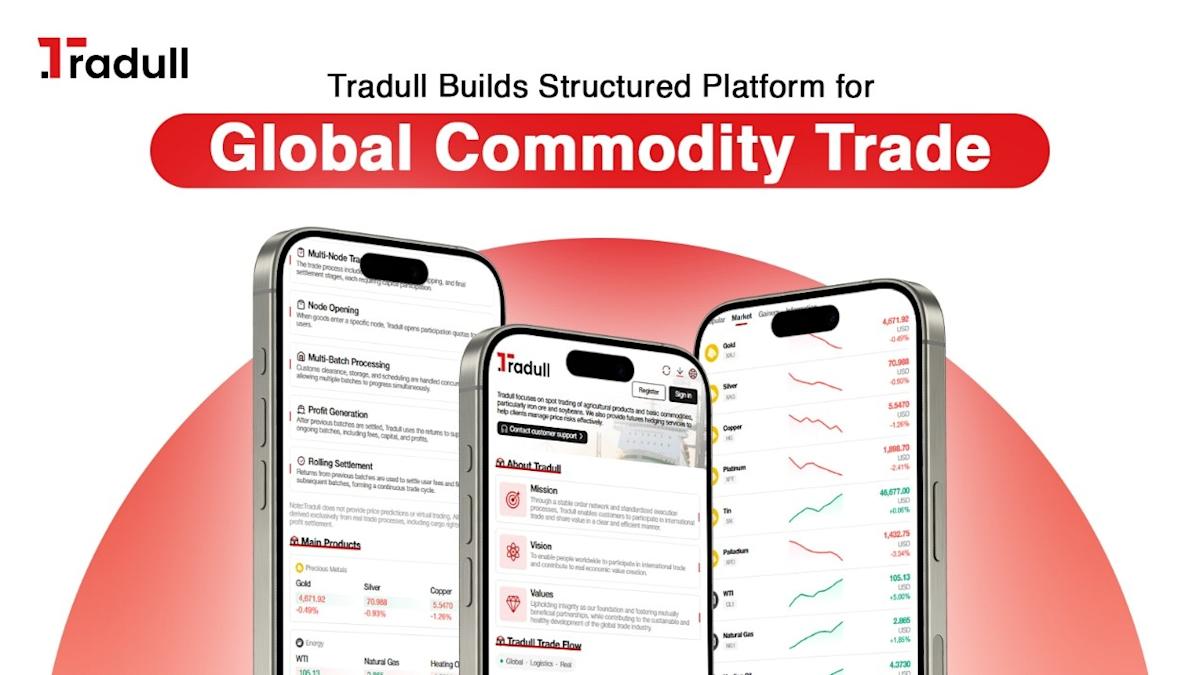
NEW YORK, April 18, 2026 (GLOBE NEWSWIRE) — Tradull has introduced a structured framework aimed at improving visibility and organization within commodity trade workflows, reflecting broader changes in how global trade operations are being digitized and systematized.
In today’s global economy, commodity trade continues to play a central role in ensuring the movement of essential resources. Alongside this importance, the industry is increasingly shaped by supply chain volatility, shifting logistics routes, and rising demand for operational reliability. These factors have placed greater emphasis on execution efficiency and process coordination across trade networks.
At the same time, the complexity of commodity trading systems has historically made the sector difficult to interpret for external observers. Many stages of the trade lifecycle—including sourcing, logistics, and fulfillment—have traditionally operated within fragmented or highly specialized environments.

Tradull’s approach focuses on organizing these operational stages into a more structured format. According to available information, the platform integrates trade-related activities such as resource coordination, logistics management, and fulfillment processes within a unified execution framework. It also presents these stages in a structured format intended to improve clarity and process visibility.
The model distinguishes between operational execution and information presentation. While trade activities continue to operate within established commercial and logistical frameworks, the platform aims to make workflow stages more observable through structured system design.

Public information indicates that since 2025, Tradull has been progressively refining its platform structure and project system, continuously optimizing process segmentation, information display, and project management. Entering 2026, with increased operational maturity and evolving market conditions, the platform has shown accelerated growth in both business development and market attention.
Industry observers note that amid ongoing changes in the global trade environment, the demand for both execution capability and information clarity is rising. Traditional fully closed trading systems are increasingly unable to meet these new expectations, while platforms that combine real trade foundations with structured presentation are emerging as a new direction.
In the long term, commodity trade will continue to revolve around the flow of resources, but its external form is evolving—from a highly closed professional system toward a complex system with structured visibility. Balancing professionalism with clarity will remain a key area of exploration for the industry.