

Gold loans, which currently account for around 25% of the loan book, are expected to grow 17-18% this financial year to reach 27-28% of the overall book by year-end.
“Even if there is an increase in losses for the industry, we should perform a little bit better than the industry,” Seshadri said, citing the bank’s underwriting standards and low cost of funds.
The bank reported gross non-performing assets (NPA) of 1.38% and net NPA of 0.26% for the Indian Bank The management acknowledged that delinquencies could rise if geopolitical tensions persist.
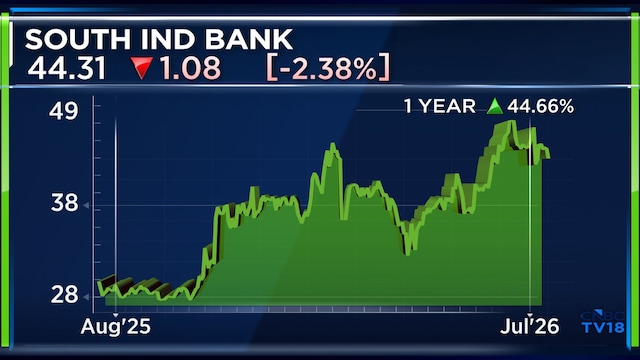
South Indian Bank, which has a market capitalisation of ₹11,600.65 crore, has delivered a 44% gain in its share price over the past year.
This is an edited transcript of the interview.Q: Let me start with the asset quality because that looks particularly strong for South Indian Bank. Your gross NPAs have come down to 1.38%, while net NPAs are below 0.3%. Will these trends sustain as you scale up? And because of what’s happening in West Asia, and concerns in the market about MSME stress, are there any pockets you’d like to flag or give us guidance on for the full year?A: We’ve had a very good quarter, and we are feeling quite good about it.
The asset quality numbers are particularly strong. Our slippages for the quarter were 12 basis points, which means that, on an annualised basis, they are about 48 basis points. Net NPAs are down to 26 basis points. While we have seen a little bit of an uptick in delinquencies, that happens every year in the first quarter because we go through a bunch of transfers and reassignments and so on. We don’t see that as being very material.
Our SMA-1 and SMA-2 numbers continue to be – they were around 60 basis points last quarter. Now they are about 80 basis points or thereabouts.
The impact of the West Asia crisis is a little hard to predict because petroleum is used in almost everything on this planet. Therefore, even the first-order impact is hard to predict, and the second-order and third-order impacts become almost impossible to predict.
So, our outlook is that there will be an increase in delinquencies if this were to continue. Given El Niño and so on, there will be an added complication. Going forward through the year, there may be a little increased stress.
But we are feeling reasonably good about our underwriting standards. Our belief is that what we’ve done so far will hold us in good stead, and even if there is an increase in losses for the industry, we should perform a little better than the industry. That’s what we are looking forward to.
Our strategy has been that we have traded off price for quality, and as a consequence, we have leveraged the fact that we have among the lowest costs of funds in our peer group. That has also helped our asset quality.
Q: The one segment that everybody is talking about right now is gold loans and increasing competition, with all kinds of lenders also making a foray into this space. Your gold loans grew 43% this time around. How much of that was volume-led compared to price-led, and what kind of growth are you anticipating ahead? Are you planning on scaling this business into a significant part of your overall book?A: Gold loans now are approximately a quarter of our total book. We think that there is still some room for it to grow, but we will have to cap it at some point in time. We think that by the end of this year, gold loans will account for closer to 27-28% of the total book, and we expect to grow the portfolio by about 17-18% for the year, if the first quarter is anything to go by.
We will continue to grow gold loans. While there has been a significant increase in competition, we are not seeing any decrease in volumes. We continue to grow our balance sheet by ₹20-30 crore a day.
We think that this trend will continue. Prices have come off a little. Gold prices were trading at around $5,500 per ounce at their peak. Now they’re down to a little under $4,000 per ounce. Therefore, any growth that we get now will be driven by the actual tonnage of gold held with us. We see this as an area where strong growth will continue.
Q: In the first quarter, your margins have improved quite a bit. They stand at 3.23%. With your cost of deposits also helping, do you think margins can meaningfully expand from these levels for the rest of the year, or is this the normalised level we should expect? Also, what are your medium-term targets for return on assets and return on equity?A: The way we work is that we give effect to any repo rate change on a T+1 basis. So, when repo rates go down, we get impacted immediately. The reason why we chose to do that is our belief that if you do it quickly, then you adjust to it quickly.
We are at a point in the rate cycle where rates are likely to rise. So, if rates were to increase, we would be beneficiaries almost immediately. The view today is that rates will increase at some point in time—maybe not immediately, but perhaps a quarter down the road or a quarter and a half down the road—which means that the spreads you’re seeing today should improve as we go forward.
Q: Your book outside Kerala is now almost 70%. Do you plan on increasing that number? If so, what kind of steps are you taking? What is your branch expansion plan for this year?A: We want to be a material player in peninsular India, Maharashtra, Gujarat, and the Delhi-NCR area. Those are the areas of focus for us.
We intend to start growing our branch distribution in southern India, excluding Kerala, during this year and going forward as well. The majority of our growth is now coming from outside Kerala on the asset side.
Liability tends to be more evenly distributed, with significant growth coming from Kerala as well. We are not deprioritising Kerala. Kerala is a place where we want to be the home bank. We want to be the preferred bank in Kerala, and we’re working as hard as we can to make that happen by having a strategy that is fit for purpose in the state, where we have approximately six million customers.
We’ve had meaningful growth in places like Mumbai, Delhi, Bengaluru, Hyderabad, and so on, and we intend to continue doing what we have done over the last year or two.
For the full interview, watch the accompanying video

Catch all the latest updates from the stock market here