
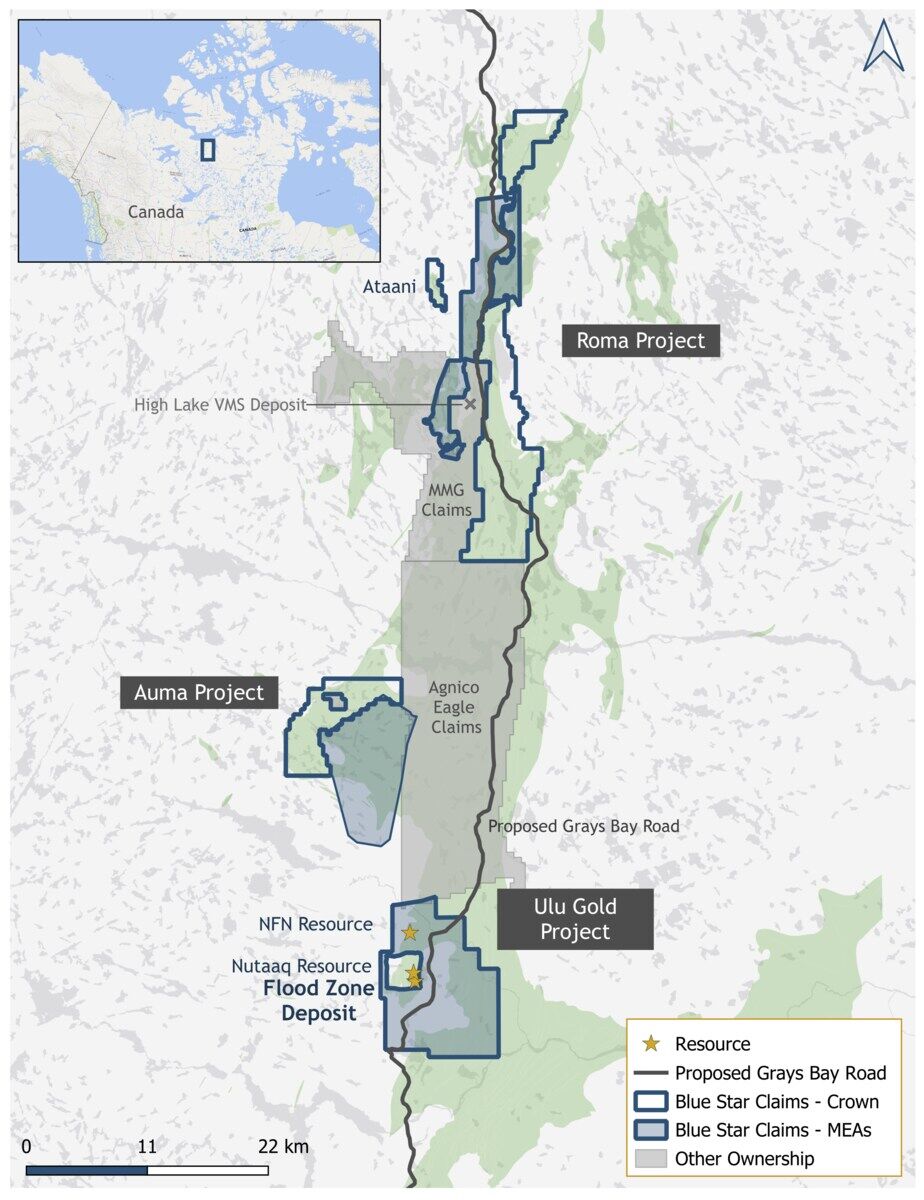
Blue Star Gold Corp. July 6 announced that it has been selected to receive up to C$250,000 in funding through Nunavut’s Discover, Invest, Grow, or DIG program, and provided an update on the Grays Bay Road and Port Project that runs through two of the company’s three projects along an 80-kilometer (50 miles) stretch of Nunavut’s High Lake Greenstone Belt.
Established to support early-stage exploration and encourage local employment in Nunavut, DIG provides grants for mineral exploration projects in the territory that include at least:
• 500 meters of reverse circulation (RC) or rotary air blast (RAB) drilling, or;
• 2,000 meters of diamond drilling or;
• 1,000 metric tons of bulk sampling.
To help support local businesses, mineral projects that use Nunavut goods and services, including local employment, receive priority consideration.
Successful applicants may receive up to 25% of eligible expenditures, to a maximum of C$250,000 per year, and up to C$500,000 over a project’s lifespan.
“There is abundant, yet-to-be realized value in the vast underexplored, and highly prospective Territory of Nunavut,” said Blue Star CEO Grant Ewing. “Exploration support programs like this improve investor confidence, demonstrating that Nunavut is an excellent jurisdiction for precious and critical metals exploration and development.”
This year, Blue Star has been awarded a $250,000 grant for its 2026 exploration at Auma, one of three projects the company is exploring along the High Lake Greenstone belt.
The company plans to complete 2,000 meters of drilling this year at Auma’s Bamako prospect, where historical drilling cut 2.6 meters of 15.3 g/t gold and grab samples collected from an undrilled target returned grades as high as 151.5 g/t gold.

Blue Star Gold Corp.
In addition to the DIG grant award, Blue Star reported that the Canadian government has initiated consultations to consider listing the Grays Bay Road and Port Project as a project of national interest under the Building Canada Act.
This designation would expedite the funding, financing, and construction of the proposed 230-kilometer (145 miles) road to a new deep-water port along Northwest Passage shipping routes on Nunavut’s Arctic coast.
Once completed, this nation-building infrastructure project is expected to unlock mining projects throughout the Slave Geological Province, one of the richest mineral districts in Canada’s North.
The Grays Bay Road would run through Blue Star’s Ulu Gold and Roma projects, and about eight kilometers (five miles) east of Auma.
Road access to shipping lanes would lower the development and operational costs for any future mines developed on these projects.
Ulu, the most advanced of the projects along the route, hosts 2.2 million metric tons of measured and indicated resources averaging 7.87 g/t (558,000 oz) gold, plus 3.26 million metric tons of inferred resources averaging 4.54 g/t (476,000 oz) gold in two deposits.
Roma, the northernmost Blue Star project, hosts both high-grade gold targets and polymetallic volcanogenic massive sulfide (VMS) targets enriched with copper, zinc, and other critical minerals.
Blue Star plans to explore all three of its projects this year.
“The stage is set for a high-impact exploration season, supported by a comprehensive program designed to maximize discovery potential and advance resource growth across multiple high-priority target areas,” said Ewing.
Author Bio
Shane Lasley, Publisher

Over his more than 18 years of covering mining and mineral exploration, Shane has become renowned for his ability to report on the sector in a way that is technically sound enough to inform industry insiders while being easy to understand by a wider audience.