
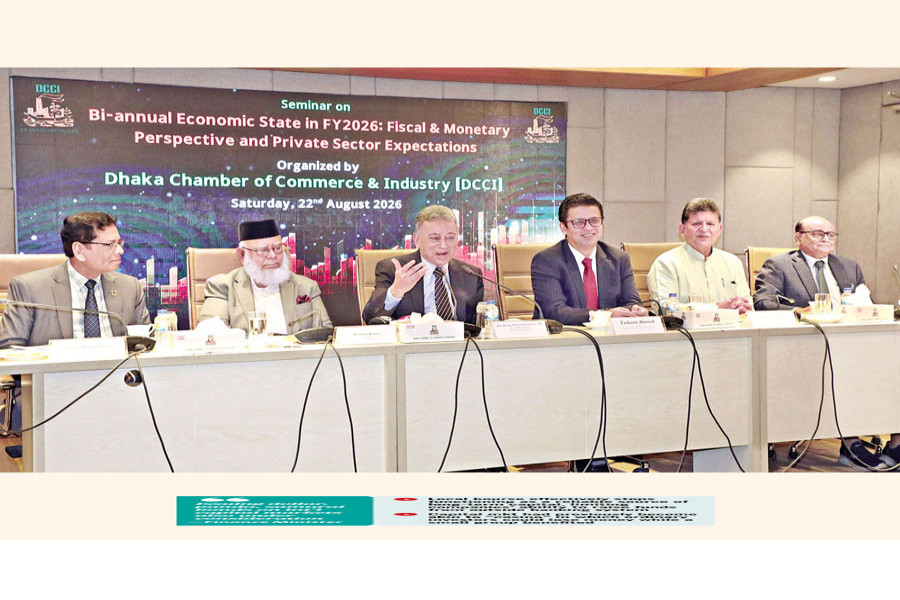
Finance and Planning Minister Amir Khosru Mahmud Chowdhury unveiled the plan on Saturday, explaining that the proposed Bangladesh-dedicated fund would provide equity rather than loans, meaning it would not create a direct debt obligation for the government.
“We are going to have a dedicated fund for Bangladesh in Hong Kong. It will be a $2.0 billion worth of Bangladesh-dedicated fund. This is equity and not a loan,” he said at a seminar organised by Dhaka Chamber of Commerce and Industry (DCCI) in Dhaka.
The seminar, titled ‘Biannual Economic State in FY2026: Fiscal & Monetary Perspective and Private-Sector Expectations’, brought together policymakers, economists, bankers and business leaders.
The proposed fund is part of a broader effort to widen Bangladesh’s access to international capital as the government seeks to ease pressure on domestic-financing sources and create more room for private-sector borrowing.
Mr. Khosru said Bangladesh was also considering issuing dollar, panda and samurai bonds to tap different international capital markets.
“We want to go for dollar bonds. We will go for panda bonds and samurai bonds,” he said.
The government has already reduced its reliance on bank borrowing to some extent, but the shift would take time, he told his business audience.
“We have already brought down bank borrowing somewhat. But, the process will take time. We are moving in that direction.”
The finance minister said reviving Bangladesh’s capital market is central to the government’s strategy to develop alternative sources of finance.
He said the market has effectively stopped functioning as a reliable source of long-term capital for an extended period, limiting companies’ ability to raise funds outside the banking system.
“As there was virtually no functioning capital market in Bangladesh for quite some time, we are trying to revive it as one of the alternative sources of financing.”
The government has overhauled the regulatory leadership of the Bangladesh Securities and Exchange Commission, appointing a chairman and four commissioners through what Mr. Khosru described as a transparent selection process.
He said investor confidence was beginning to return, although the market has not yet fully recovered.
“I won’t say that the capital market has recovered completely, but confidence is coming back. The market is gaining ground and moving upward.”
He said restoring investor confidence alone, however, would not be sufficient. Companies must also believe that the market is credible enough to raise capital through listings.
“Good companies will come for listing only when they have confidence in the market.”
Mr. Khosru criticised the previous state of the market, saying that it had become akin to a “casino” in which ordinary investors could lose money while a small group of participants benefited.
The government was seeking to replace that culture with greater transparency, professionalism and institutional governance, he said.
Mr. Khosru said the government did not intend to increase the tax burden on existing taxpayers but wanted to expand the tax base.
“When we talk about increasing taxes, we are not talking about increasing taxes on those who are already paying. We are trying to expand the network.”
Automation of tax administration would be important in achieving that goal. Reducing direct interaction between taxpayers and tax officials could improve transparency and limit opportunities for corruption, he said.
The minister also said the government was working to remove regulatory barriers and planned to establish a committee and dedicated website through which businesses could report obstacles to deregulation.
Customs and port procedures would be made more time-bound to reduce business costs and speed up import clearance.
“We are not leaving anything open-ended. Every decision of this government is time-bound,” he said.
The government was also reviewing the work of the Bangladesh Bureau of Statistics to improve the credibility of economic data.
Mr. Khosru admitted that the government faced a difficult energy situation and that electricity and gas shortages could not be resolved immediately.
Negotiations were under way for two or more floating storage and regasification units, while efforts were also being made to increase gas reserves.
He noted the government had inherited energy reserves equivalent to only about 15-17 days but had increased them to roughly one month, with a longer-term target of three months.
“The energy crisis will improve slowly. It will improve, but slowly,” he said.
The government has introduced measures for businesses affected by circumstances beyond their control, including rescheduling facilities, grace periods and exit option.
He also referred to a Tk600 -billion financing package for small and midsize enterprises, saying that lending would be based on eligibility rather than political influence.
“Those who fulfil the criteria will receive the loans. There will be no political influence in giving loans,” he said.
The government also wants to bring artisans, cottage industries, sports, entertainment, theatre, music and other creative activities into the mainstream economy under its concept of “democratisation of the economy”.
Support would include credits, skills development, design, branding and marketing, including access to global online marketplaces.
Mr. Khosru said raising the tax-to-GDP ratio is necessary to create fiscal space for welfare, infrastructure, business support and subsidies.
He also said the government had managed to turn around the economy despite inheriting difficult conditions.
“Bangladesh has been unfortunate that whenever the BNP comes to power, it inherits the country at a time when the economy is in a devastated condition,” he said.
ICC Bangladesh President Mahbubur Rahman, who was special guest at the event, said inflation remained above the desired level and called for stronger private-sector confidence, competitiveness and a predictable investment environment.
Mr. Rahman said that as Bangladesh enters fiscal year 2027, the economy remains resilient despite the slower growth, persistent inflation, weak private investment, banking-sector stress and global uncertainty.
DCCI President Taskeen Ahmed, in his keynote presentation, said global economic growth in 2026 was projected at 3.1 per cent amid trade barriers, the Middle East crisis, supply-chain disruptions, higher energy prices and rising transport costs.
These pressures were weighing on investment, business and trade.
He highlighted budget measures, including digitising company registration to complete the process within 48 hours, extending bonded-warehouse facilities for the leather, footwear and home-textile sectors, providing duty-free benefits to 10 new sectors, expanding tax automation and speeding up customs procedures.
PPRC Executive Chairman and BRAC Chairman Hossain Zillur Rahman said the economy was at a critical juncture.
He proposed an “Economic Reform Acceleration Unit” to monitor implementation of economic reforms.
PRI Chairman Zaidi Sattar said Bangladesh faced a significant gap between policy formulation and implementation.
He also criticised restrictive import policies and high tariffs, saying they contributed to higher domestic prices and inflation.
He urges the government to formulate and implement strategies within the remaining timeframe before Bangladesh’s graduation from least-developed-country status.
CPD distinguished Fellow Mustafizur Rahman said a “revolution” in tax collection was needed to finance the Annual Development Programme and questioned the likelihood of meeting the revenue target in the national budget.
He also called for monetary-policy reforms and greater caution in taking foreign loans and managing debt repayments.
BIDS Director-General Dr. A K Enamul Haque said prolonged high inflation was particularly concerning for a remittance-dependent economy amid global uncertainty.
He called for greater banking-sector liquidity and a more business-friendly environment.
Dr. Haque said that the inflation globally so far predicted that will not be contained on many grounds including supply -chain bottlenecks.
Transcom Group CEO Simeen Rahman said budget measures had yet to restore the desired momentum in private-sector activity, with small and medium-sized enterprises among the hardest hit.
She urges improvements in ports, customs and logistics.
Mutual Trust Bank Managing Director and CEO Syed Mahbubur Rahman called for closer coordination between monetary and fiscal policies, greater tax digitisation and investment in skilled workers.
DCCI President Taskeen Ahmed delivered the welcome remarks, former DCCI presidents including Abul Kasem Khan and Rizwan Rahman also spoke, among others.
DCCI senior vice-president Razeev H Chowdhury, vice-president Md Salem Sulaiman, board members and public- and private-sector representatives attended the seminar.