
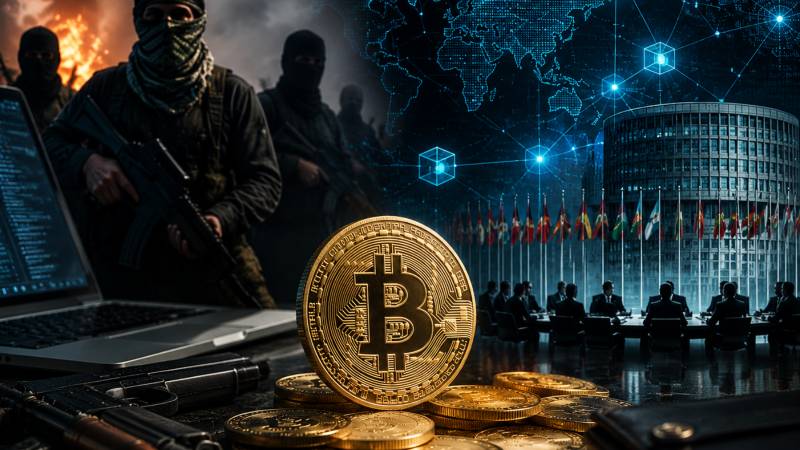
For four centuries, the state’s claim to legitimacy has rested on a bargain Thomas Hobbes described with brutal clarity: subjects surrender their liberty to a sovereign in exchange for order, and the sovereign, in turn, monopolises the instruments of violence and value. Leviathan was never just a treatise on political obedience, it was an argument that a functioning state has to control how force and wealth move through society, or society collapses back into the war of all against all. Although he presents this as a state of nature but that orderlessness is imbued in humans. Money has always been the lynchpin of conspiracies, wars, order, peace and so on. Since ancient times, influence created by spending money was another form of true currency which was unable to track, tax or freeze, in Hobbesian terms, it may simply be defined as a crack in the foundation of order itself. In digital age cryptocurrency is prying that crack open and terrorist organizations have learnt to use it for their nefarious desings.
Such an evidence is no longer speculative as the Financial Action Task Force’s (FATF) July 2026 targeted update on virtual assets found that illicit use of digital assets has grown more complex and interconnected over the past year, and this is the part worth sitting with, most identified on-chain illicit activity now runs through stablecoins rather than volatile tokens like Bitcoin. Stablecoins such as Tether offer terrorist financiers something Bitcoin never could: price stability, near-instant settlement, and, on networks like TRON, transaction fees low enough to make micro-donations viable at scale. The FATF goes further still, flagging an emerging risk in which criminal and terrorist-linked networks are experimenting with proprietary stablecoins engineered specifically to resist freezing and seizure, a direct technological answer to the very enforcement tools regulators built to stop them.
Tehrik-i-Taliban Pakistan (TTP) mainly operates from Afghanistan and has its safe havens there, it has increasingly used crypto wallets to move donations from diaspora sympathizers in the Gulf and Europe, sidestepping the banking-sector scrutiny that has squeezed its traditional funding channels. Even bigger then TTP has been the network of Al-Qaeda with transnational sympethisers . Al Qaeda’s regional affiliates are also increasingly using cryptocurrency alongside their traditional hawala networks to move money, particularly in the Sahel region of Africa and South Asia. Analysts believe that crypto has become an important additional tool for financing their activities.
Similarly, after the footprints of Islamic State of Khorasan (ISK) in Afghanistan it has also maximised the use of cryptocurrency. The Islamic State Khorasan Province (ISK) uses cryptocurrency to overcome the financial restrictions imposed on Afghanistan. Since Afghanistan’s banking system has limited access to the international financial system, ISK relies on peer-to-peer cryptocurrency exchanges and local intermediaries to convert digital assets into cash and transfer funds within and into the country.
The Congressional Research Service in the US notes that wallets linked to insurgent groups, jihadi networks in middl east alone received tens of millions of dollars in cryptocurrency donations between 2020 and 2023, though how much of that money actually translated into operational capability is still hard to verify, a caveat policymakers shouldn’t discard in their rush to act. What makes the current situation different from the cash- and hawala-based financing used by terrorist groups in the past is not only the speed or global reach of cryptocurrency, but the way the technology itself is designed. Cash transactions usually require physical movement and often pass through banks, borders, or informal money brokers, creating opportunities for governments and law enforcement to monitor or disrupt them. In contrast, blockchain technology was built to allow value to be transferred without relying on a central authority or trusted institution. Instead, trust is established through cryptography and decentralized network consensus.
The developers and early advocates of cryptocurrency envisioned a financial system that would operate independently of government control, giving individuals greater freedom from financial censorship and state intervention. While this vision has attracted many legitimate users seeking privacy and financial autonomy, it has also been exploited by terrorist organizations such as the Tehrik-i-Taliban Pakistan (TTP), Al-Qaeda, the Islamic State Khorasan Province (ISK), and various other terrorist groups regionally and globally. Despite their ideological and geographic differences, these groups share a common understanding: a financial system designed to operate outside traditional government oversight can also help them evade counterterrorism financing measures.
Global compliance with anti-money laundering standards remains weak, as many jurisdictions fail to monitor virtual asset service providers effectively.
This does not mean that cryptocurrency is dangerous per se or that Bitcoin is more harmful than the cash and hawala networks that have financed terrorist activities for decades. According to the FATF , traditional methods remain the primary source of terrorist financing, although they are increasingly being combined with cryptocurrency in hybrid financial networks. Overall, the amount of terrorist financing involving cryptocurrency is still smaller than that conducted through conventional channels.
However, the direction of this trend is more important than its current scale. Evidence suggests that the use of cryptocurrency by terrorist groups is steadily increasing. The main reason is that global south is unable to catch tech-based terrorist networks. At the same time, FATF reports that 69% of assessed jurisdictions continue to have significant weaknesses in investigating and prosecuting terrorist financing cases, even as terrorist financing methods become more technologically advanced. In addition, only about one-third of monitored jurisdictions are largely compliant with FATF’s standards for regulating Virtual Asset Service Providers (VASPs). The implementation of the Travel Rule, which requires cryptocurrency exchanges to collect and share information about the sender and recipient of transactions, also remains inconsistent, even in countries where the necessary laws have already been introduced.
This creates a great challenge for policymakers, as there is no simple solution. Excessive regulation of decentralized finance (DeFi) could discourage legitimate innovation and drive businesses to less regulated jurisdictions, while doing little to stop terrorist groups that already operate outside formal regulatory systems. On the other hand, weak regulation would allow terrorist organizations to exploit a growing gap in the global financial system, a concern repeatedly highlighted by the Financial Action Task Force (FATF). A more balanced approach is needed. Consistent with FATF’s recommendations, governments should strengthen oversight of offshore cryptocurrency exchanges and unhosted wallets, where compliance with anti-money laundering and counterterrorism financing standards is often weakest. They should also improve intelligence sharing between blockchain analytics companies and law enforcement agencies to better identify and disrupt illicit financial networks. In addition, greater international cooperation and diplomatic engagement are required with jurisdictions where facilitators linked to terrorist groups continue to operate with limited accountability.
Political philosopher Thomas Hobbes argued that state authority must be continuously maintained to preserve order and security. The rise of cryptocurrency presents a new challenge to that authority because it enables financial transactions that can operate beyond the direct control of governments. However, cryptocurrency itself is not inherently a threat. With effective regulation, international cooperation, and stronger enforcement of counterterrorism financing measures, it can continue to support legitimate financial innovation while limiting its misuse.
Treating cryptocurrency as a secondary issue in counterterrorism policy, however, would be a serious mistake. As terrorist organizations increasingly incorporate digital assets into their financial networks, governments must recognize cryptocurrency as an important component of modern terrorist financing. Failing to strengthen oversight and international cooperation increases the risk that future terrorist attacks could be financed, at least in part, through digital currencies that remain difficult for any single government to regulate or control.