
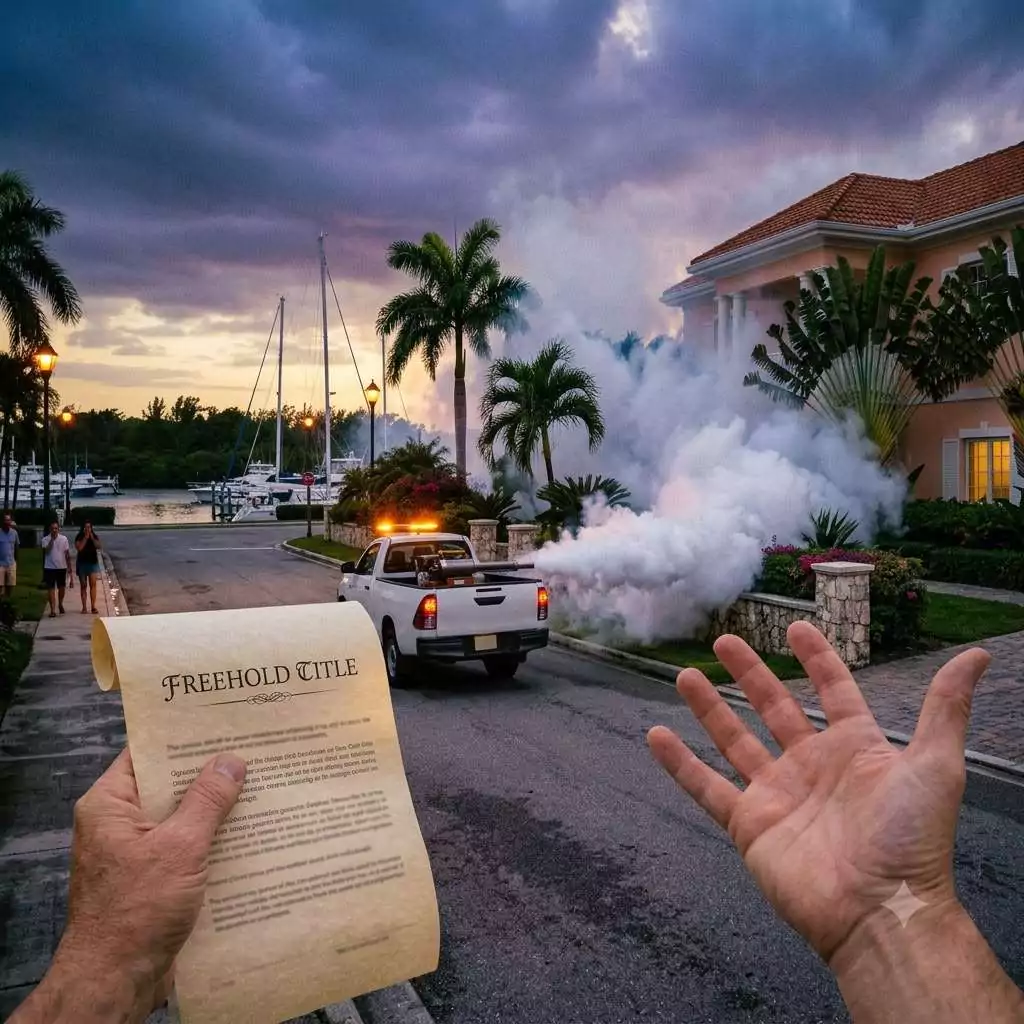
A judge of Antigua’s High Court has held that a freeholder’s private property rights are not decided by what the majority of his neighbours would prefer.
The sentence is short, and it is likely to outlast the case that produced it:
“The vindication of private rights in trespass and nuisance is not a matter to be determined by majority preference.”
In a development of some 850 owners where almost every objection is met with the reply that most residents are content, that holding reaches a great deal further than the dispute it came from.
The ruling was delivered on 9 July 2026 by Madam Justice Birnie Stephenson, in a claim brought by Jolly Harbour freeholder Cyprian Kowalczyk, who represents himself, against Caribbean Developments (Antigua) Limited (CDAL) over the developer’s chemical mosquito fogging. The interim injunction he sought was refused, on the balance of convenience. He has said he will appeal; an appeal against the refusal of an interim injunction lies as of right, and the time to bring it has not expired.
The argument the Court rejected — three times
The developer put the community argument to the Court in three forms. It was rejected in all three.
First, as a headcount. CDAL relied on a 2023 survey which, on the Court’s description, indicated that “some 80% of the community favours fogging” — the familiar answer at Jolly Harbour: most owners do not object, so the objector must give way. The Court gave it little weight. The survey, it held, was “not determinative of any question in issue” and was “at most, a modest indication of community reliance”.
Second, as a bar to suing at all. CDAL argued that the claimant lacked standing to restrain a community-wide activity on the basis of harm to a single parcel — that one owner, in effect, cannot challenge something done for everyone. The Court rejected it: ownership of the affected parcel “ordinarily confers a sufficient interest to sue in trespass and private nuisance”. The developer’s submissions about community reliance, the judge held, went “to the balance of convenience and to remedy, not to the existence of a cause of action”. Such arguments may bear on what remedy a court grants. They do not bear on whether the right exists.
Third, as a public interest that outweighs the right. Here the judge accepted that the public interest may be a weighty consideration — and it is ultimately why she refused the injunction sought. But she recorded the limit on it: an injunction remains the prima facie remedy for an established nuisance, and “the public benefit of an activity informs the form of relief rather than extinguishing the underlying right”.
That is the distinction the ruling turns on. Public benefit can shape what a court orders. It does not cancel what an owner holds.
What the 2023 survey actually was
The instrument behind the headline figure will be familiar to owners. On the fogging question, 122 answered yes and 30 answered no — 152 responses, in a development the Court put at some 850 owners. So the eighty per cent is eighty per cent of the fewer than one in five owners who answered: about 122 owners in 850. Among those who did answer, one in five said no.
The surveys are conducted online through an open link, with no identity verification: anyone holding the link can vote, and nothing establishes that a respondent is an owner or that an owner votes once. Results and data that do not favour the developer are not published, or are removed from publication after release.
The survey also complicates the word “community”. Asked how much of the year they spend at Jolly Harbour, only 22.44% of respondents said it was their primary residence, and roughly two-thirds said six months or less.