
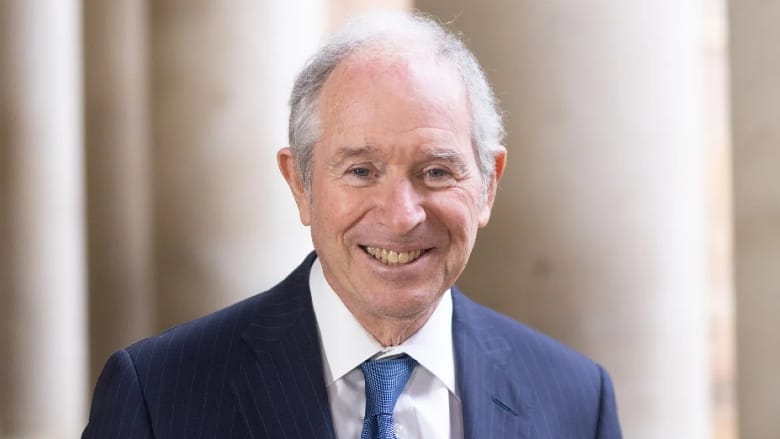
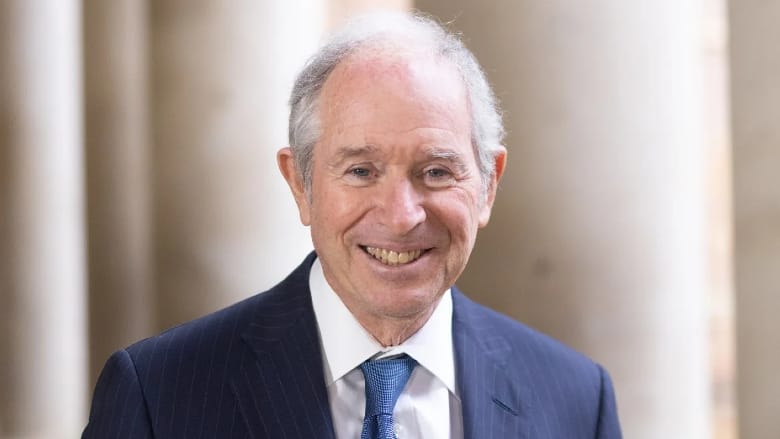
Blackstone co-founder, chairman and CEO Stephen Schwarzman
Blackstone’s global data centre platform has swelled to $185 billion in total value, including projects under construction, from $130 billion at the start of the year, as the fund management giant’s artificial intelligence bets drive returns across its property, infrastructure and private equity businesses.
The data centre platform could double again over the next few years, Blackstone said Thursday in an earnings call, with AI-related holdings accounting for nine of the firm’s 10 biggest mark-ups during the second quarter.
The AI-fuelled gains helped lift Blackstone’s distributable earnings by 26 percent year-on-year to $1.98 billion in Q2, while assets under management climbed 11 percent to a record $1.35 trillion. Fee-related earnings rose 22 percent to $1.78 billion as the Manhattan-based firm extended the growth momentum seen in the first quarter.
“Our decision to lean into the artificial intelligence megatrend is leading to standout investment performance across numerous strategies and creating extraordinary opportunities for growth,” chairman and CEO Stephen Schwarzman said in the earnings release. “We’ve become a trusted partner at scale to many of the key innovators in this ecosystem, which positions our firm extremely well for the future.”
Digital Buildout
Blackstone’s infrastructure investments returned 7.2 percent during the quarter and 28.6 percent over the past year, with US data centre operator QTS ranking as the single largest contributor to appreciation across the firm.

Blackstone president and chief operating officer Jonathan Gray
President and chief operating officer Jonathan Gray said during the call that the company was beginning to see data centre demand pick up in the US, Europe and Asia, with Blackstone controlling 15 gigawatts of powered and entitled sites capable of supporting $200 billion in data centres.
Blackstone’s AI infrastructure push traces back to its 2021 privatisation of QTS, which Schwarzman has described as the cornerstone of the group’s data centre strategy. By the first quarter, Blackstone counted more than $150 billion of data centre assets globally and another $160 billion of prospective developments, with its control of Sydney-based AirTrunk providing the backbone of an expanding Asia Pacific platform.
Blackstone and the Canada Pension Plan Investment Board acquired AirTrunk in a $16 billion transaction in 2024, when the operator had 800 megawatts across 11 facilities in Australia, Hong Kong, Japan, Malaysia and Singapore. The partners are now moving towards a partial capital recycling, with AirTrunk filing confidentially for a Singapore REIT offering that could raise $1.5 billion and is being targeted for September or October.
The planned trust is expected to hold $3.9 billion in assets across markets including Singapore, Australia, Japan and Hong Kong, while AirTrunk continues to expand its development book. The operator entered India in April by acquiring Blackstone-backed Lumina CloudInfra and its 600MW pipeline, which Blackstone has estimated could be worth up to $5 billion, before announcing plans to invest $30 billion in India and build more than 5GW of capacity by 2030.
Multiple Angles
At the same time, Blackstone has opened another route for monetising completed facilities through Blackstone Digital Infrastructure Trust, or BXDC, whose $2 billion offering was described by management as the largest blind-pool REIT IPO on record.
The firm is playing the AI buildout beyond property, teaming with Broadcom and another investment manager on a platform that initially provided $35 billion to finance 1GW of computing infrastructure. Blackstone also announced a $5.3 billion investment in energy infrastructure company Williams to fund projects serving data centres, while its private equity holdings include Anthropic, OpenAI and SpaceX.
Gray noted that the constraints on chips, power and development entitlements distinguish the data centre boom from conventional property cycles in which rising prices trigger a wave of speculative construction.
With most large facilities backed by long-term contracts, he characterised the market as a “global shortage of compute” and said Blackstone continues to see attractive prospective returns despite increasing capital flowing into the sector.
Property Rebound
Beyond data centres, Blackstone said its real estate values appreciated modestly during the quarter as digital infrastructure gains outweighed declines in life sciences offices and other sectors.
Data centres, logistics and rental housing now account for nearly 80 percent of the firm’s global property equity portfolio, while leasing volume at US warehouse platform Link Logistics jumped 26 percent in the first half. Gray called logistics “the first asset class that really starts to emerge” in the property recovery.
Blackstone’s real estate business finished June with $314.1 billion in assets under management and attracted inflows of $8.2 billion during the quarter, up from $6.8 billion in the first three months of the year. The Q2 haul included $2 billion from the BXDC offering, $1.2 billion for the non-listed BREIT vehicle and $2.1 billion for real estate debt strategies, while the property platform deployed $5.8 billion and generated $6.6 billion in realisations.
Company-wide inflows reached $68.3 billion, roughly level with the $68.5 billion raised in the first quarter, taking the 12-month haul to $262.5 billion. Private equity drew $24.5 billion during Q2 and credit and insurance attracted $31 billion, while Blackstone deployed $34.2 billion across strategies and realised $31.8 billion.
Fundraising included a final close of $13.1 billion for Blackstone’s third Asia corporate private equity fund, more than double the size of the preceding vintage, after the manager raised another $1.8 billion during Q2. Infrastructure assets under management grew 40 percent year-on-year to $90 billion, while multi-asset unit BXMA reached a record $109 billion and collected another $4.8 billion in July for its best month of fundraising on record.
Blackstone’s total second-quarter revenue jumped 36 percent year-on-year to $5.04 billion, while fee revenues rose 22 percent to $3 billion and real estate performance revenues increased nearly fivefold to a four-year high. BREIT raised $1.2 billion as repurchase requests dropped 42 percent from a year earlier, producing its best regular-way net flows in nearly four years, with data centres now accounting for 27 percent of the $57 billion vehicle’s portfolio.