
Companies actively use it as an opportunity to raise funds
Burden supply and demand on the stock market…Similar to Dotcom Bubble
“A rally will continue due to favorable AI” comments
![SK Group Chairman Chey Tae-won and SK Hynix CEO Kwak No-jung are taking photos in front of the Nasdaq Tower in Times Square, New York, on the 10th (local time). [Courtesy of SK Hynix]](https://wimg.mk.co.kr/news/cms/202607/15/rcv.NEWSIS.NEWSIS.20260711.NISI20260711_0021359478_P1.jpg)
As the world’s largest companies have started large-scale financing one after another, concerns are growing that the U.S. stock market, which has been going on for three years and nine months, may be nearing its end.
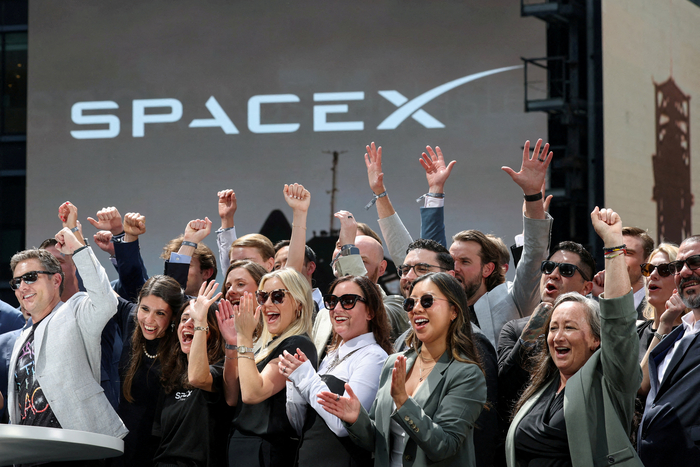
According to the Wall Street Journal (WSJ) on the 14th (local time), SpaceX conducted an initial public offering (IPO) worth $75 billion, Alphabet, Google’s parent company, issued a paid-in capital increase of $85 billion, and SK Hynix issued an ADR worth more than $26 billion. Although the S&P 500 index more than doubled during the same period, analysts say that the burden of supply and demand in the market is increasing as companies use the boom as an opportunity to raise funds.
Experts point out that while the bull market does not end just because it has a long run or high valuation, the rise could slow down if new stock issuance increases beyond investor demand. In fact, companies’ stock issuance surged at the end of 1999 and the first half of 2000, which is considered one of the factors that encouraged the dot-com bubble collapse.
According to the financial information company Delogy, new stocks sold to investors through IPOs, capital increase, and convertible bonds (CB) this year amounted to $344.7 billion, which has already exceeded all annual volumes from 2022 to 2025. “Stock issuance tends to surge in the second half of the bull market,” said Rob Arnott, chairman of Research Appliances.
This trend is coupled with competition for AI investment. Following SpaceX and SK Hynix, AI start-up Antropics is also preparing to go public, while stock supply to the market is increasing rapidly as treasury stock purchases decrease.
In particular, AI hyperscalers are expanding their issuance of stocks and bonds to invest in data centers. Janus Henderson Investors predicted that these companies’ facility investment will exceed $800 billion this year, a significant increase from last year ($450 billion), and will exceed $1 trillion next year.
![Executives and guests celebrate the listing on the balcony of the Nasdaq Market Site in New York on the day of the SpaceX IPO on June 12. [Reuters Yonhap News]](https://wimg.mk.co.kr/news/cms/202607/15/rcv.YNA.20260624.PRU20260624091001009_P1.jpg)
“Many hyperscalers are raising funds by issuing new stocks instead of buying back their shares,” said John Lloyd Janus, Henderson’s global multi-segment credit director. “Companies that used to focus on buying back their shares based on their cash generation power before AI have completely changed.”
On the other hand, some argue that it is difficult to conclude that the bull market will end soon. As the market capitalization of the U.S. stock market reaches about $80 trillion, the impact of new stock issuance on supply and demand is limited. Howard Max, co-chairman of Oaktree Capital Management, said, “The bull market will not end just by increasing stock issuance and reducing share buybacks.”
Corporate earnings remain solid and the U.S. economy has shown no clear signs of slowing down. Although the S&P 500 dividend yield is so high that it has fallen to a record low of 1.05%, historically, the stock market has not collapsed just by high valuation. “If AI-related good news continues, the rally may last longer than expected,” said Antiyilmanen, co-chairman of AQR Capital Management.
The WSJ said that historically ending the bull market was a surge in interest rates, new regulations, and unexpected risks. Portfolio insurance in 1987 and subprime mortgage crisis in 2008 ended the bull market. “We don’t see any obvious risk factors that could bring down the market at the moment,” Max said. “It’s reckless to predict a recession in the near term.”