
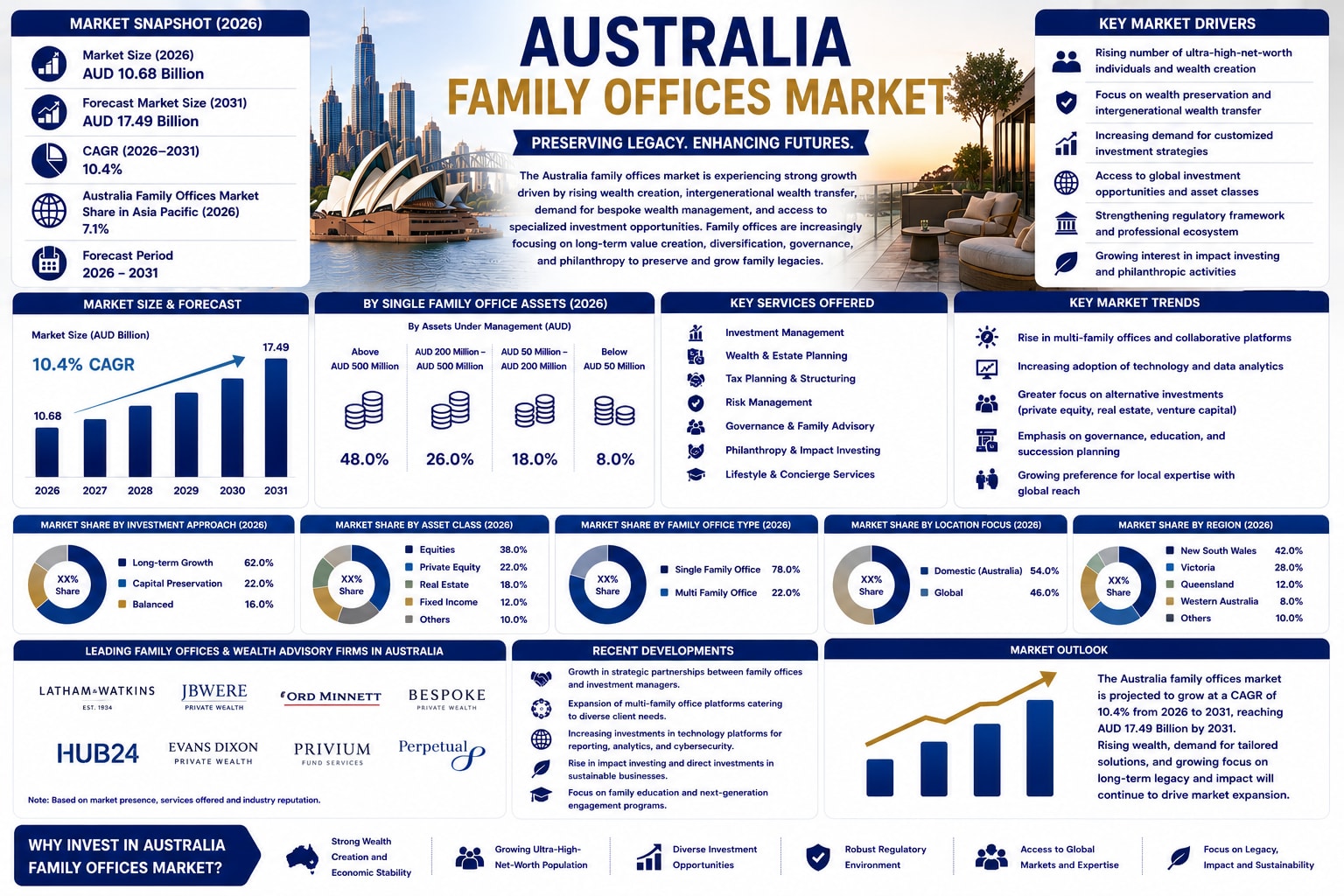
Australia’s family offices sector is steadily evolving into one of the country’s most influential private wealth management segments as affluent families increasingly seek customized investment, succession, and asset preservation strategies. Growing concentrations of private wealth, combined with rising interest in long-term capital management and alternative investments, are driving sustained expansion across the market. According to IMARC Group, the Australia family offices market reached USD 429.3 Million in 2025 and is expected to reach USD 609.9 Million by 2034, growing at a CAGR of 3.86% during 2026–2034.
Family offices are becoming increasingly important within Australia’s financial ecosystem as wealthy individuals and multi-generational families look beyond traditional wealth management models. These private entities are designed to oversee investments, estate planning, philanthropy, tax management, governance, and succession planning under highly personalized structures tailored to long-term family objectives.
The market’s expansion reflects broader changes in Australia’s wealth landscape. Rising entrepreneurial success, strong real estate holdings, and growing private business ownership have significantly increased the number of high-net-worth and ultra-high-net-worth individuals seeking sophisticated capital management solutions. As family wealth becomes more complex and globally diversified, demand for dedicated advisory structures continues rising.
Request a Business Sample Report for Procurement & Investment Evaluation:
According to IMARC, the market is segmented into several key categories:
• By Type: Single Family Office, Multi-Family Office
• By Service Type: Financial Planning, Strategy, Governance, Advisory, Others
• By Office Type: Founder’s Office, Investment Office, Trust Office, Compliance Office, Philanthropy Office, Others
• By Asset Class: Bonds, Equities, Alternative Investments, Commodities, Cash or Cash Equivalents, Others
• By Region: New South Wales, Victoria, Queensland, Western Australia, South Australia, Others
Australia’s increasing participation in global investment markets and the growing appeal of alternative assets are also contributing to the transformation of the family office sector.
Why the Market Is Growing So Rapidly
One of the primary drivers behind market growth is the steady rise in ultra-high-net-worth wealth across Australia. Successful entrepreneurs, business owners, property investors, and corporate executives are accumulating larger and more diversified asset portfolios that require specialized financial oversight. Family offices provide tailored wealth management structures capable of addressing complex investment, tax, and succession challenges.
Intergenerational wealth transfer is another major catalyst shaping the market. Many affluent Australian families are preparing for large-scale transitions of wealth between generations, creating increased demand for governance frameworks, estate planning, and long-term capital preservation strategies. Family offices help ensure continuity, financial discipline, and strategic alignment across multiple generations.
The growing interest in alternative investments is significantly influencing family office strategies as well. Wealthy families are increasingly allocating capital toward private equity, venture capital, infrastructure, real estate, renewable energy, and hedge funds to diversify portfolios and improve long-term returns. Family offices provide greater flexibility and direct investment capabilities compared to traditional institutional wealth management structures.
Philanthropy and impact investing are becoming increasingly important within the sector. Many Australian family offices are integrating social impact objectives, charitable initiatives, and sustainability-focused investments into their broader financial strategies. This trend reflects changing generational attitudes toward responsible investing and legacy-building.
Technology adoption is also reshaping the industry. Advanced financial analytics, digital reporting systems, AI-driven portfolio management tools, and cybersecurity infrastructure are improving operational efficiency and investment oversight for family offices managing complex global assets. Modern digital platforms allow families to monitor investments, governance structures, and reporting more effectively.
What the Opportunities Are
1. Expansion of Alternative Investment Portfolios
Family offices are increasingly seeking exposure to private equity, venture capital, infrastructure, and real estate investments.
2. Rising Demand for Succession and Governance Planning
Intergenerational wealth transfer creates strong opportunities for advisory services focused on long-term governance and estate management.
3. Growth of Multi-Family Office Platforms
Shared service models offering institutional-quality wealth management to multiple families are gaining traction in Australia.
4. Integration of ESG and Impact Investing
Sustainability-focused investment strategies continue attracting wealthy families seeking both financial returns and social impact.
5. Digital Wealth Management and Analytics
Technology-driven portfolio monitoring, AI-powered analytics, and cybersecurity solutions are becoming essential within modern family office operations.
6. Global Asset Diversification Strategies
Families increasingly seek international investment exposure and cross-border asset management capabilities.
7. Expansion of Philanthropic Advisory Services
Growing interest in structured charitable giving and legacy planning creates opportunities for specialized philanthropy management solutions.
Recent News & Developments in Australia Family Offices Market
• January 2025: Australian private wealth and advisory discussions continued highlighting increased demand for sophisticated family office structures amid rising intergenerational wealth planning activity. Several advisory firms expanded services focused on governance, succession management, and alternative investment advisory for high-net-worth families. Industry participants noted growing interest in long-term capital preservation and diversified global investment strategies.
• May 2025: Multiple wealth management and private investment firms accelerated expansion efforts targeting Australia’s growing ultra-high-net-worth population. New investment platforms and advisory solutions emphasized digital portfolio management, private market access, and customized family governance frameworks. Market analysts observed rising family office allocations toward infrastructure, technology, and sustainability-oriented investments.
• September 2025: Australia’s family office sector reported continued growth in private capital activity and alternative asset investments. Industry stakeholders highlighted stronger demand for multi-family office services, philanthropic advisory capabilities, and cross-border investment management expertise. Market forecasts also indicated increasing participation from next-generation wealth holders seeking more personalized and impact-focused financial strategies.
Why Should You Know About Australia Family Offices Market?
The Australia family offices market represents a major evolution in how private wealth is managed, preserved, and transferred across generations. As affluent families seek greater control, customization, and long-term strategic alignment, family offices are becoming increasingly central to the country’s private investment and wealth advisory ecosystem.
For investors and financial institutions, the market offers growing opportunities across advisory services, private investments, governance consulting, and alternative asset management. For wealthy families, family offices provide sophisticated structures capable of balancing wealth growth, legacy preservation, and philanthropic objectives. For policymakers and economic leaders, the sector highlights the increasing influence of private capital within Australia’s broader financial landscape.
As wealth creation accelerates and investment strategies become more globally diversified, Australia’s family office industry is positioned to play an increasingly important role in shaping the future of private capital management.