
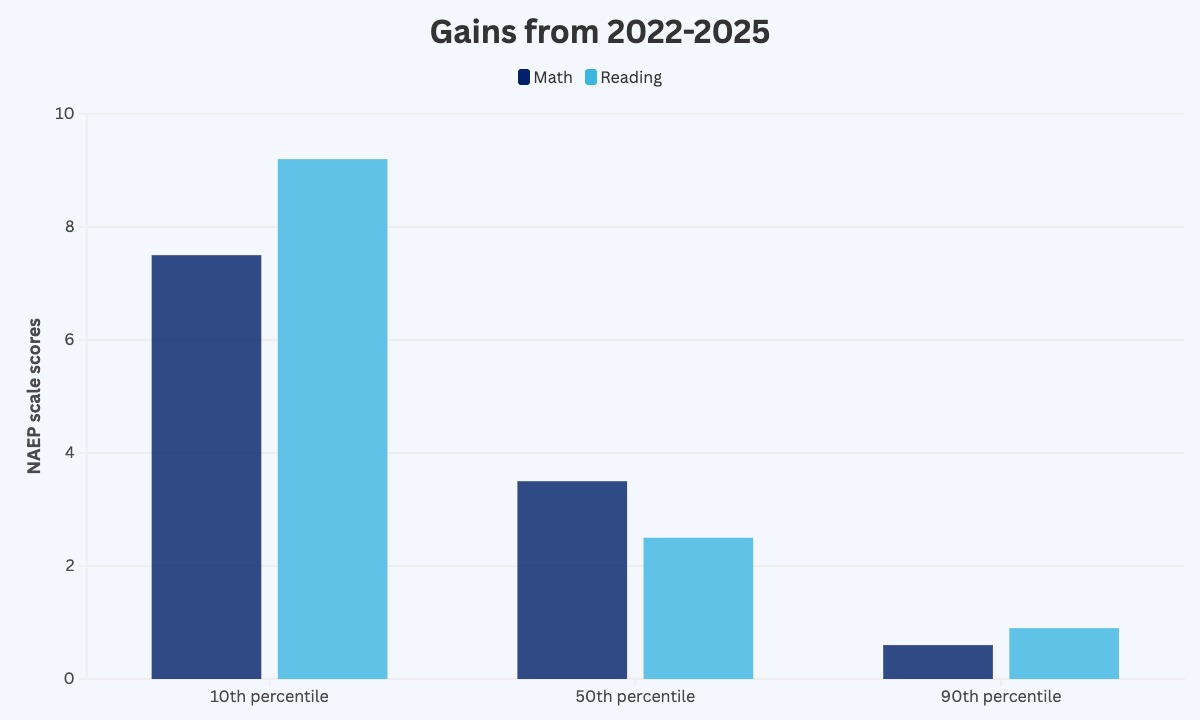
After years of bad news on student test scores, there’s finally a sliver of hope. The latest results from NAEP, the Nation’s Report Card, found gains in both reading and math for 9-year-olds. Not only that, but they provide the first signs in more than a decade of increases among the nation’s lowest-performing students.
This is an important reversal. The key trend over the last 10 to 15 years has been a steady decline in student performance across a range of tests, across ages and grade levels, and across a variety of subjects. Moreover, the steepest declines have been among the lowest-performing kids.
But the latest results showed something different. In math, for example, the median score for 9-year-olds rose 3.5 points. For the highest performers (those at the 90th percentile), scores rose by 0.7 points. In contrast, for students at the 10th percentile, their math scores rose 7.5 points. Similarly, in reading, the lowest performers gained 9.3 points.
These scores come from a nationally representative sample of some 32,000 9- and 13-year-olds who were tested on reading or math during the 2024-25 school year.
Called the Long-Term Trend, this battery of tests is administered using pencil and paper and has been given in comparable form since the early 1970s.
Long-Term NAEP Shows Growth for 9-Year-Olds, More Disappointment for Teens
The latest gains are both meaningful and historically large. Depending on the year, students in general gain about 10 points per year on the NAEP math tests. As a rough comparison, that means achievement gaps narrowed by nearly one year’s worth of schooling over the last few years. In historical terms, the gains from 2022 to 2025 now represent some of the largest on record.
The gains were also widespread, with particularly large increases among the lowest-performing Black, Hispanic and low-income students.
To be fair, there are several good reasons to temper any collective enthusiasm.
For one, the gains for 9-year-olds on the latest NAEP results did not transfer up to 13-year-olds. Particularly in math, the scores of middle school students continued to decline, especially for low performers. It’s quite likely that COVID-related school closures contributed to a lost generation that is slowly working its way through the nation’s schools.
It’s also possible that the gains from 2022 to 2025 may not be replicable. That is, they could just be a bounce off the depths of the COVID lows, fueled in part by an infusion of federal funding, and not the start of a new rising tide.
Still, while the increases on the Long-Term Trend tests are surprising, they are not the only evidence pointing toward recent improvements. For example, a team of researchers from Dartmouth, Harvard and Stanford universities released an Education Scorecard last month that mainly documented the “learning recession” that began around 2013. However, their full report also showed increases in 2025 in both reading and math. Similarly, interim assessment data from NWEA shows that students made larger-than-expected gains in the 2024-25 school year, and the 2025-26 results are on a similar trajectory.
New NAEP Report Shows Learning Progress Has Stalled. Here’s What to Do About It
In other words, it’s worth pausing to reflect on the increases that have emerged recently. The policy question now is how to understand what changed and how to extend those gains upward through the grade levels.
Disclosure: The author consults with NWEA and is serving in an advisory role with NAEP on an unrelated project. The conclusions drawn here are his own.